Heat Transfer Worksheets for Grades 6-8 (Free Sample + Full Unit)
Download a free heat transfer worksheet for Grades 6-8 below: one student page with an answer key, ready to print. The full unit is two illustrated lessons, one on thermal energy and temperature and one on heat transfer and design, with guided notes, a diagram task, a design challenge, reading checks, two Prove-it data tasks, vocabulary cards and a quiz, for USD 4.50 on TPT.
Teaching notesHow to Teach Heat Transfer in Middle School (Grades 6-8)
Free sample worksheet
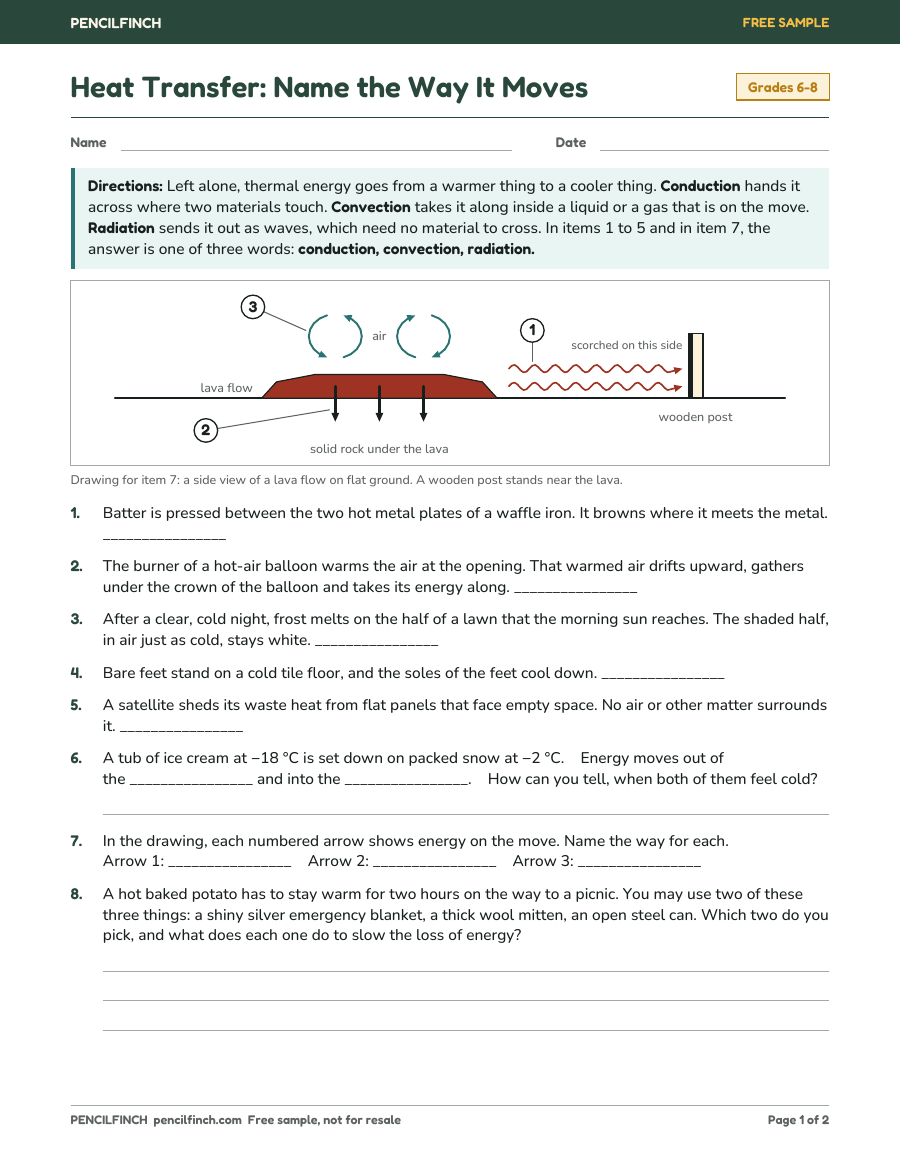 Download the free sample (PDF, 8 items with answer key)
Free to download, no email needed. These problems are not in the paid unit.
What is in the full unit
| Full unit | Thermal Energy & Heat Transfer Science Lessons | Insulation Design | Grades 6-8 |
|---|---|
| Pages | 30 pages in one PDF |
| Standards | Supports and connects to NGSS MS-PS3-3 and MS-PS3-4 (not a claim of full alignment) |
| Grades | 6-8 |
| Price on TPT | USD 4.50 |
Get the full unit on TPT (USD 4.50)
- Lesson 1, thermal energy and temperature: temperature measures the average motion energy of particles, while thermal energy also depends on how much matter there is. Students draw energy-transfer arrows (always warmer to cooler), read and draw graphs of thermal equilibrium, and use simulated heating data to show that the same energy changes temperature less for a larger mass and for a material with a higher specific heat (real values for water, aluminum, granite and copper).
- Lesson 2, heat transfer and design: conduction, convection and radiation at a campfire, conductors and insulators with real thermal conductivity data, a vacuum bottle cut-away, and criteria and constraints. Students plan a Cocoa Keeper cup within a budget, then use simulated cooling data to decide which design meets both the criterion and the constraint.
- Two Prove-it data tasks with CER. The data in the Prove-it tasks are simulated and labeled that way; the specific heats and thermal conductivities are real published values. Students never calculate amounts of thermal energy.
- Explanation pages with two scene illustrations drawn in code (no AI image generator), graphs, a heat-transfer diagram and a vacuum-bottle cut-away; guided notes, reading checks, two pages of picture vocabulary cards and a 10-question quiz.
- Answer key for every question with scoring rules, completed notes, arrows, graph and bar chart, an example design and model CER answers; a two-lesson plan with an optional conduction demo and build-and-test day, misconceptions and printing notes for the teacher.
Pages from the unit
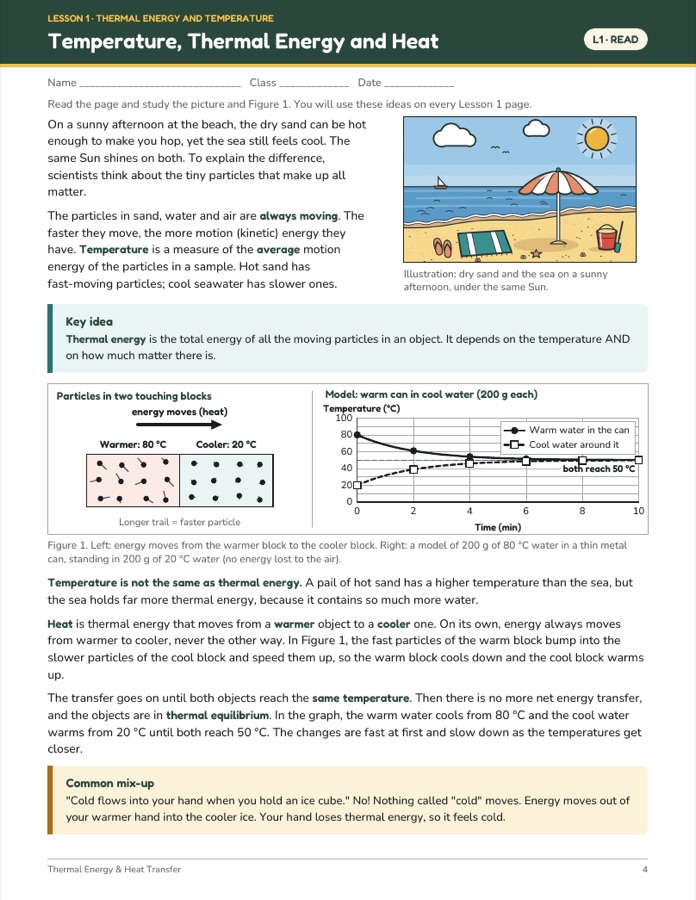
Page 4 of 30 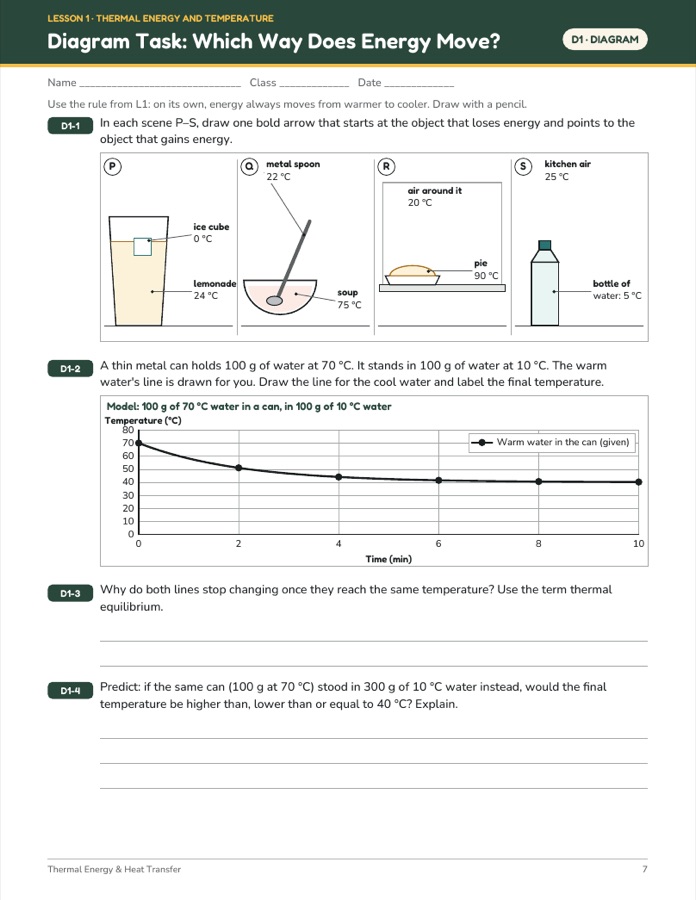
Page 7 of 30 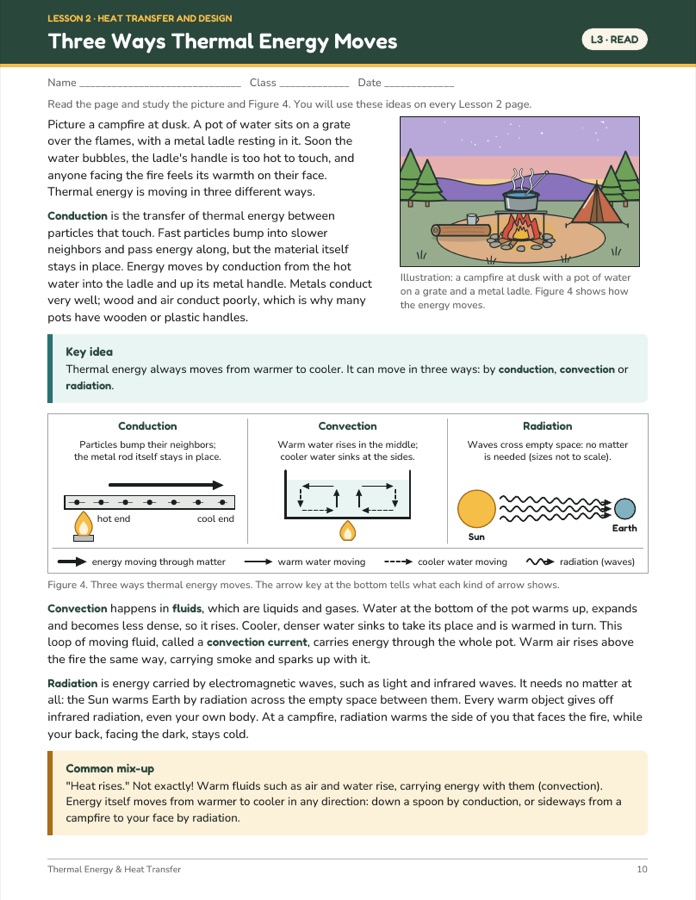
Page 10 of 30
Student pages are designed to print in black and white; all labels, numbers, graphs and arrows are printed text and vector drawings.
How teachers use it
Heat is thermal energy that moves from a warmer object to a cooler one, and it can move in three ways: conduction, convection and radiation. Each lesson is planned for about 50 minutes. Students read the explanation pages first, then work the guided notes, the diagram task or design challenge and the reading check, and finish with a Prove-it data task and a claim-evidence-reasoning write-up.
The free sample on this page is a one-page practice set on heat transfer with an answer key. Its items are new and are not in the paid unit, so it can serve as a quick check before the unit or a review after it without repeating anything students will see in the lessons.
The unit separates three words students tend to blend: temperature, thermal energy and heat. Lesson 1 settles the direction of transfer (warmer to cooler, until both objects reach the same temperature) before Lesson 2 names the three ways it happens. The design challenge then puts the ideas to work: students choose materials for a cup that keeps cocoa warm, within a budget, and judge designs against a criterion and a constraint. The listed prerequisites are reading a simple line graph, a bar chart and a data table.
The unit supports and connects to NGSS MS-PS3-3 (a device that minimizes or maximizes thermal energy transfer) and MS-PS3-4 (energy transferred, type of matter, mass and temperature change), with a connection to MS-PS3-5 (motion energy and energy transfer). That is not a claim of full alignment.
Before and after this topic
In the order used on this site, this page comes after mixtures and solutions and before distance-time graphs, where the site moves from matter and energy to motion.
- Teaching notes for this topicHow to Teach Heat Transfer in Middle School (Grades 6-8)
- Before this topicMixtures and Solutions Worksheets, Grades 6-8 (Free Sample + Unit)
- After this topicDistance-Time Graphs Worksheets, Grades 6-8 (Free Sample + Full Unit)
- All topics in this lineMiddle School Physical Science Worksheets (Grades 6-8)
Common questions
Is the free worksheet the same as a page from the paid unit?
No. The sample is written separately for this site, and its items are not in the unit. It uses the same page style, so you can see what the student pages look like before you buy.
Do students calculate amounts of thermal energy?
No. Students never calculate amounts of thermal energy in this unit. They compare temperature changes, read and draw graphs, and reason with specific heat and thermal conductivity values printed on the pages.
Do I need materials for the design challenge?
No. The Cocoa Keeper challenge is planned on paper from printed supply cards and a budget, and the cooling data students analyze are simulated and labeled that way. The teacher pages describe an optional conduction demo and an optional build-and-test day if you want hands-on time.