How to Teach Heat Transfer in Middle School (Grades 6-8)
Students should leave this topic able to say which way thermal energy goes (from the warmer thing to the cooler one, every time) and to name the route it takes: conduction, convection or radiation. They pick up the three names quickly and then misuse them, because everyday talk says that cold comes in, that metal is cold and that heat rises. This note gives you the idea in brief, those three wrong ideas with a reply for each, a board lesson and three check questions.
Printable for this topic: Heat Transfer Worksheets for Grades 6-8 (Free Sample + Full Unit) (free sample page and the full unit).
The idea in plain words
Heat is energy that passes from one thing to another because their temperatures are different. Left alone, the energy goes from the hotter object to the colder one, and the transfer stops when the two reach the same temperature.
Conduction is transfer through matter that stays where it is: particles that touch pass energy along, as from a stove burner into the bottom of a pan. Convection is transfer by a liquid or gas that itself moves, carrying its energy along. Radiation is transfer by electromagnetic waves such as infrared; it needs no matter, which is how energy from the Sun crosses space.
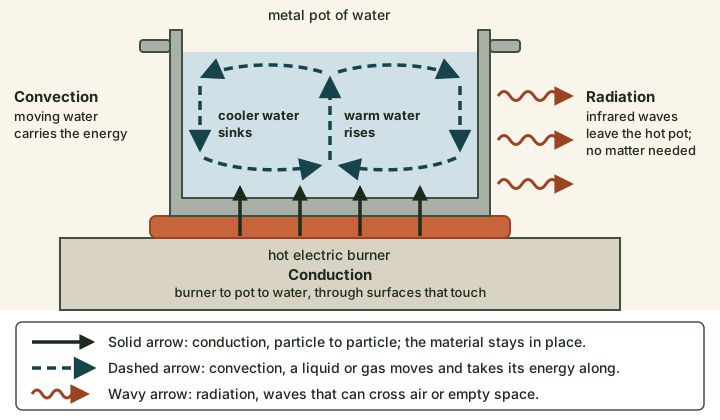
A single pot heating on a stove shows all three. Ask the same two questions about any example: which side is warmer, and what carries the energy across?
Three misconceptions and what to say
"The cold from the ice goes into my drink."
Cold feels like a thing that arrives, and ordinary speech agrees: we tell people not to let the cold in. Nothing called cold travels. Energy leaves the warmer drink and enters the cooler ice, so the drink's temperature drops while the ice warms and melts. Ask: "Which of the two gained energy?"
"The metal chair leg is colder than the wooden desk."
The metal really does feel colder. Objects that have sat in the same room for hours are at the same temperature. Skin is warmer than the room, and metal conducts energy away from it far faster than wood does: the OpenStax table gives stainless steel a conductivity of 14 J/(s·m·°C) and wood 0.08 to 0.16. The skin touching metal cools faster, and that is what we sense. Ask: "What would a thermometer left on each surface overnight read?"
"Heat rises."
Hot-air balloons go up and upstairs is warmer, so the rule seems safe. What rises is warm fluid. Heated air or water expands and becomes less dense, and the cooler, denser fluid around it pushes it upward. That describes convection only. Conduction carries energy along a metal skewer in whatever direction the skewer points, and radiation from a heat lamp travels down onto the food under it. Say: "Warm air rises; heat goes toward whatever is cooler."
A 10-minute mini-lesson
- (1 minute) Write "oatmeal 70 °C, bowl 20 °C" on the board. Ask: "Which way does the energy go? When does it stop?" Draw one arrow from oatmeal to bowl and write "warmer to cooler, until equal".
- (2 minutes) Sketch a pot on a burner with water in it. Ask: "The burner touches the pot. How does energy get into the pot bottom and then into the water?" Draw short solid arrows, label them conduction and write "by contact".
- (2 minutes) Ask: "The water at the bottom is now warmer than the water on top. What does it do, and what takes its place?" Draw a dashed loop, label it convection and write "the fluid itself moves".
- (2 minutes) Ask: "Picture standing beside a glowing burner, not touching it and not above it. You still feel warmth. What carried the energy?" Draw wavy arrows going sideways, label them radiation and write "waves; no matter needed".
- (2 minutes) Read four cases; students write C, V or R on paper: an egg cooking where it touches the pan; a forced-air furnace warming a house; sunlight warming a parked car's seat; a cheek cooling on a cool pillow. Key: C, V, R, C.
- (1 minute) Ask: "In which of the four did anything called cold move? Which two show energy going downward?" (None; the sunlight and the cheek.)
Quick check
- On a winter night a room is at 20 °C and the air outside is at −5 °C. A student says the window glass lets the cold in. Say what really crosses the glass, which way and by which route.
- A steel gate and a wooden fence stand in the same sun, both at 45 °C; a hand is at about 33 °C. Which feels hotter to the hand, and why?
- An electric heater with glowing bars stands on the floor. A book lying in front of it warms on the side facing the bars. Name the route, and explain why this case does not fit the saying "heat rises".
Answers: 1. Energy, not cold. It goes from the warmer room to the colder air outside, and it crosses the solid glass by conduction. 2. The steel gate. Both are warmer than the hand, so energy goes into the skin, and it arrives much faster through steel than through wood. 3. Radiation. Infrared waves go straight out from the bars to the book, sideways and not upward. Only a warm liquid or gas rises, and that is convection.
Sources
- OpenStax, College Physics 2e, section 14.1 "Heat": https://openstax.org/books/college-physics-2e/pages/14-1-heat
- OpenStax, College Physics 2e, section 14.4 "Heat Transfer Methods": https://openstax.org/books/college-physics-2e/pages/14-4-heat-transfer-methods
- OpenStax, College Physics 2e, section 14.5 "Conduction" (tile and carpet, Table 14.3): https://openstax.org/books/college-physics-2e/pages/14-5-conduction
- OpenStax, College Physics 2e, section 14.6 "Convection": https://openstax.org/books/college-physics-2e/pages/14-6-convection
- OpenStax, College Physics 2e, section 14.7 "Radiation": https://openstax.org/books/college-physics-2e/pages/14-7-radiation
- NOAA JetStream, "The Transfer of Heat Energy": https://www.noaa.gov/jetstream/atmosphere/transfer-of-heat-energy
The full unit
Thermal Energy & Heat Transfer Science Lessons | Insulation Design | Grades 6-8
30 pages, grades 6-8. USD 4.50
Get the full unit on TPT (USD 4.50)
Next topics
- Before this topicMixtures and Solutions Worksheets, Grades 6-8 (Free Sample + Unit)
- After this topicDistance-Time Graphs Worksheets, Grades 6-8 (Free Sample + Full Unit)
- All topics in this lineMiddle School Physical Science Worksheets (Grades 6-8)