Mixtures and Solutions Worksheets, Grades 6-8 (Free Sample + Unit)
Download a free mixtures and solutions worksheet for Grades 6-8 below: one student page with an answer key, ready to print. The full unit is two illustrated lessons, one on mixtures and solutions and one on separating mixtures, with guided notes, diagram tasks, reading checks, two Prove-it data tasks, vocabulary cards and a quiz, for USD 4.50 on TPT. A no-equipment mixtures and solutions paper lab is sold separately for USD 4.50.
Free sample worksheet
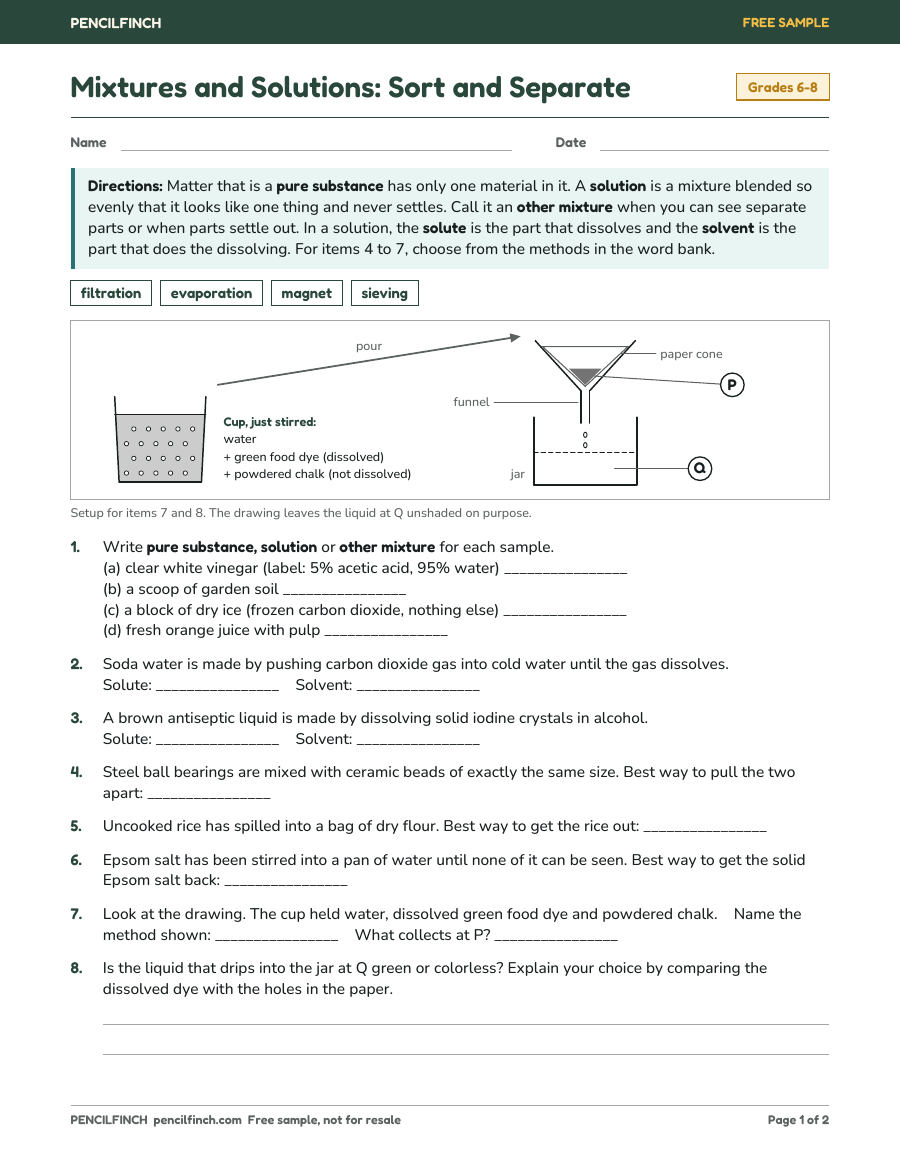 Download the free sample (PDF, 8 items with answer key)
Free to download, no email needed. These problems are not in the paid unit.
What is in the full unit
| Full unit | Mixtures and Solutions Science Lessons | Separating Mixtures | Grades 6-8 |
|---|---|
| Pages | 29 pages in one PDF |
| Answer key | Included with Rubric |
| Standards | Supports and connects to NGSS MS-PS1-2 and MS-PS1-3 (not a claim of full alignment) |
| Grades | 6-8 |
| Price on TPT | USD 4.50 |
Get the full unit on TPT (USD 4.50)
- Lesson 1, mixtures and solutions: pure substances vs. mixtures, heterogeneous vs. homogeneous mixtures, solute, solvent and concentration. Students classify particle models, read real solubility curves for potassium nitrate and table salt, decide whether solutions are saturated, and use real data for three solids and oxygen gas to test the claim that heating always makes more dissolve.
- Lesson 2, separating mixtures: filtration, magnets, evaporation, crystallization, distillation and chromatography, chosen by the property that differs. Students plan how to separate sand, salt and iron filings, match a mystery ink with chromatography, see how seawater and crude oil are separated, and use simulated lab data to show that dissolved salt is not destroyed.
- Two Prove-it data tasks with CER. The solubility values are real published data (CRC Handbook, NIST and USGS); the separation results in one Prove-it task are simulated and labeled that way.
- Explanation pages with two scene illustrations drawn in code (no AI image generator), particle models, solubility curves, separation diagrams, a distillation setup and a refinery tower; guided notes, reading checks, two pages of picture vocabulary cards and a 10-question quiz.
- Answer key for every question with scoring rules, completed notes, models, graph and flowchart, and model CER answers; a two-lesson plan with optional chromatography and separation demos with safety notes, misconceptions and printing notes for the teacher.
Goes with
-
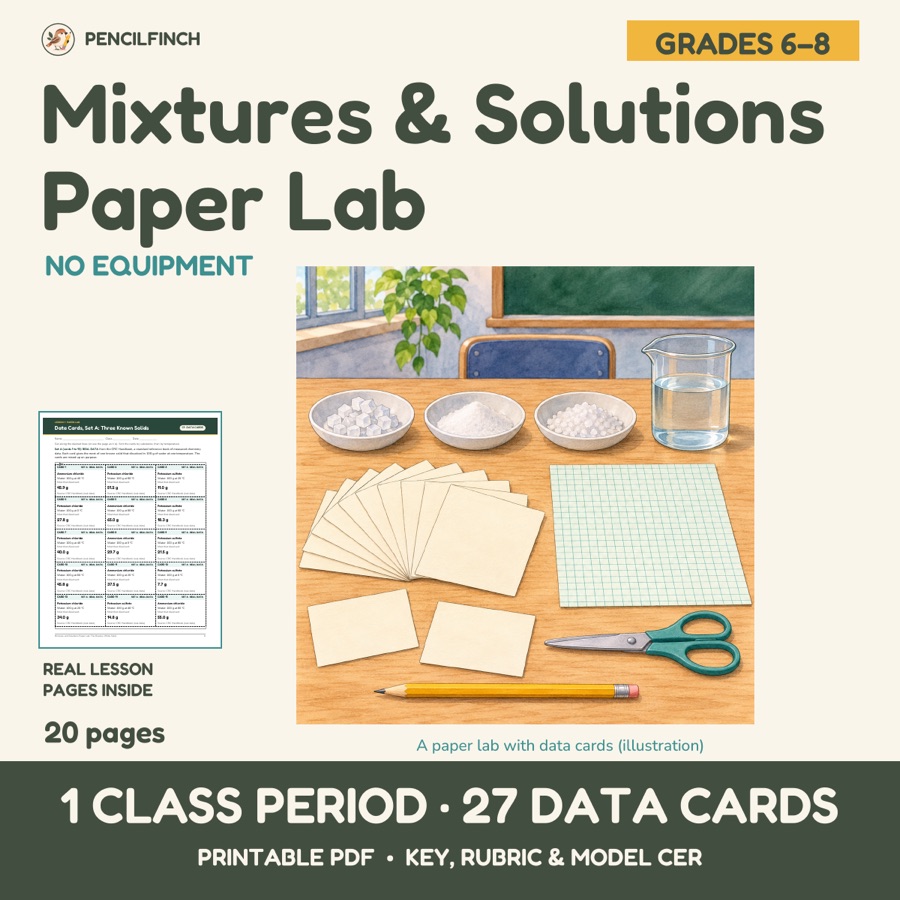
Mixtures and Solutions Lab | Science Paper Lab, No Equipment | Grades 6-8
Companion. 20 pages, grades 6-8, answer key included. USD 4.50
View on TPT
Pages from the unit
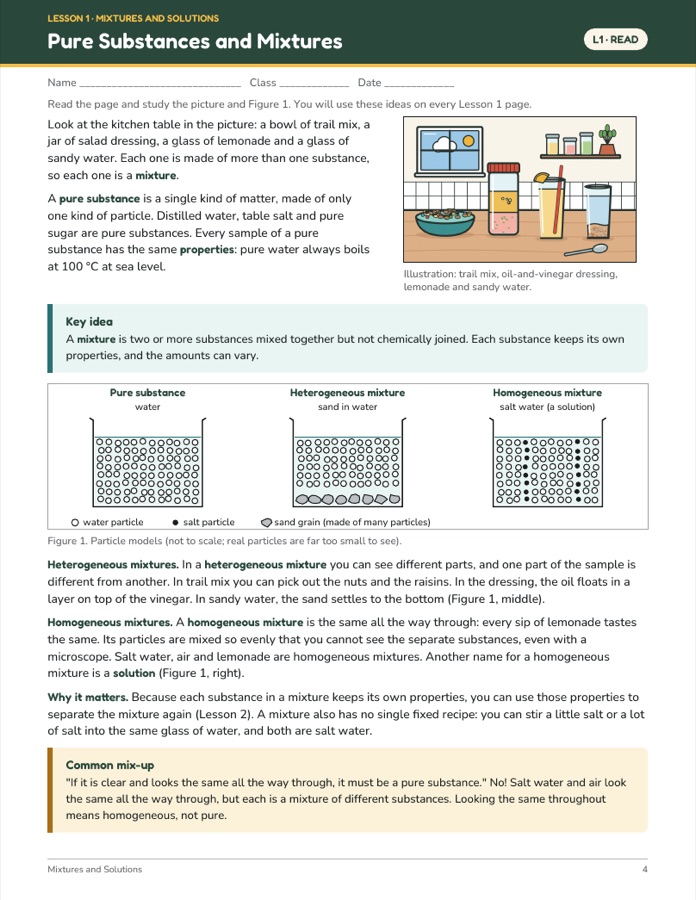
Page 4 of 29 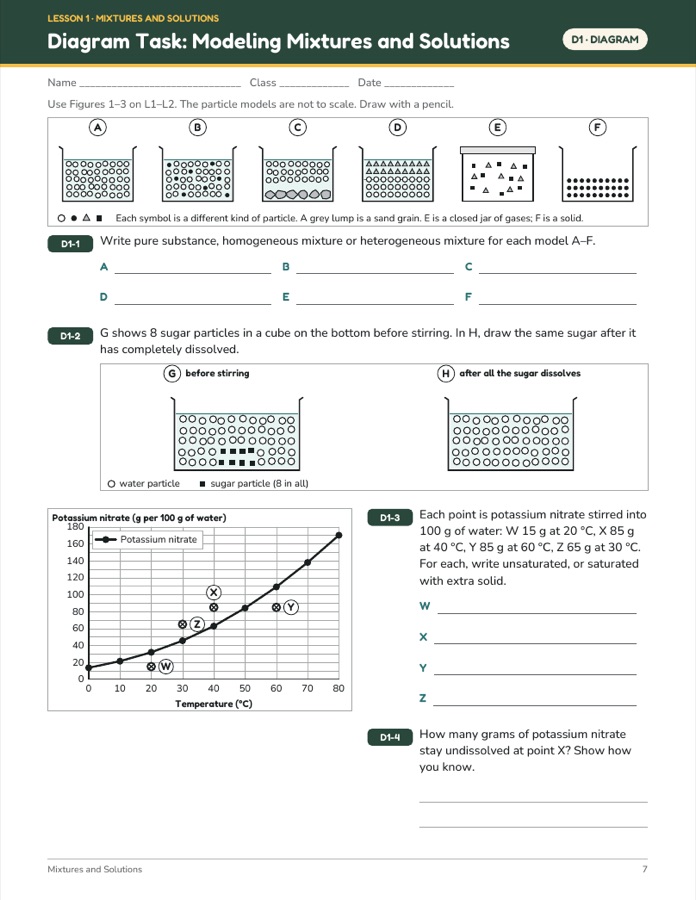
Page 7 of 29 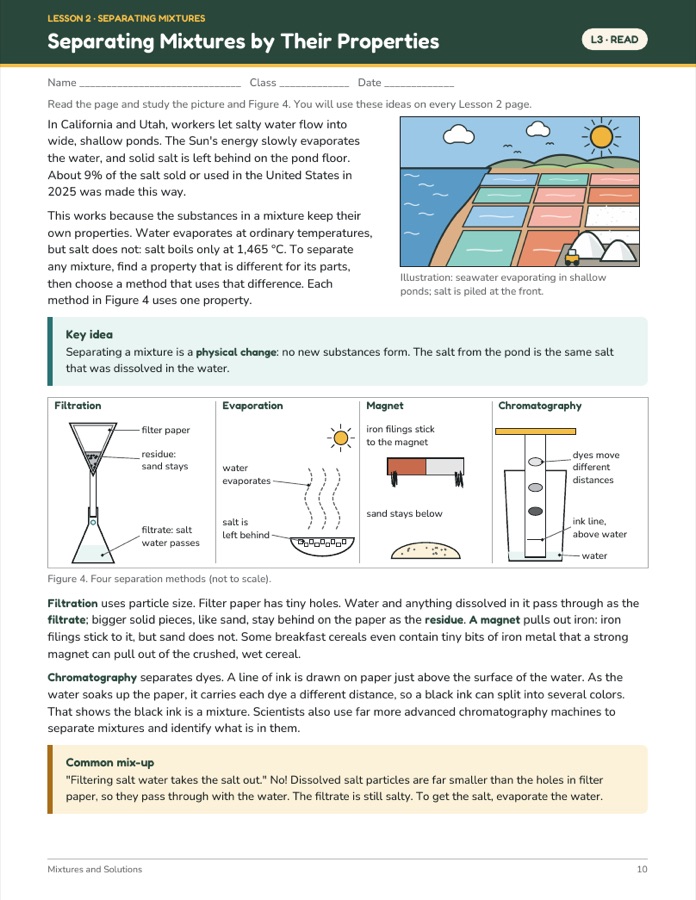
Page 10 of 29
Student pages are designed to print in black and white; all labels, numbers, graphs and particle models are printed text and vector drawings.
How teachers use it
A mixture is two or more substances mixed together but not chemically joined, so each substance keeps its own properties, and a solution is a homogeneous mixture: the same all the way through. Each lesson is planned for about 50 minutes. Students read the explanation pages first, then work the guided notes, the diagram task and the reading check, and finish with a Prove-it data task and a claim-evidence-reasoning write-up.
The free sample on this page is a one-page practice set on mixtures and solutions with an answer key. Its items are new and are not in the paid unit, so you can use it as a pre-check or an exit ticket and still teach the full lessons afterward.
Lesson 1 gives students the sorting words (pure substance, heterogeneous mixture, homogeneous mixture) through particle models, then has them read solubility curves to decide whether a solution is unsaturated or saturated. Lesson 2 turns the same idea around: because each substance in a mixture keeps its properties, a property that differs is what lets you separate it. The listed prerequisites are reading a simple line graph and a data table and knowing that matter is made of particles.
The unit supports and connects to NGSS MS-PS1-2 (properties of substances, including solubility) and MS-PS1-3 (synthetic materials come from natural resources). That is not a claim of full alignment.
Before and after this topic
In the order used on this site, this page comes after atoms, elements and molecules, where students first sort elements, compounds and mixtures, and before heat transfer. The paper lab listed above is a one-period lab on printed data cards.
- Before this topicAtoms, Elements and Molecules Worksheets, Grades 6-8 (Free Sample)
- After this topicHeat Transfer Worksheets for Grades 6-8 (Free Sample + Full Unit)
- All topics in this lineMiddle School Physical Science Worksheets (Grades 6-8)
Common questions
Is the free worksheet the same as a page from the paid unit?
No. The sample is written separately for this site, and its items are not in the unit. It uses the same page style, so you can see what the student pages look like before you buy.
Are the solubility numbers real?
Yes. The solubility values are published data from the CRC Handbook, NIST and USGS. The separation results in one Prove-it task are simulated lab data and are labeled as simulated.
What is the difference between the unit and the paper lab?
The unit teaches the ideas in two lessons. The paper lab is a single 45 to 50 minute lab where students identify a mystery white solid from results printed on cut-apart data cards, average trials, graph solubility against temperature and write a CER conclusion. Its real-data cards give CRC Handbook solubilities for potassium chloride, ammonium chloride and potassium sulfate, its class-results cards are simulated and labeled on every card, and it needs no lab room, chemicals, heat or glassware.