Atoms, Elements and Molecules Worksheets, Grades 6-8 (Free Sample)
Download a free atoms, elements and molecules worksheet for Grades 6-8 below: one student page with an answer key, ready to print. The full unit is two illustrated lessons, Atoms and elements and Molecules, compounds and structures, with guided notes, diagram tasks, reading checks, two Prove-it evidence tasks, vocabulary cards and a quiz, for USD 4.50 on TPT. Two companions are sold separately: a one-day atoms and molecules sub plan for USD 4.50 and a paper escape-room style matter review for USD 4.50.
Teaching notesHow to Teach Atoms, Elements and Molecules (Grades 6-8)
Free sample worksheet
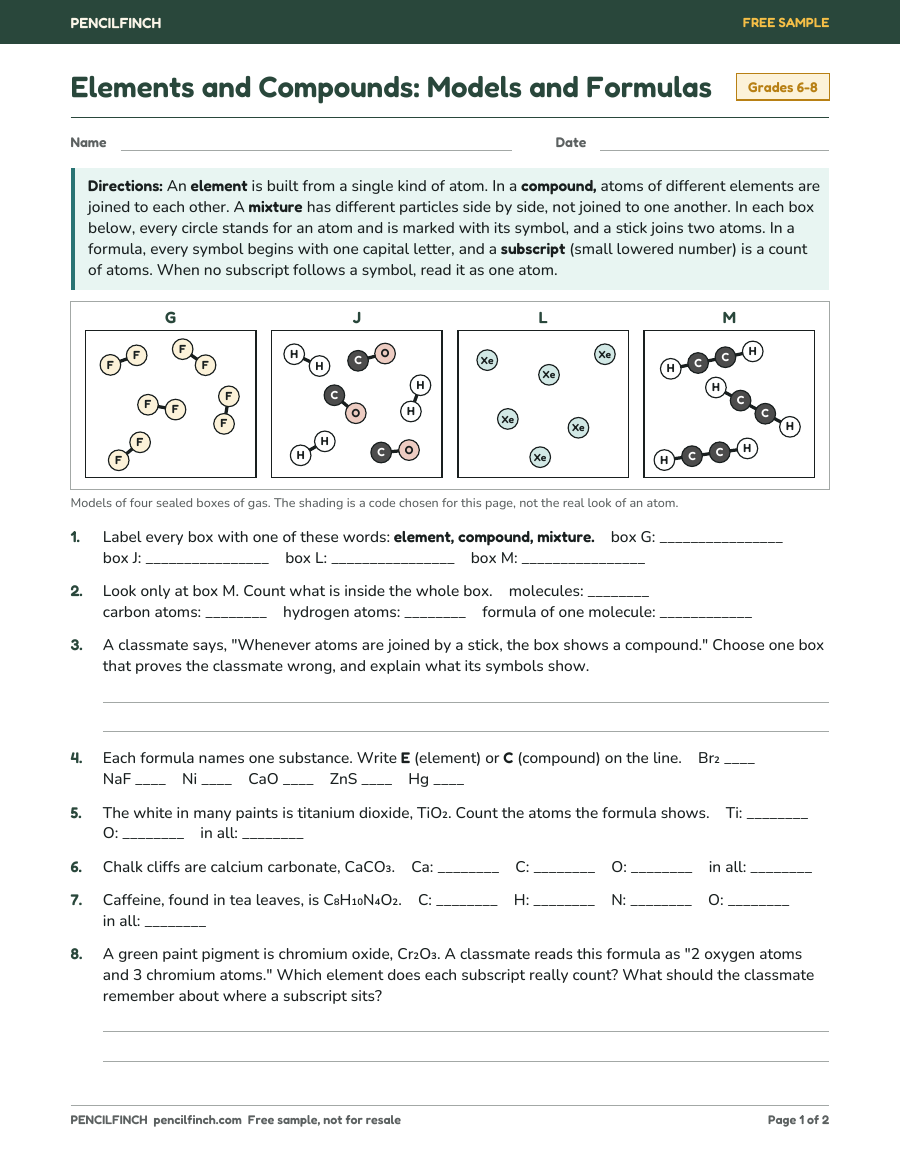 Download the free sample (PDF, 8 items with answer key)
Free to download, no email needed. These problems are not in the paid unit.
What is in the full unit
| Full unit | Atoms, Elements, Molecules & Compounds Science Lessons | Grades 6-8 |
|---|---|
| Pages | 28 pages in one PDF |
| Standards | NGSS MS-PS1-1 |
| Grades | 6-8 |
| Price on TPT | USD 4.50 |
Get the full unit on TPT (USD 4.50)
- Lesson 1, Atoms and elements: all matter is made of atoms, elements have one kind of atom, the periodic table and chemical symbols, atom models, and a Prove-it task that uses real data to decide whether pencil graphite and diamond are the same element.
- Lesson 2, Molecules, compounds and structures: molecules such as water, carbon dioxide, ammonia and methanol, counting atoms in chemical formulas, extended structures such as salt, diamond and copper, element vs. compound vs. mixture, and a Prove-it task that refutes the claim "all substances are made of molecules".
- Two Prove-it evidence tasks with claim-evidence-reasoning. Property data are cited from university and science-organization sources.
- Explanation pages with labeled particle models, a full periodic table and two scene illustrations (the two scene illustrations were made with an AI image generator and reviewed; the models are vector drawings), guided notes, diagram tasks, reading checks, two pages of picture vocabulary cards and a 10-question quiz.
- Answer key for every question with scoring rules, completed notes and tables, a model drawing and model CER answers; a two-lesson plan with an optional model-building activity, misconceptions and printing notes for the teacher.
Goes with
-
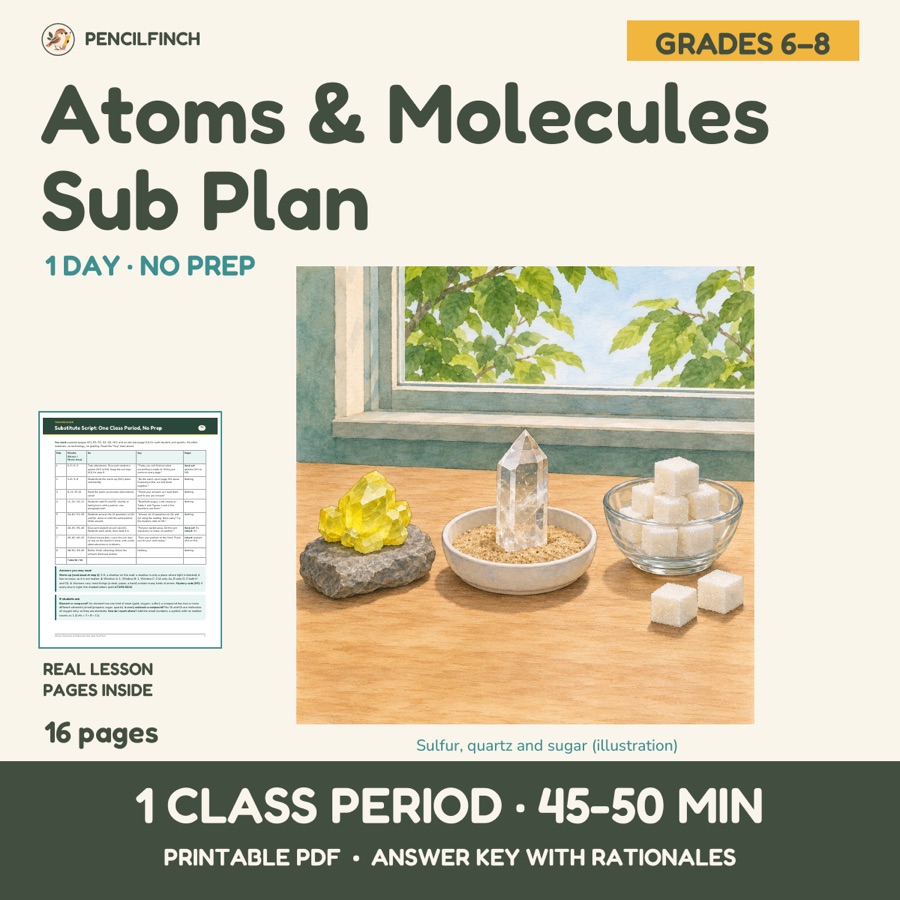
Atoms & Molecules Science Sub Plan | One Day, No Prep | Grades 6-8
Companion. 16 pages, grades 6-8, answer key included. USD 4.50
View on TPT -
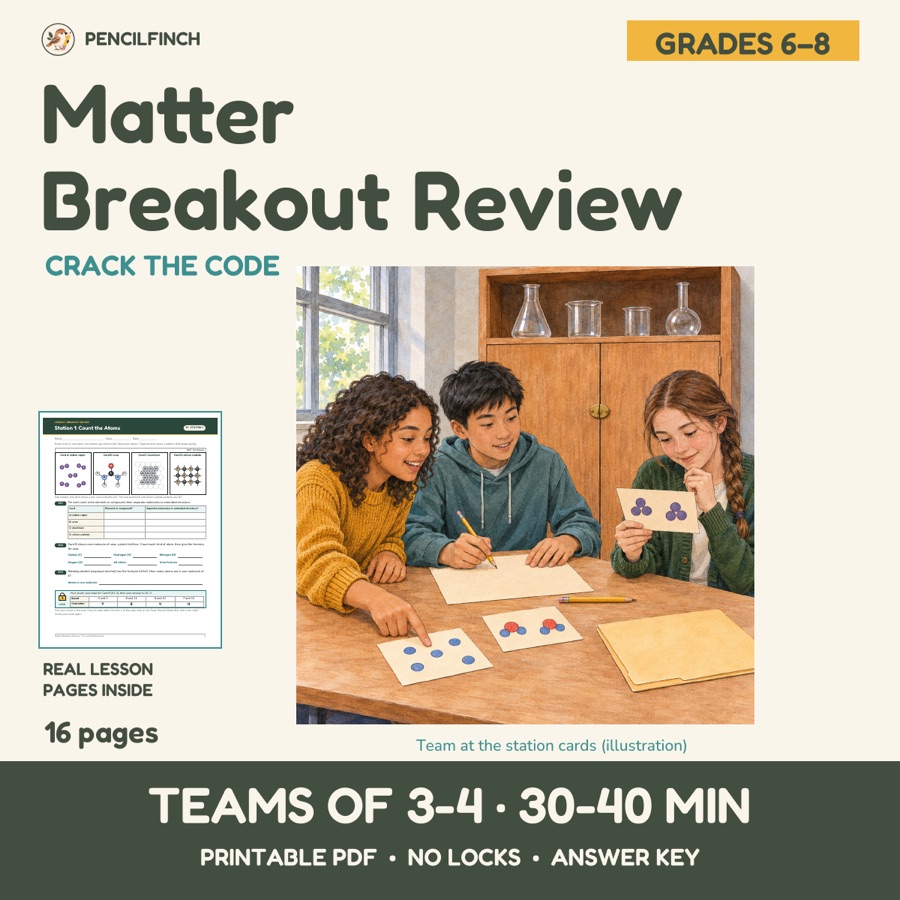
Matter Escape Room Science Review | Atoms, States & Changes | Grades 6-8
Companion. 16 pages, grades 6-8, answer key included. USD 4.50
View on TPT
Pages from the unit
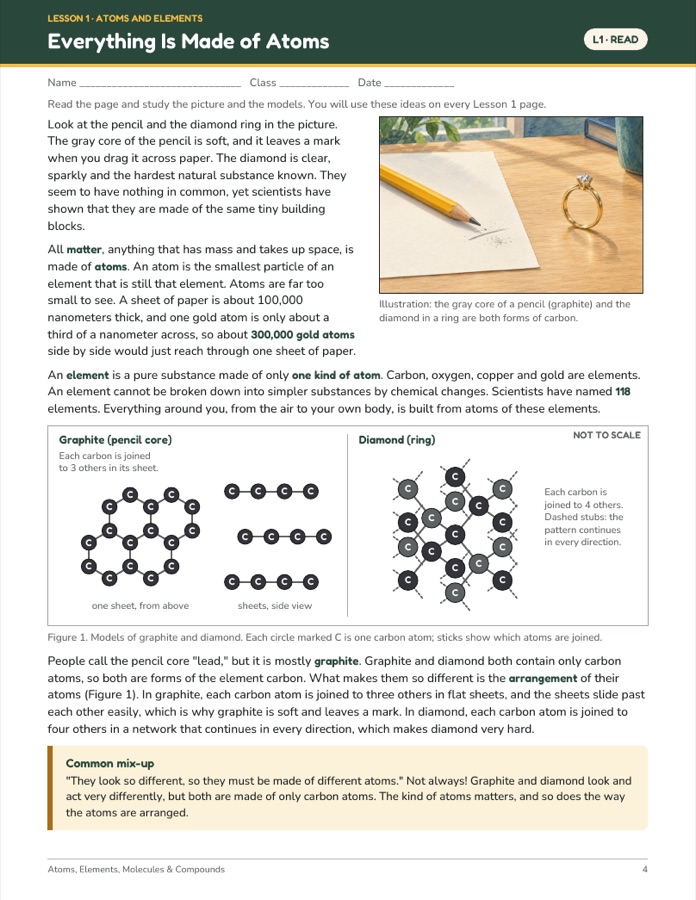
Page 4 of 28 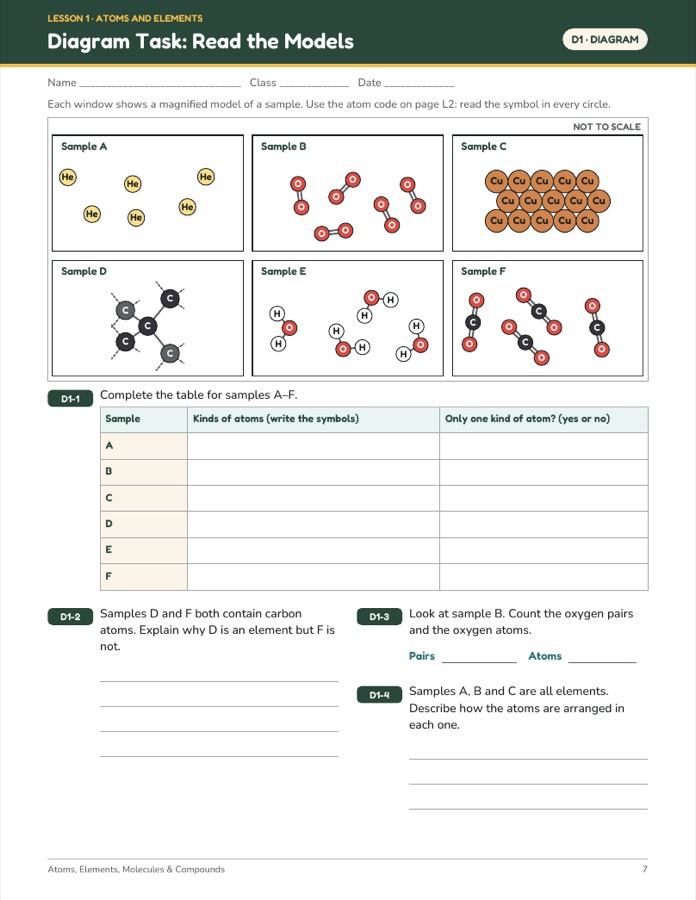
Page 7 of 28 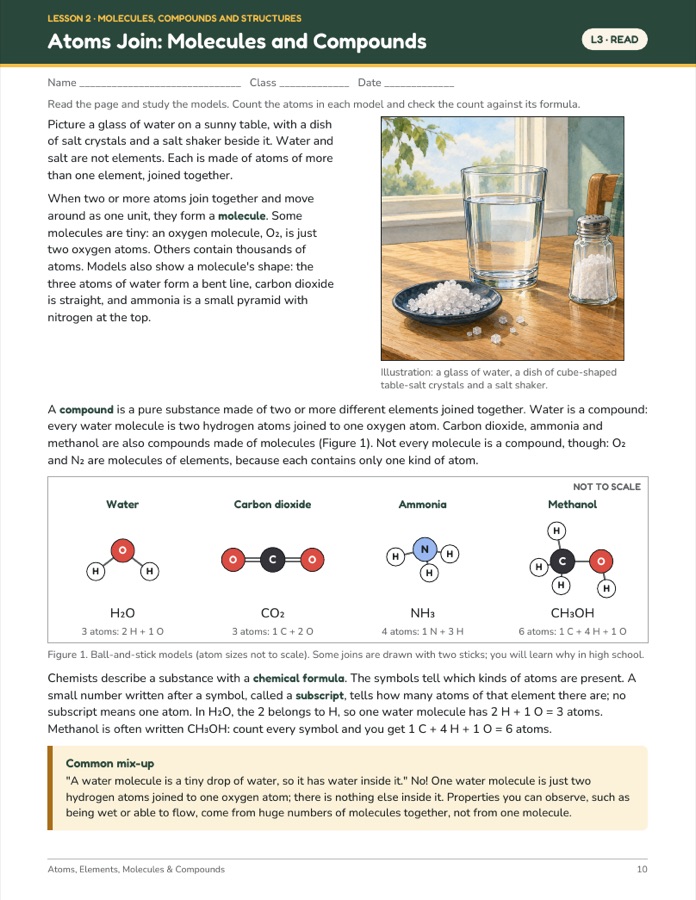
Page 10 of 28
Student pages are designed to print in black and white: every atom in a model has its chemical symbol printed inside. The models are not to scale and are labeled that way.
How teachers use it
An atom is the smallest particle of an element that is still that element, and an element is a pure substance made of only one kind of atom. Each lesson is planned for about 50 minutes. Students read the explanation pages and study the particle models first, then work the guided notes, the diagram task and the reading check, and finish with a Prove-it task and a claim-evidence-reasoning write-up.
The free sample on this page is a one-page practice set on atoms, elements and molecules with an answer key. Its items are new and are not in the paid unit, so it can serve as a pre-check before the unit or a review after it without repeating anything students will see in the lessons.
Lesson 1 starts from two things that look nothing alike, pencil graphite and diamond, and uses them to show that the kind of atom and the arrangement of the atoms both matter. Lesson 2 moves to atoms joined together: students count atoms from formulas and from models, and learn that some substances, such as salt, diamond and copper, are extended structures and not separate molecules. The listed prerequisite is reading a simple table; matter, atoms and the periodic table are introduced in the pages.
The unit supports and connects to NGSS MS-PS1-1 (models of the atomic composition of simple molecules and extended structures). Students use and interpret supplied models; that is not a claim of full alignment.
Before and after this topic
In the order used on this site, this page comes after density and before mixtures and solutions, which uses the particle models and the element, compound and mixture sorting that students meet here.
- Teaching notes for this topicHow to Teach Atoms, Elements and Molecules (Grades 6-8)
- Before this topicDensity Worksheets for Grades 6-8 (Free Sample + Full Unit)
- After this topicMixtures and Solutions Worksheets, Grades 6-8 (Free Sample + Unit)
- All topics in this lineMiddle School Physical Science Worksheets (Grades 6-8)
Common questions
Is the free worksheet the same as a page from the paid unit?
No. The sample is written separately for this site, and its items are not in the unit. It uses the same page style, so you can see what the student pages look like before you buy.
Do students have to memorize the periodic table?
No. A full periodic table is printed on the explanation pages, and students read chemical symbols from the pages and from the atoms in each model.
What is the difference between the unit, the sub plan and the escape-room review?
The unit teaches the ideas in two lessons. The sub plan is a single 45 to 50 minute class with a one-page script for the substitute, an illustrated reading, 12 questions, a mystery code and an exit slip; it uses different substances, models and questions from the unit. The review is a team game for the end of a matter unit: five station cards with lock strips on atoms, states of matter, and physical and chemical changes, planned for 30 to 40 minutes.