How to Teach Atoms, Elements and Molecules (Grades 6-8)
Students should finish this topic able to look at a particle drawing or a formula and say whether it shows an element, a compound or a mixture, and whether its atoms are bonded into molecules. The sticking point is that four words (atom, element, molecule, compound) arrive almost together, and students file them as one idea. This note gives you two questions that keep the words apart, three wrong ideas with a reply for each, a board lesson and three check questions.
Printable for this topic: Atoms, Elements and Molecules Worksheets, Grades 6-8 (Free Sample) (free sample page and the full unit).
The idea in plain words
An atom is the smallest bit of an element that can take part in a chemical change, and in an element all the atoms are of one kind. For the other two words: a compound is a substance in which atoms of two or more elements are bonded in a fixed ratio, and a molecule is two or more atoms, alike or different, held together by chemical bonds.
Those words answer two separate questions. First: how many kinds of atom does the substance have? One kind makes it an element; two or more kinds bonded together make it a compound. Second: are the atoms bonded into small separate groups? If so, the groups are molecules. Every combination exists. Argon is an element of single atoms. Oxygen gas is also an element, but its atoms are bonded in pairs, O₂. Water is a compound made of molecules, H₂O. Table salt, NaCl, is a compound with no separate molecules.
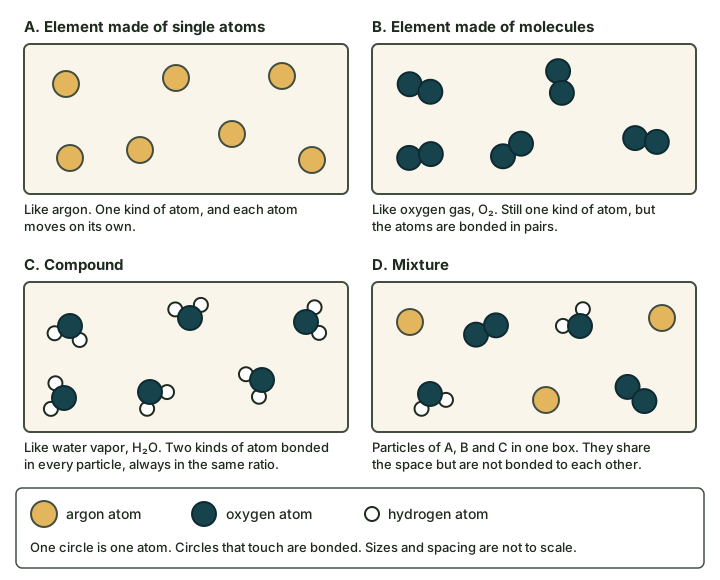
A mixture is different again: two or more substances that share a space without being bonded to each other, in amounts that can vary.
Three misconceptions and what to say
"Molecule and compound are two words for the same thing."
The first molecule most students meet is water, which happens to be both, so the two labels fuse. O₂ is a molecule but not a compound, since every atom in it is the same kind. Table salt is a compound but is not made of molecules. Ask: "Which word counts the kinds of atom, and which says the atoms are bonded into a group?"
"A gold atom is a tiny speck of shiny yellow metal."
We say that gold is made of gold atoms, and diagrams print atoms in color, so students picture the metal shrunk down. A Michigan State University chemistry text puts it plainly: an isolated atom has no color and no boiling point, and such properties appear only when very large numbers of atoms are together. Say: "Shiny, hard and melted describe a crowd of atoms, never one member of the crowd."
"The little 2 in H₂O counts the water molecules."
In math class a number written next to a letter multiplies it, so students read the 2 as a count of whatever the formula names. A subscript counts atoms of the symbol just before it, inside one molecule; a number written in front counts whole molecules. Write 3H₂O, draw the three molecules and count aloud: 3 molecules, 6 hydrogen atoms, 3 oxygen atoms.
A 10-minute mini-lesson
- (1 minute) Draw a box with six separate, identical circles. Ask: "How many kinds of atom are here? Are any of them bonded?" Write "element, single atoms (neon)".
- (2 minutes) Draw a second box with shaded circles joined in pairs. Ask: "What changed? Did the number of kinds of atom change?" Write "element, made of molecules (oxygen, O₂)".
- (2 minutes) Draw a third box in which every particle is one shaded circle joined to two small open circles. Ask: "How many kinds of atom are in one particle? Is every particle the same?" Write "compound, made of molecules" and H₂O. Ask: "What does the small 2 count?"
- (2 minutes) Draw a fourth box holding some of the three-atom particles and some pairs from box two. Ask: "Is this one substance? Are the two kinds of particle bonded to each other?" Write "mixture".
- (2 minutes) On paper, students draw a grid: columns "one kind of atom" and "two or more kinds", rows "molecules" and "no molecules". They place helium (He), chlorine gas (Cl₂), methane (CH₄) and table salt (NaCl); tell them that salt has no separate molecules. Key: He one kind, no molecules; Cl₂ one kind, molecules; CH₄ two kinds, molecules; NaCl two kinds, no molecules.
- (1 minute) Ask: "Which two entries in your grid prove that molecule and compound are not the same word?" (Cl₂ and NaCl.)
Quick check
- One form of the element carbon is written C₆₀. Is this substance an element or a compound? Is it made of molecules?
- A student writes 3C₆H₆ for a sample of benzene. How many molecules is that? Count the carbon atoms and the hydrogen atoms in the sample.
- A drawing shows only single circles, none of them touching: some are shaded and the rest are open. Does the drawing show an element, a compound or a mixture? Explain.
Answers: 1. An element, because C is the only kind of atom in it. It is made of molecules of sixty bonded carbon atoms. 2. Three molecules. With 6 carbon and 6 hydrogen atoms in each, that is 18 carbon atoms and 18 hydrogen atoms. 3. A mixture of two elements. There are two kinds of atom, but none are bonded, so nothing in the drawing is a compound.
Sources
- OpenStax, Chemistry 2e, section 1.2 "Phases and Classification of Matter" (elements, compounds, mixtures, atoms and molecules): https://openstax.org/books/chemistry-2e/pages/1-2-phases-and-classification-of-matter
- OpenStax, Chemistry 2e, section 2.4 "Chemical Formulas" (subscripts, H₂ and 2H, methane, benzene): https://openstax.org/books/chemistry-2e/pages/2-4-chemical-formulas
- OpenStax, Chemistry 2e, section 2.6 "Ionic and Molecular Compounds" (ionic compounds are not discrete molecules): https://openstax.org/books/chemistry-2e/pages/2-6-ionic-and-molecular-compounds
- OpenStax, Chemistry 2e, section 18.4 "Structure and General Properties of the Nonmetals" (C₆₀ molecules): https://openstax.org/books/chemistry-2e/pages/18-4-structure-and-general-properties-of-the-nonmetals
- M. M. Cooper and M. W. Klymkowsky, CLUE: Chemistry, Life, the Universe and Everything, chapter 3 (Michigan State University Libraries): https://openbooks.lib.msu.edu/clue/chapter/chapter-3-elements-bonding-and-physical-properties/
The full unit
Atoms, Elements, Molecules & Compounds Science Lessons | Grades 6-8
28 pages, grades 6-8. USD 4.50
Get the full unit on TPT (USD 4.50)
Next topics
- Before this topicDensity Worksheets for Grades 6-8 (Free Sample + Full Unit)
- After this topicMixtures and Solutions Worksheets, Grades 6-8 (Free Sample + Unit)
- All topics in this lineMiddle School Physical Science Worksheets (Grades 6-8)