Density Worksheets for Grades 6-8 (Free Sample + Full Unit)
Download a free density worksheet for Grades 6-8 below: one student page with an answer key, ready to print. The full unit is two illustrated lessons, Density is a property and Sink, float and layer, with guided notes, model tasks, reading checks, two Prove-it data tasks that use NIST reference densities, vocabulary cards and a quiz, for USD 4.50 on TPT. Two companions are sold separately: a three-level density skill ladder for USD 3.50 and a no-equipment density paper lab for USD 4.50.
Free sample worksheet
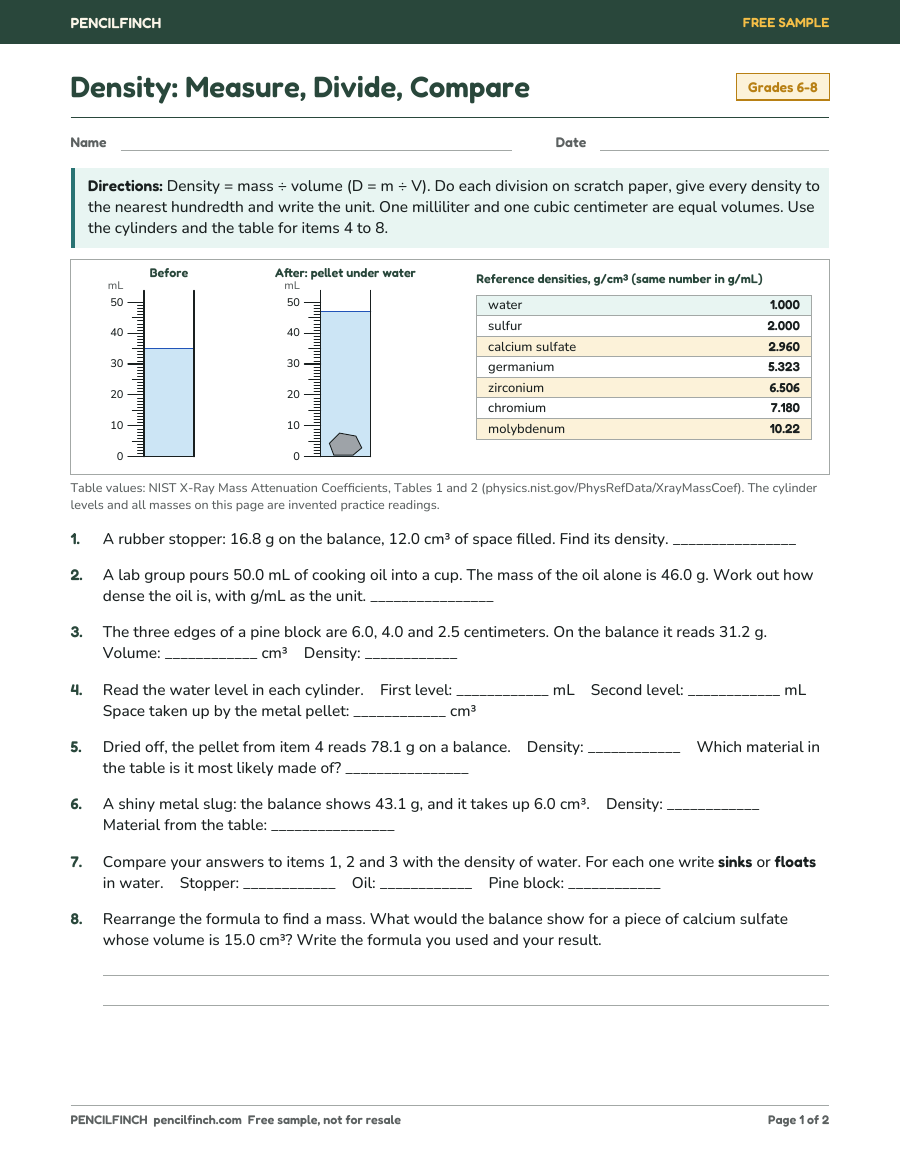 Download the free sample (PDF, 8 items with answer key)
Free to download, no email needed. These problems are not in the paid unit.
What is in the full unit
| Full unit | Density Science Lessons | Mass, Volume, Sink or Float & Layers | Grades 6-8 |
|---|---|
| Pages | 29 pages in one PDF |
| Answer key | Included with Rubric |
| Standards | Connects to NGSS MS-PS1.A (disciplinary core idea) and CCSS RST.6-8.3 |
| Grades | 6-8 |
| Price on TPT | USD 4.50 |
Get the full unit on TPT (USD 4.50)
- Lesson 1, Density is a property: mass, volume, 1 mL = 1 cm³, D = m ÷ V in g/cm³ and g/mL, volume by ruler and by water displacement, reading a meniscus, and why pieces of one substance have the same density whatever their size. Students read simulated balance and cylinder readings, compute densities and identify materials with a real NIST table.
- Lesson 2, Sink, float and layer: comparing densities with water at 1.000 g/mL, buoyancy in words, the fraction of a floater under the waterline, why ice floats, layered liquids, average density, cargo ships and the load line, and submarine ballast tanks. Students place objects in a tank, order four liquids, and work out whether a toy steel hull floats empty, loaded and overloaded.
- Two Prove-it data tasks with CER using NIST reference densities. The reference densities are real NIST values; the measured objects are simulated and labeled that way.
- Explanation pages with three scene illustrations drawn in code (no AI image generator), worked examples and particle models, guided notes, reading checks, two pages of picture vocabulary cards and a 10-question quiz.
- Answer key for every question with the division shown, scoring rules, completed notes and drawings, and model CER answers; a two-lesson plan with two optional demos with safety notes, misconceptions and printing notes for the teacher.
Goes with
-
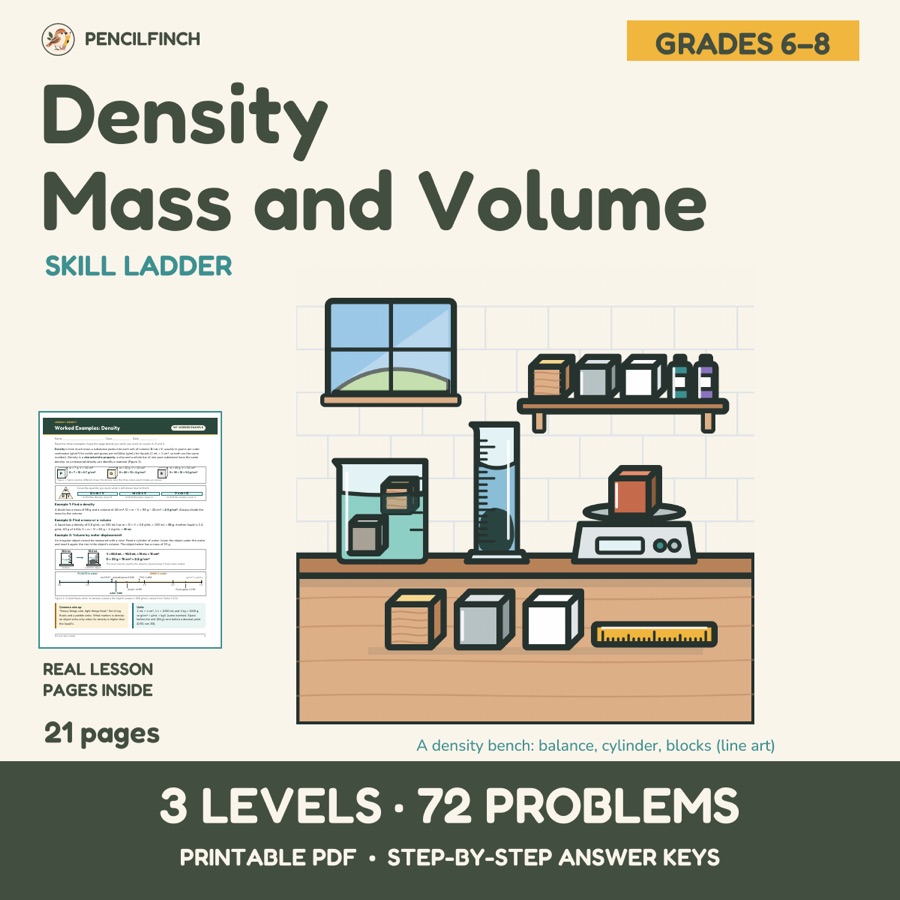
Density Science Worksheets | 3-Level Skill Ladder, Sink or Float | Grades 6-8
Companion. 21 pages, grades 6-8, answer key included. USD 3.50
View on TPT -
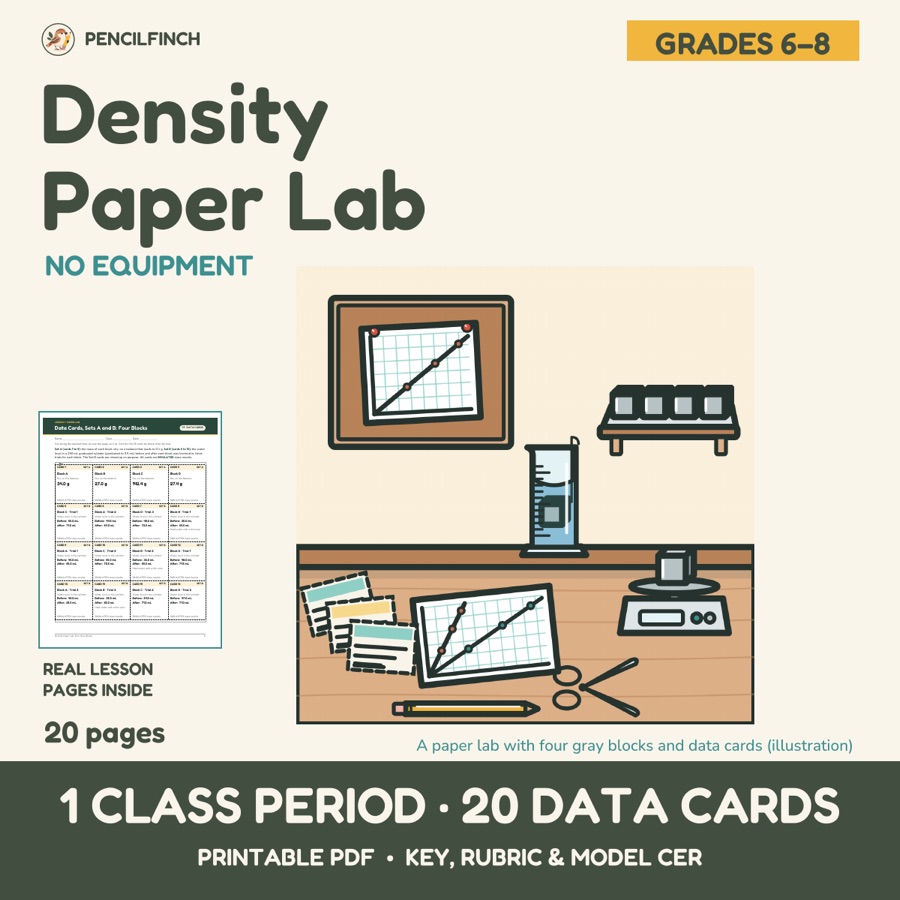
Density Lab | Science Paper Lab, No Equipment, Identify 4 Blocks | Grades 6-8
Companion. 20 pages, grades 6-8, answer key included. USD 4.50
View on TPT
Pages from the unit
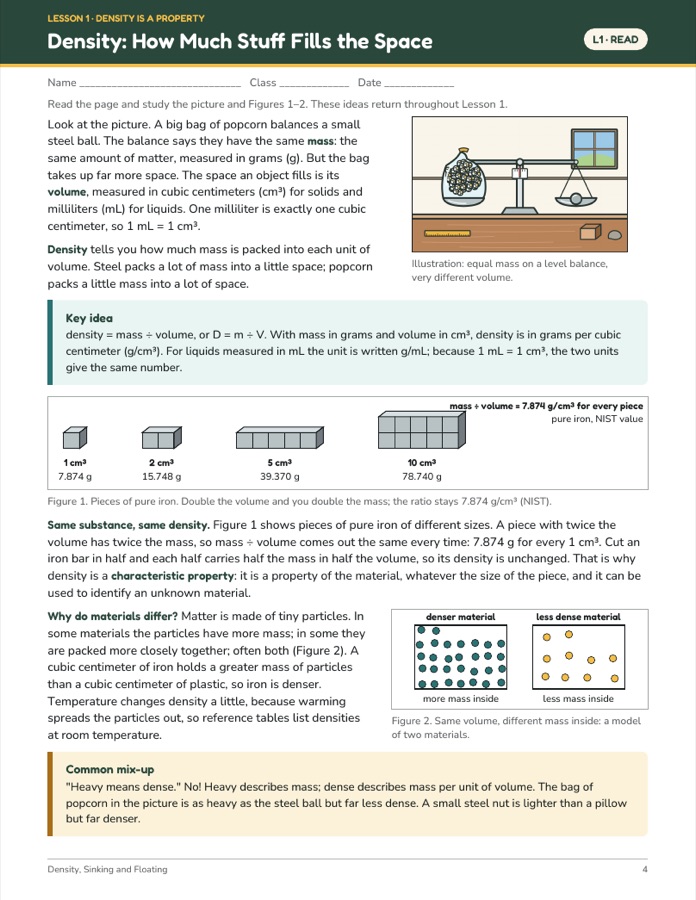
Page 4 of 29 
Page 7 of 29 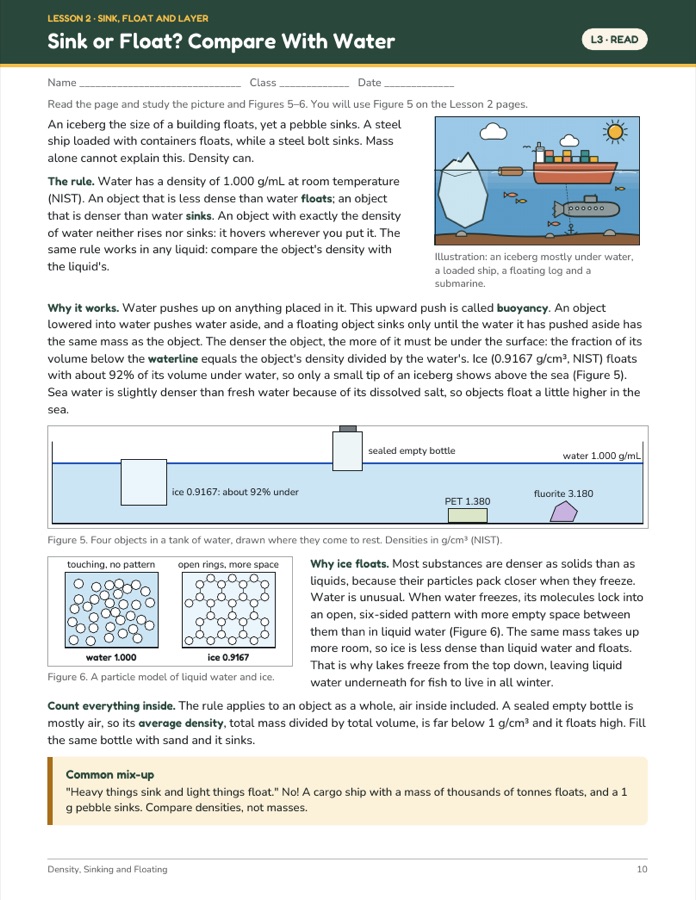
Page 10 of 29
Student pages are designed to print in black and white; all labels, numbers, models and figures are printed text and vector drawings.
How teachers use it
Density is the amount of mass packed into each unit of volume, found by dividing mass by volume (D = m ÷ V) and written in g/cm³ for solids or g/mL for liquids. Each lesson is planned for about 50 minutes. Students read the explanation pages and their worked examples first, then work the guided notes, the model task and the reading check, and finish with a Prove-it data task and a claim-evidence-reasoning write-up.
The free sample on this page is a one-page density practice set with an answer key. Its items are new and are not in the paid unit, so it can serve as a quick check before the unit or a review after it without repeating anything students will see in the lessons.
Lesson 1 treats density as a property of the material: students use ratio reasoning to show that the size of a piece does not change its density. Lesson 2 then uses one comparison, the object's density against water at 1.000 g/mL, to explain sinking, floating and layering, and extends it to average density for ships and submarines. The listed prerequisites are multiplying and dividing decimals and reading a simple table.
The unit connects to the NGSS disciplinary core idea MS-PS1.A (characteristic properties identify a substance; density is the first property named in the MS-PS1-2 assessment boundary), to CCSS RST.6-8.3 (follow a multistep measuring procedure) and to 6.RP.A.3 ratio and rate reasoning. No middle school performance expectation names density, so this is a connection, not a claim of full alignment.
Before and after this topic
In the order used on this site, density follows metric conversions and measurement, because Lesson 1 measures mass in grams and volume in milliliters and cubic centimeters. The skill ladder listed above gives three levels of extra calculation practice, and the paper lab is a one-period lab on printed data cards.
- Before this topicMetric Conversions Worksheets for Grades 6-8 (Free Sample + Full Unit)
- After this topicNewton's Third Law Worksheets for Grades 6-8 (Free Sample + Full Unit)
- All topics in this lineMiddle School Physical Science Worksheets (Grades 6-8)
Common questions
Is the free worksheet the same as a page from the paid unit?
No. The sample is written separately for this site, and its items are not in the unit. It uses the same page style, so you can see what the student pages look like before you buy.
Are the densities real?
The reference densities are real NIST values, for example 7.874 g/cm³ for pure iron. The objects students measure on the pages are simulated and are labeled as simulated.
What is the difference between the unit, the skill ladder and the paper lab?
The unit teaches the idea in two lessons. The skill ladder is practice only: one page of worked examples and three levels of problems with self-check strips. The paper lab is a single 45 to 50 minute lab where students identify four unlabeled blocks from simulated results printed on cut-apart data cards and a real NIST reference table; it needs no balance, glassware or water.