Newton's Third Law Worksheets for Grades 6-8 (Free Sample + Full Unit)
Download a free Newton's third law worksheet for Grades 6-8 below: one student page with an answer key, ready to print. The full unit is two illustrated lessons, one on action-reaction force pairs and one on collisions and designing something safer, with guided notes, diagram tasks, reading checks, two Prove-it data tasks, vocabulary cards and a quiz, for USD 4.50 on TPT.
Free sample worksheet
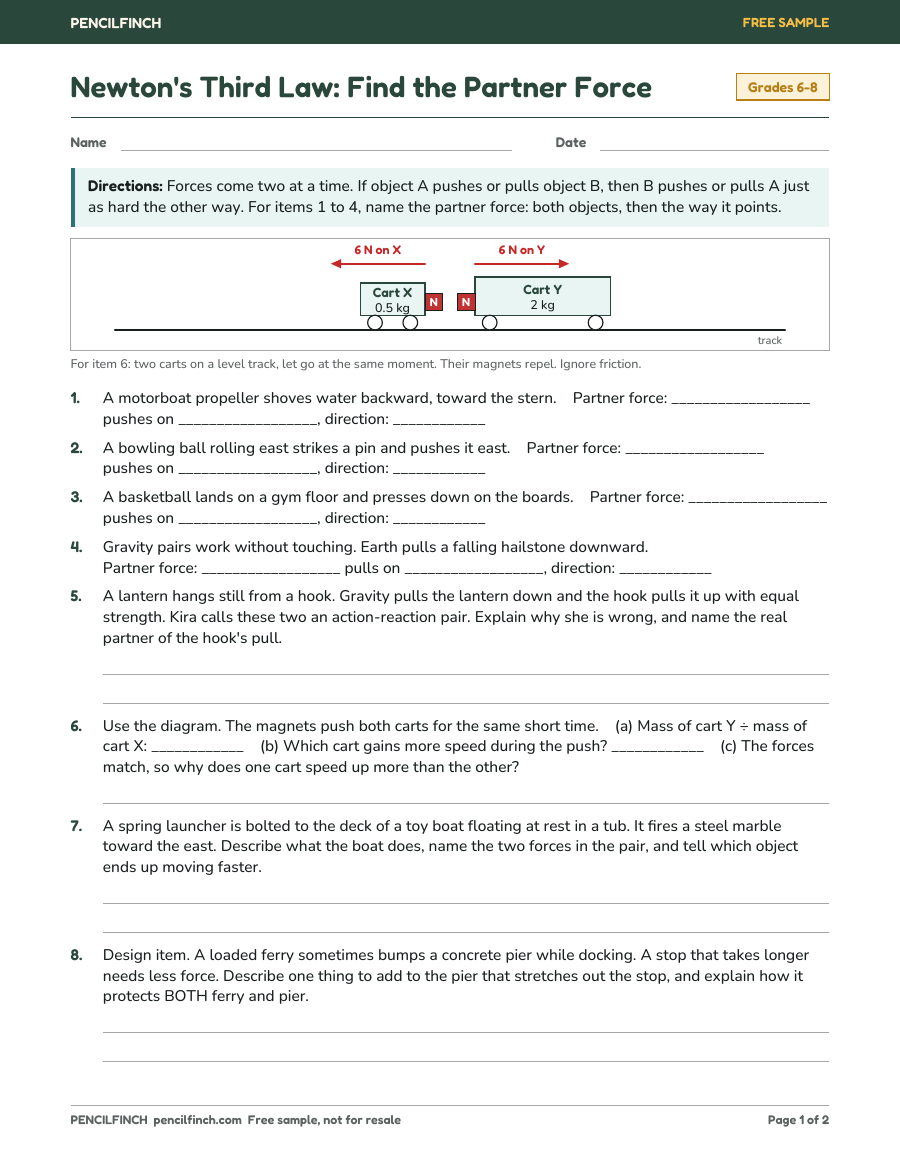 Download the free sample (PDF, 8 items with answer key)
Free to download, no email needed. These problems are not in the paid unit.
What is in the full unit
| Full unit | Newton's Third Law Science | Action Reaction Pairs & Collisions | Grades 6-8 |
|---|---|
| Pages | 29 pages in one PDF |
| Answer key | Included with Rubric |
| Standards | NGSS MS-PS2-1 |
| Grades | 6-8 |
| Price on TPT | USD 4.50 |
Get the full unit on TPT (USD 4.50)
- Lesson 1, force pairs: every force is "object A on object B" and its partner is "object B on object A"; equal size, opposite direction, two different objects, so pairs never cancel; contact pairs, magnet pairs and gravity pairs; balanced forces on one object are not a third-law pair; recoil and rockets; why the same force moves a small mass more. Students draw missing partner forces and use simulated spring push-off data to show that both carts get the same force.
- Lesson 2, collisions and design: contact time, force = mass × change in speed ÷ stopping time, the same stop as a short hard spike or a long gentle hump, crumple zones with a rigid safety cage, helmet shell and foam liner, belts, airbags and break-away poles, and a padded-cart design problem with trade-offs and criteria. Students label a crash scene, draw force bars for three bumpers and use simulated crash-sled data to judge a claim about how well a rigid steel front protects.
- Two Prove-it data tasks with CER. All data tables and graphs are simulated models with round numbers and are labeled that way; real test facts from the U.S. bicycle helmet standard, the IIHS moderate overlap test and NHTSA's frontal test appear in the reading.
- Explanation pages with two scene illustrations drawn in code (no AI image generator), force-pair diagrams, a push-off model, a force-time graph, and crumple-zone and helmet diagrams; guided notes, reading checks, two pages of picture vocabulary cards and a 10-question quiz.
- Answer key for every question with scoring rules, completed notes, completed drawings and bar charts, and model CER answers; a two-lesson plan with an optional balloon-rocket demo, misconceptions and data notes for the teacher.
Pages from the unit
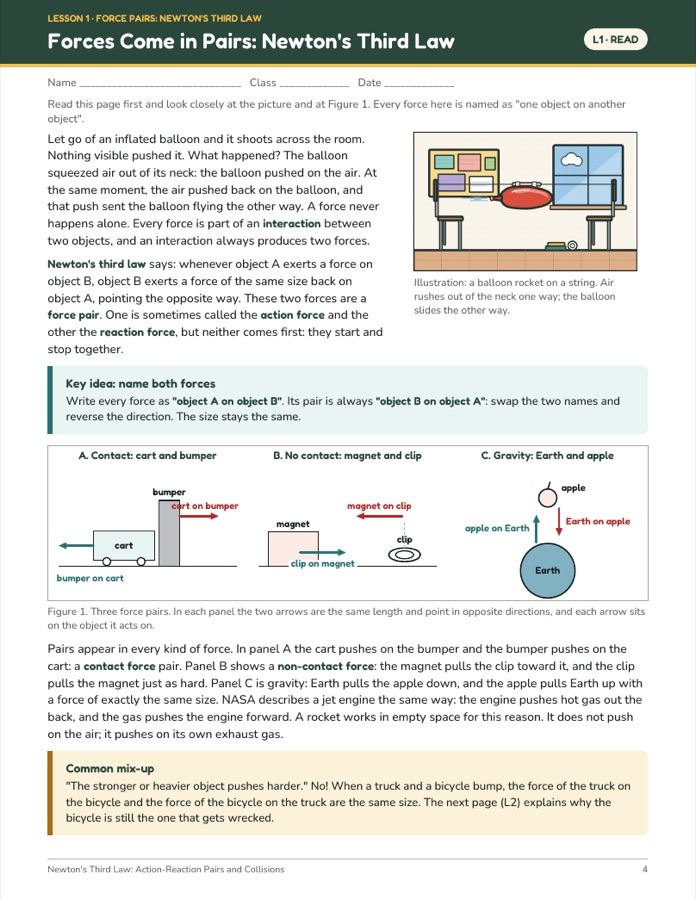
Page 4 of 29 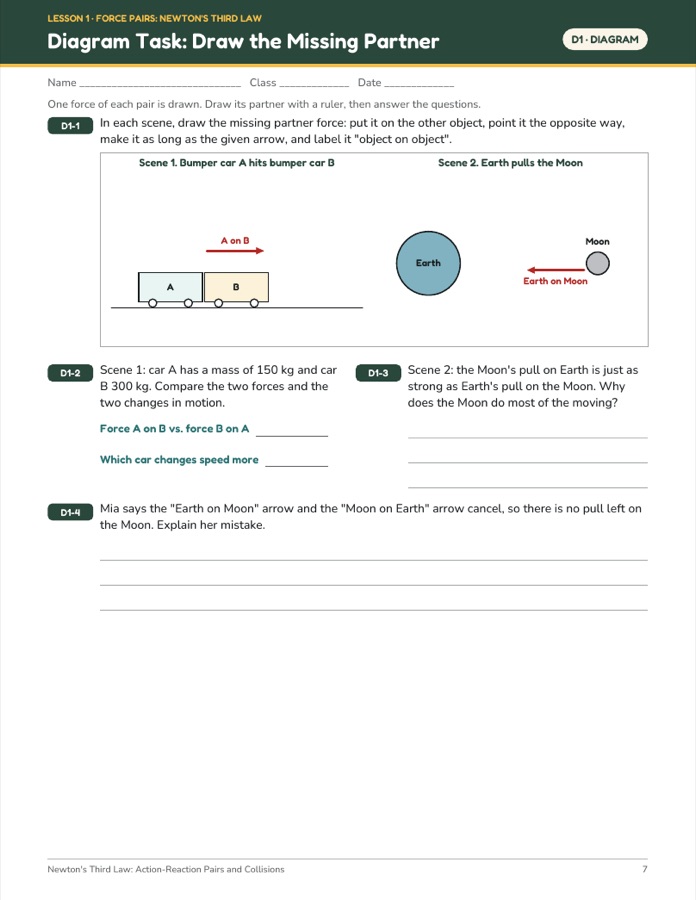
Page 7 of 29 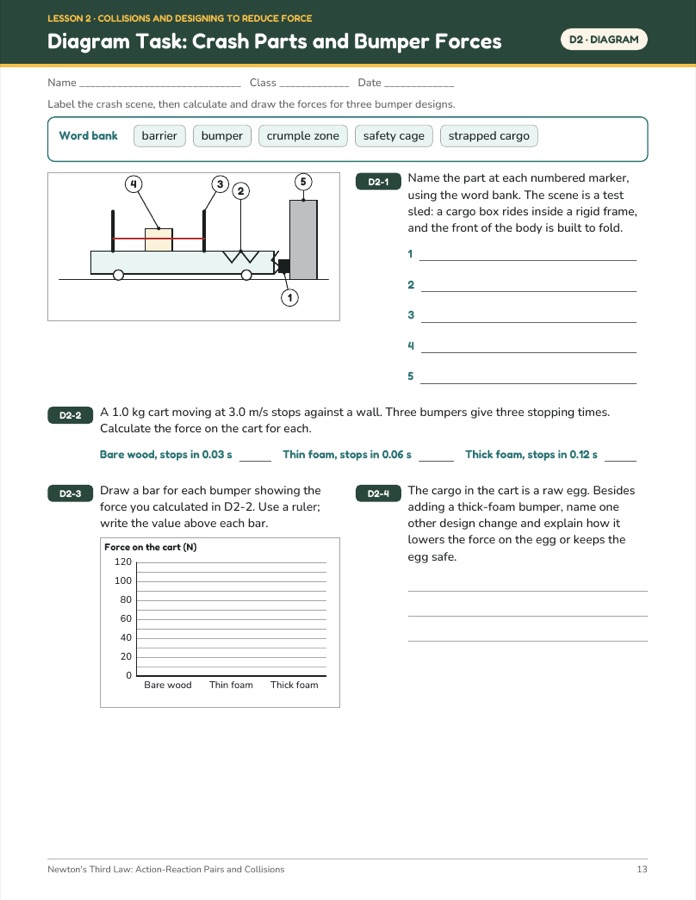
Page 13 of 29
Student pages are designed to print in black and white; all labels, numbers, graphs and arrows are printed text and vector drawings.
How teachers use it
Newton's third law says that whenever object A exerts a force on object B, object B exerts a force of the same size back on object A in the opposite direction. Each lesson is planned for about 50 minutes. Students read the explanation pages, then work the guided notes, a diagram task and a reading check, and close with a Prove-it data task and a claim-evidence-reasoning write-up.
The free sample on this page is a one-page practice set on Newton's third law with an answer key. Its items are new and are not in the paid unit, so you can use it as a warm-up or an exit ticket and still teach the full lessons afterward.
Lesson 1 is built around one habit: name every force as "object A on object B", then swap the names to find its partner. That habit is what separates a true third-law pair from the two balanced forces on a book resting on a table, which the unit treats as the trap to avoid. Lesson 2 applies the law to collisions, where a longer stopping time means a smaller force, and ends with a padded-cart design problem. The listed prerequisites are multiplying and dividing decimals (a calculator helps) and reading a table.
The unit supports and connects to NGSS MS-PS2-1 (apply Newton's third law to design a solution to a problem involving two colliding objects). That is not a claim of full alignment. Net force, free-body diagrams, F = m × a problems, momentum, impulse and energy are not taught in this unit.
Before and after this topic
In the order used on this site, this page comes after density and before simple machines, work and power.
- Before this topicDensity Worksheets for Grades 6-8 (Free Sample + Full Unit)
- After this topicSimple Machines Worksheets for Grades 6-8 (Free Sample + Full Unit)
- All topics in this lineMiddle School Physical Science Worksheets (Grades 6-8)
Common questions
Is the free worksheet the same as a page from the paid unit?
No. The sample is written separately for this site, and its items are not in the unit. It uses the same page style, so you can see what the student pages look like before you buy.
Does the unit cover momentum or F = m × a?
No. The listing states that net force, free-body diagrams, F = m × a problems, momentum, impulse and energy are not taught. Lesson 2 uses one relationship in words and numbers: force = mass × change in speed ÷ stopping time.
Is the crash data real?
The data tables and graphs are simulated models with round numbers and are labeled as simulated. The reading quotes real test facts: the U.S. bicycle helmet standard (impact at about 6.2 m/s, fail above 300 g), the IIHS moderate overlap test (40 mph) and NHTSA's frontal test (35 mph).