Simple Machines Worksheets for Grades 6-8 (Free Sample + Full Unit)
Download a free simple machines worksheet for Grades 6-8 below: one student page with an answer key, ready to print. The full unit is two illustrated lessons, one on work and power and one on the six simple machines and mechanical advantage, with guided notes, diagram tasks, reading checks, two Prove-it data tasks, vocabulary cards and a quiz, for USD 4.50 on TPT.
Free sample worksheet
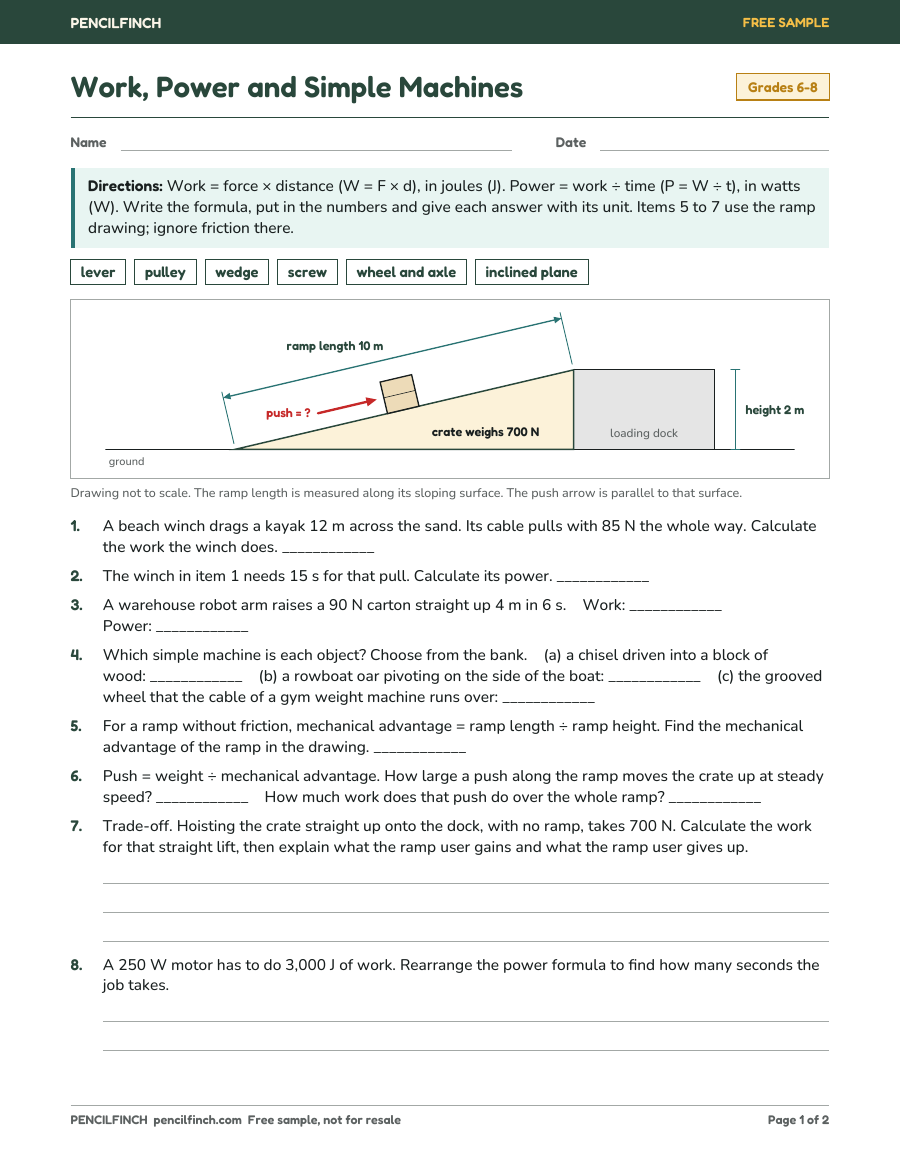 Download the free sample (PDF, 8 items with answer key)
Free to download, no email needed. These problems are not in the paid unit.
What is in the full unit
| Full unit | Simple Machines Science Lessons | Work, Power, Mechanical Advantage | Grades 6-8 |
|---|---|
| Pages | 28 pages in one PDF |
| Answer key | Included with Rubric |
| Standards | Connects to NGSS MS-PS3-2 and MS-ETS1-2 (no alignment claimed) |
| Grades | 6-8 |
| Price on TPT | USD 4.50 |
Get the full unit on TPT (USD 4.50)
- Lesson 1, work and power: work = force × distance along the force, newtons, meters and joules, the two no-work cases (no motion; force at right angles to the motion), power = work ÷ time in watts and kilowatts, and worked examples with whole and one-decimal numbers. Students judge four work-or-no-work cases, draw a work bar chart and test the claim "the heaviest load always means the most power" with simulated hoist data.
- Lesson 2, simple machines and mechanical advantage: input and output force, MA = output ÷ input, the ideal-machine trade-off (less force, more distance), the six simple machines, first-, second- and third-class levers with MA from the arms, fixed and movable pulleys and rope counting, inclined plane MA = length ÷ height, wedge, screw, wheel and axle, and ideal vs. real machines with friction. Students place a fulcrum for a target MA, count pulley ropes and test the claim "a longer ramp means less work" with simulated ramp data.
- Two Prove-it data tasks with CER. All trial data are simulated round-number examples and are labeled simulated on the pages; reference facts (joule, watt, horsepower, standard gravity) come from NIST SP 811 and HyperPhysics and are listed on the teacher source page.
- Explanation pages with two scene illustrations drawn in code (no AI image generator), force-and-motion diagrams, work and power bar charts, and lever, pulley and ramp figures; guided notes, reading checks, two pages of picture vocabulary cards and a 10-question quiz.
- Answer key for every question with scoring rules, completed notes, completed drawings and model CER answers; a two-lesson plan with an optional spring-scale desk demo, misconceptions and data notes for the teacher.
Pages from the unit
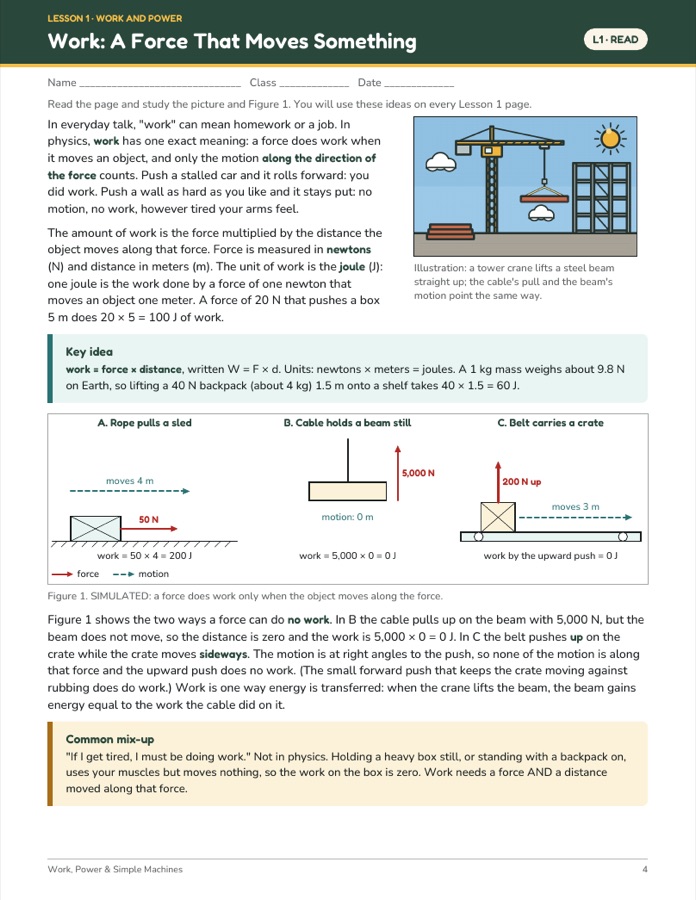
Page 4 of 28 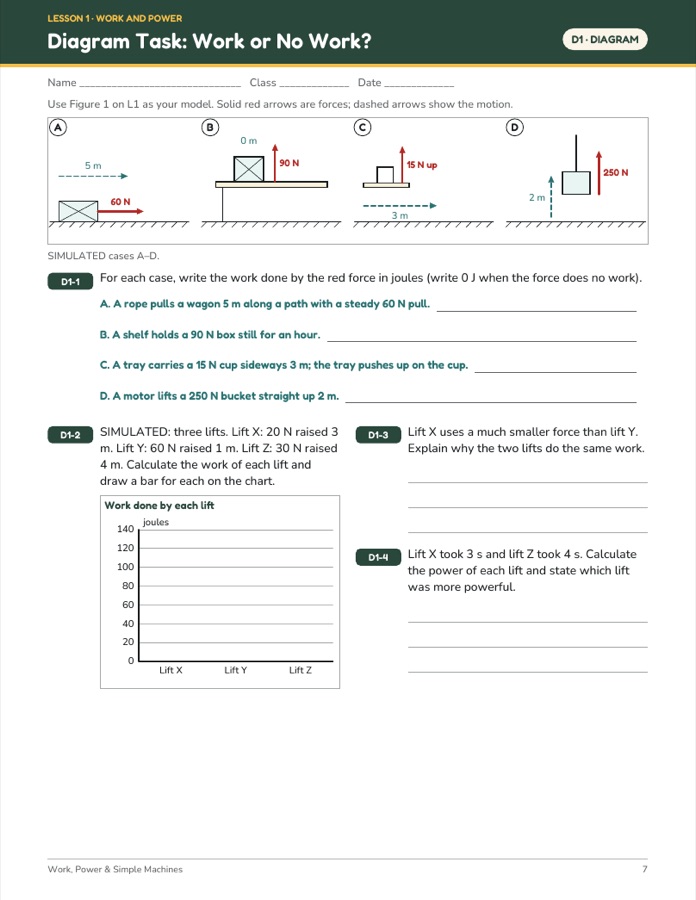
Page 7 of 28 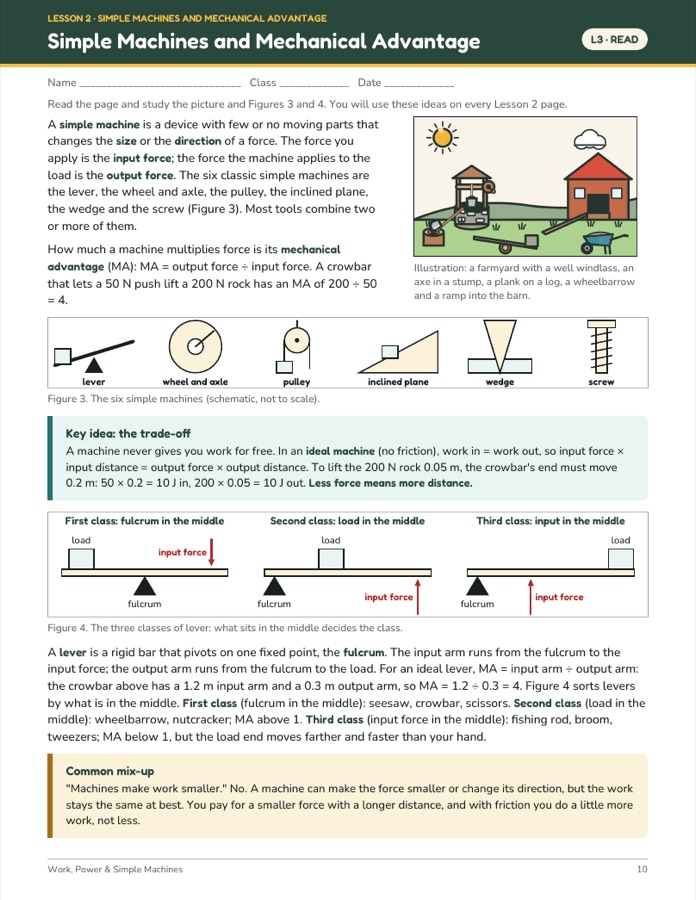
Page 10 of 28
Student pages are designed to print in black and white; all labels, numbers, arrows and charts are printed text and vector drawings.
How teachers use it
A simple machine is a device with few or no moving parts that changes the size or the direction of a force, and its mechanical advantage is the output force divided by the input force. Each lesson is planned for about 50 minutes. Students read the explanation pages, then work the guided notes, a diagram task and a reading check, and close with a Prove-it data task and a claim-evidence-reasoning write-up.
The free sample on this page is a one-page practice set on simple machines with an answer key. Its items are new and are not in the paid unit, so it works as a pre-check or a review without repeating the lesson pages.
The unit teaches work and power before the machines. Once students can compute work in joules, Lesson 2 can show the trade-off with numbers: an ideal machine lets you use less force over a longer distance, and the work stays the same. Students find mechanical advantage two ways, from the geometry (lever arms, rope segments, ramp length ÷ height) and from measured forces. The listed prerequisites are multiplying and dividing whole and one-decimal numbers and reading a table; a calculator is optional, and force in newtons is reviewed on the first page.
On standards, the listing is plain: no NGSS middle school performance expectation names work, power or simple machines, and the unit claims no alignment. It connects to MS-PS3-2 (a force between interacting objects can transfer energy) and to MS-ETS1-2 (evaluating competing solutions against criteria and constraints with measured numbers), and it supports CCSS MP.2 and 7.EE.3. Net force, F = m × a and energy formulas are not taught in this unit.
Before and after this topic
In the order used on this site, this page comes after Newton's third law and before electric circuits.
- Before this topicNewton's Third Law Worksheets for Grades 6-8 (Free Sample + Full Unit)
- After this topicElectric Circuits Worksheets for Grades 6-8 (Free Sample + Full Unit)
- All topics in this lineMiddle School Physical Science Worksheets (Grades 6-8)
Common questions
Is the free worksheet the same as a page from the paid unit?
No. The sample is written separately for this site, and its items are not in the unit. It uses the same page style, so you can see what the student pages look like before you buy.
Is this unit aligned to an NGSS performance expectation?
No. No NGSS middle school performance expectation names work, power or simple machines, and the unit claims no alignment. The standards shown on this page are connections: MS-PS3-2 and MS-ETS1-2.
How much math do students need?
Multiplying and dividing whole and one-decimal numbers, and reading a table. The main formulas are work = force × distance, power = work ÷ time and MA = output ÷ input, each with worked examples on the explanation pages. A calculator is optional.