Electric Circuits Worksheets for Grades 6-8 (Free Sample + Full Unit)
Download a free electric circuits worksheet for Grades 6-8 below: one student page with an answer key, ready to print. The full unit is two illustrated lessons, one on what a circuit needs and one on series and parallel circuits, with guided notes, diagram tasks, reading checks, two Prove-it data tasks, vocabulary cards and a quiz, for USD 4.50 on TPT.
Free sample worksheet
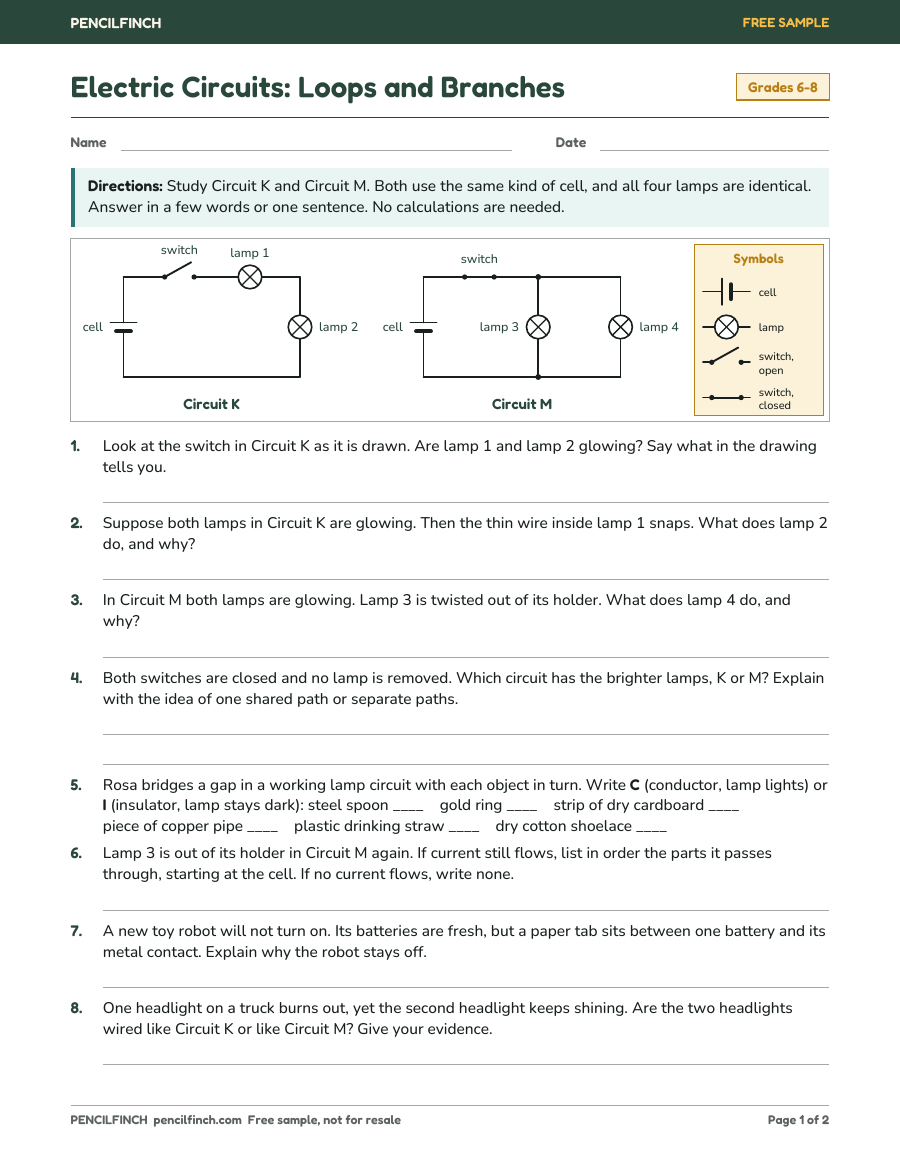 Download the free sample (PDF, 8 items with answer key)
Free to download, no email needed. These problems are not in the paid unit.
What is in the full unit
| Full unit | Electricity & Circuits Science Lessons | Series and Parallel | Grades 6-8 |
|---|---|
| Pages | 29 pages in one PDF |
| Answer key | Included with Rubric |
| Standards | Connects to NGSS MS-PS2-3, MS-PS3-5 and MS-ETS1-1 (not a claim of full alignment) |
| Grades | 6-8 |
| Price on TPT | USD 4.50 |
Get the full unit on TPT (USD 4.50)
- Lesson 1, what a circuit needs: charge and current, energy source, path, load and switch, closed and open circuits, short circuits, conductors and insulators explained by free electrons, resistance (why a filament glows), a tested-materials data table and circuit symbols. Students read and draw circuit diagrams, decide which of four circuits will light, and use class tester data plus real resistivity ratios to evaluate the claim "only shiny metals conduct".
- Lesson 2, series and parallel: one path vs branches, brightness and the push each lamp receives (qualitative current and voltage language only), what happens when one lamp is removed, home wiring in parallel, circuit breakers and overload, CPSC safety warnings, and the energy inventory of a bulb with real DOE figures. Students design a circuit where one switch controls one lamp, classify circuits, and use class brightness data to evaluate the claim "adding a bulb always dims the others".
- Two Prove-it data tasks with CER. The tester, lab-group and brightness tables are simulated and labeled that way; the resistivity ratios (HyperPhysics reference table) and lighting figures (U.S. Department of Energy) are real, and the safety statements follow the U.S. Consumer Product Safety Commission checklist.
- Explanation pages with two scene illustrations drawn in code (no AI image generator), pictorial and symbol circuit diagrams, a symbol chart, an energy inventory and a home-wiring diagram; guided notes, reading checks, two pages of picture vocabulary cards and a 10-question quiz.
- Answer key for every question with scoring rules, completed notes, completed diagrams and model CER answers; a two-lesson plan with an optional cells-and-bulbs investigation with classroom-safe rules, misconceptions and data notes for the teacher.
Pages from the unit
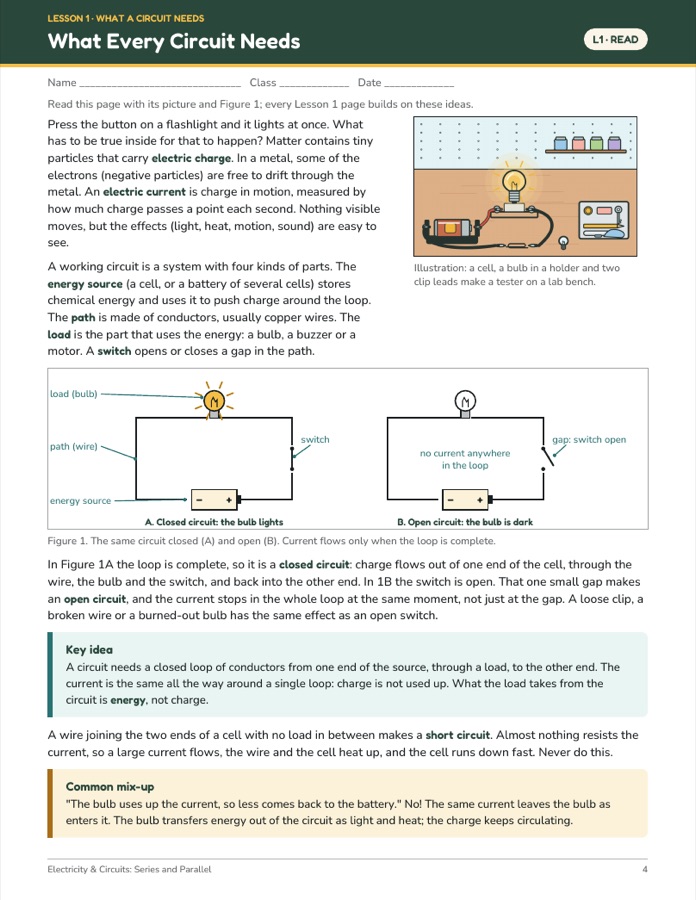
Page 4 of 29 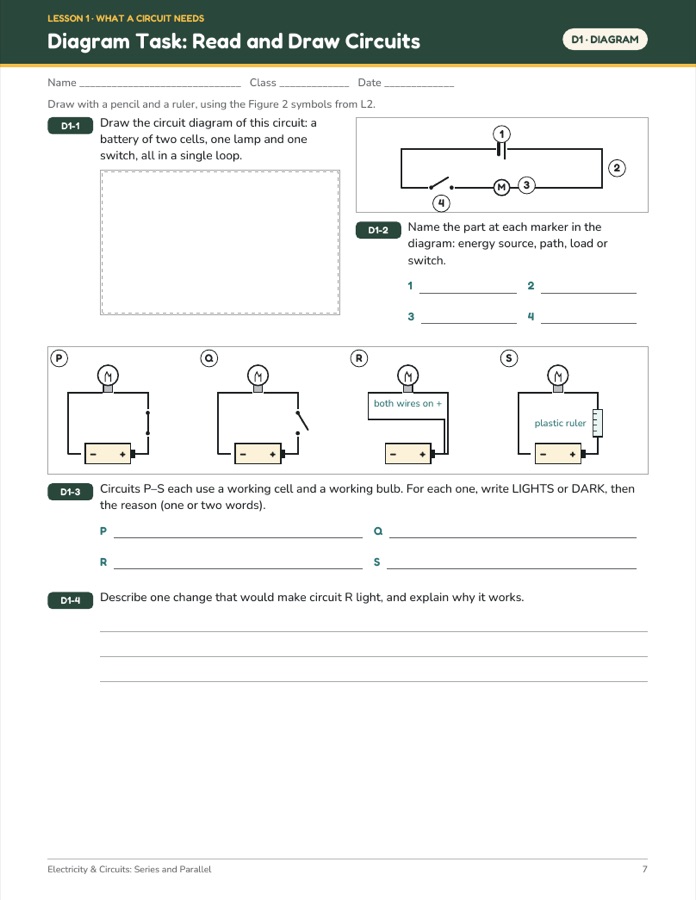
Page 7 of 29 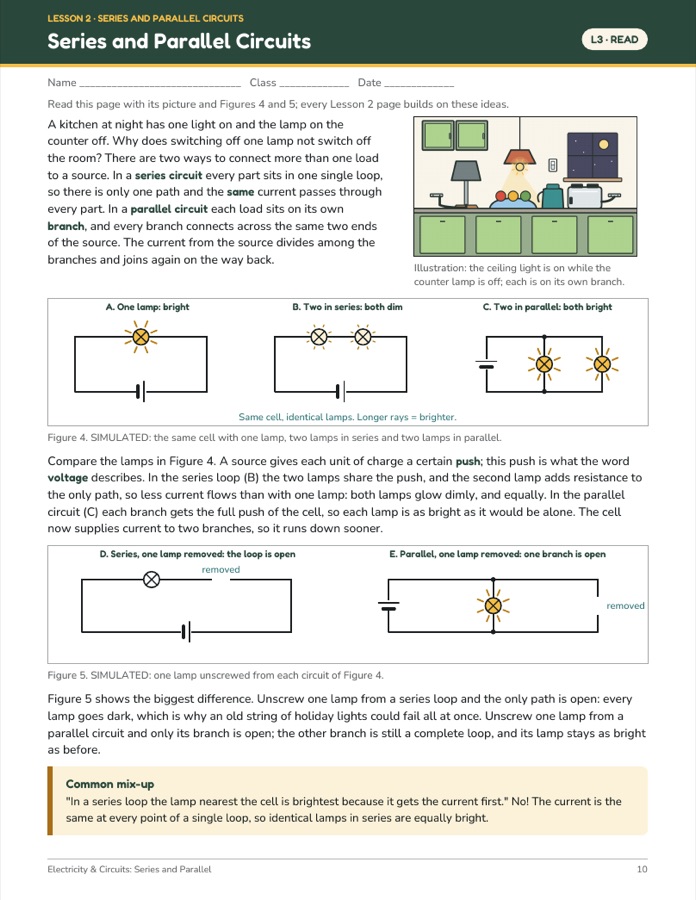
Page 10 of 29
Student pages are designed to print in black and white; all labels, symbols, diagrams and tables are printed text and vector drawings.
How teachers use it
A working electric circuit is a closed loop of conductors that runs from one end of an energy source, through a load such as a bulb, and back to the other end. Each lesson is planned for about 50 minutes. Students read the explanation pages, then work the guided notes, a diagram task and a reading check, and close with a Prove-it data task and a claim-evidence-reasoning write-up.
The free sample on this page is a one-page practice set on electric circuits with an answer key. Its items are new and are not in the paid unit, so you can use it as a warm-up or a quick check and still teach the full lessons afterward.
The unit is qualitative. Students compare brightness, trace paths and explain what happens when a lamp is removed, using the words current, push and path; there are no volts, amperes, Ohm's law or calculations. If your course needs circuit calculations, plan a separate resource for them. The listed prerequisites are reading a table and a labeled diagram, and the circuit words are introduced in the pages.
On standards, the listing says that no NGSS middle school performance expectation names electric circuits. The unit connects to MS-PS2-3 (asking questions about circuit data), MS-PS3-5 (energy inventories as evidence in arguments) and MS-ETS1-1 (criteria and constraints of a design problem), and to CCSS RST.6-8.7 (integrating text with diagrams and tables). That is not a claim of full alignment. Electric and magnetic forces, electromagnets and fields are not taught in this unit.
Before and after this topic
In the order used on this site, this page comes after simple machines, work and power, and before digital and analog signals.
- Before this topicSimple Machines Worksheets for Grades 6-8 (Free Sample + Full Unit)
- After this topicDigital and Analog Signals Worksheets, Grades 6-8 (Free Sample + Unit)
- All topics in this lineMiddle School Physical Science Worksheets (Grades 6-8)
Common questions
Is the free worksheet the same as a page from the paid unit?
No. The sample is written separately for this site, and its items are not in the unit. It uses the same page style, so you can see what the student pages look like before you buy.
Do I need circuit kits to teach the unit?
No. The lessons work fully without kits: students read and draw circuits on paper. The teacher plan describes an optional investigation with D or AA cells, flashlight bulbs and clip leads, with classroom-safe rules (cells only, never outlets or large batteries, no bare wire across a cell, disconnect if anything feels warm).
Does the unit include Ohm's law or circuit calculations?
No. It uses qualitative current and voltage language only, with no volts, amperes, Ohm's law or calculations. Students reason about brightness, paths and what happens when one lamp is removed.