Digital and Analog Signals Worksheets, Grades 6-8 (Free Sample + Unit)
Download a free digital and analog signals worksheet for Grades 6-8 below: one student page with an answer key, ready to print. The full unit is two illustrated lessons, one on how waves carry information and one on why digital signals are reliable, with guided notes, diagram tasks, reading checks, two Prove-it data tasks, vocabulary cards and a quiz, for USD 4.50 on TPT.
Free sample worksheet
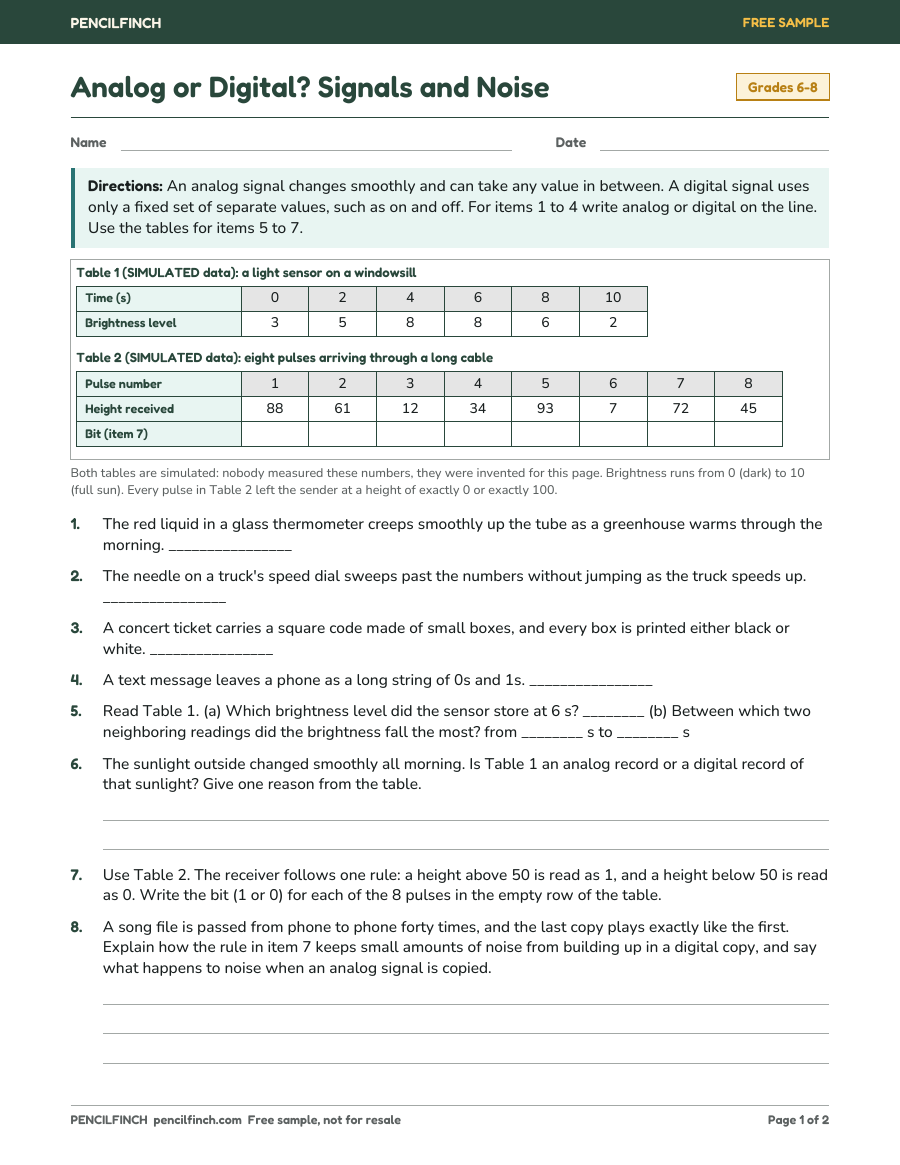 Download the free sample (PDF, 8 items with answer key)
Free to download, no email needed. These problems are not in the paid unit.
What is in the full unit
| Full unit | Digital & Analog Signals Science Lessons | Waves Carry Information | Grades 6-8 |
|---|---|
| Pages | 30 pages in one PDF |
| Answer key | Included with Rubric |
| Standards | NGSS MS-PS4-3 |
| Grades | 6-8 |
| Price on TPT | USD 4.50 |
Get the full unit on TPT (USD 4.50)
- Lesson 1, waves carry information: signal = wave + pattern; sound, light and radio as carriers; encoding and decoding; analog signals as continuous copies; digital signals as samples rounded to levels; a 3-bit code table for levels 0 to 7 (students match the table, no binary counting); pulses as bits; the sampling trade-off. Students plot a sample list, encode levels, and test whether sampling every 4 ms is good enough.
- Lesson 2, why digital is reliable: noise and why it cannot be removed from an analog signal; thresholds; regeneration; copies of copies; check bits that detect a flipped bit; where analog and digital signals are used; the limits of digital. Students decode a noisy signal, draw the regenerated pulses, apply the check-bit rule, and compare five generations of analog and digital copies.
- Two Prove-it data tasks with CER. All signal tables and graphs are simulated and labeled that way; real facts come from NIST (radio station WWVB) and NASA (Voyager 1 and the Deep Space Network), quoted with sources on the teacher pages.
- Explanation pages with two scene illustrations drawn in code (no AI image generator), signal and sampling graphs, a 3-bit code table, and noise and check-bit diagrams; guided notes, reading checks, two pages of picture vocabulary cards and a 10-question quiz.
- Answer key for every question with scoring rules, completed notes, completed graphs and model CER answers; a two-lesson plan with an optional flashlight-pulse warm-up, misconceptions and data notes for the teacher.
Pages from the unit
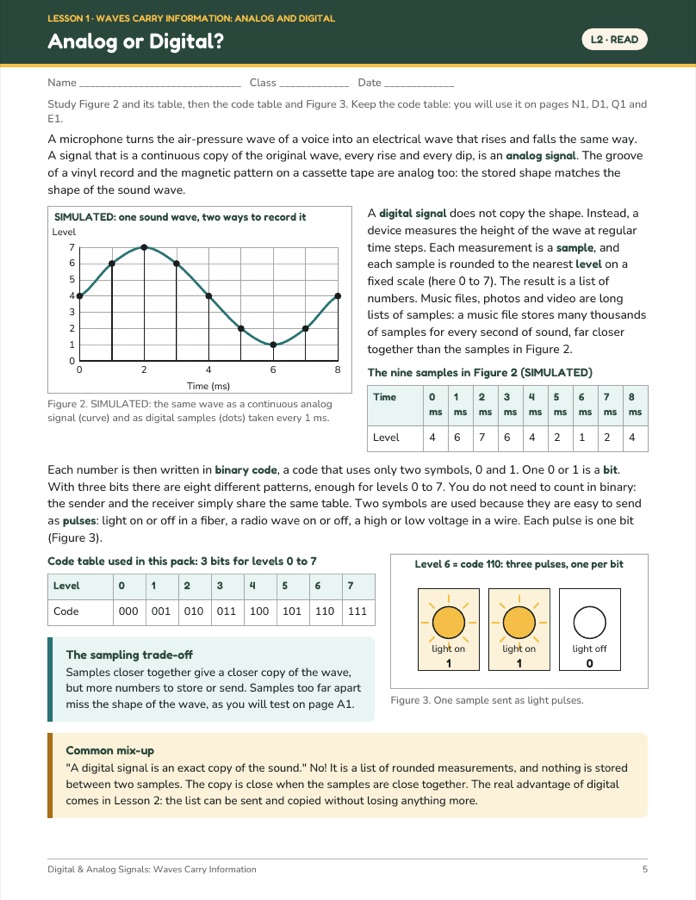
Page 5 of 30 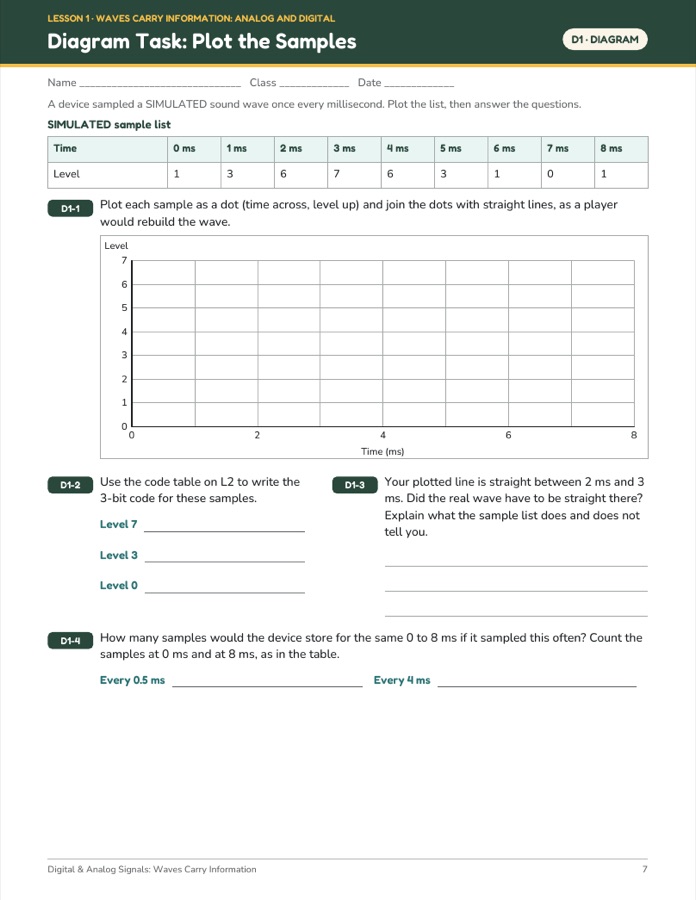
Page 7 of 30 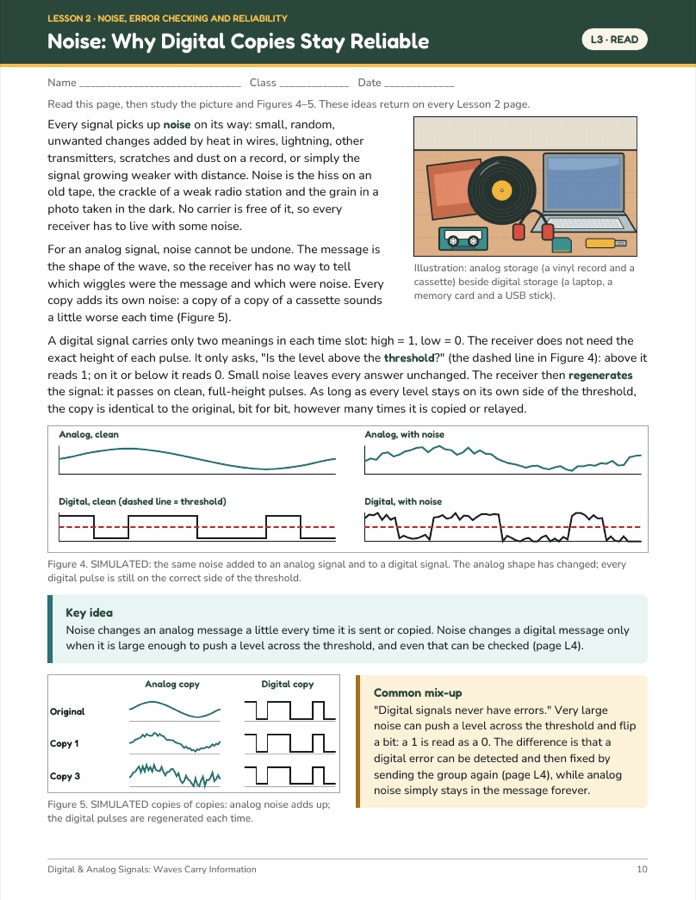
Page 10 of 30
Student pages are designed to print in black and white; all labels, numbers, codes, graphs and diagrams are printed text and vector drawings.
How teachers use it
An analog signal is a continuous copy of the original wave, while a digital signal is a list of samples of that wave, each rounded to a fixed level and sent as bits. Each lesson is planned for about 50 minutes. Students read the explanation pages, then work the guided notes, a diagram task and a reading check, and close with a Prove-it data task and a claim-evidence-reasoning write-up.
The free sample on this page is a one-page practice set on digital and analog signals with an answer key. Its items are new and are not in the paid unit, so it can open the topic or check it afterward without repeating the lesson pages.
The two lessons build one argument. Lesson 1 shows how a wave becomes a sample list and then pulses. Lesson 2 adds noise: an analog copy gets a little worse every time, while a digital receiver only asks whether each pulse is above or below a threshold and can regenerate a clean signal. Students then support the claim with evidence from signal tables and graphs. The listed prerequisites are reading a line graph and a table, and subtracting whole numbers and halves.
The unit supports NGSS MS-PS4-3 (integrate qualitative scientific and technical information to support the claim that digitized signals are a more reliable way to encode and transmit information than analog signals). It follows the assessment boundary: no binary counting and no device mechanisms. That is not a claim of full alignment. Wave properties such as amplitude, frequency, reflection and refraction are not taught in this unit.
Before and after this topic
In the order used on this site, this page comes after electric circuits and is the last physical science page so far.
- Before this topicElectric Circuits Worksheets for Grades 6-8 (Free Sample + Full Unit)
- All topics in this lineMiddle School Physical Science Worksheets (Grades 6-8)
Common questions
Is the free worksheet the same as a page from the paid unit?
No. The sample is written separately for this site, and its items are not in the unit. It uses the same page style, so you can see what the student pages look like before you buy.
Do students have to count in binary?
No. The unit uses a 3-bit code table for levels 0 to 7, and students match levels to codes in the table. No binary counting and no device mechanisms are required, which follows the MS-PS4-3 assessment boundary.
Is the signal data real?
All signal tables and graphs are simulated and are labeled as simulated. The reading uses real facts from NIST about radio station WWVB and from NASA about Voyager 1 and the Deep Space Network, with sources on the teacher pages.