How to Teach Electric Circuits in Middle School (Grades 6-8)
By the end of this topic, students should be able to trace a complete loop, say what moves around it and say what the lamp takes out of it. They usually arrive with a delivery picture, in which the battery sends electricity down a wire and the bulb uses it up. This note gives you the idea, two diagrams, three wrong ideas with replies, a board lesson and three check questions.
Printable for this topic: Electric Circuits Worksheets for Grades 6-8 (Free Sample + Full Unit) (free sample page and the full unit).
The idea in plain words
An electric circuit is an unbroken conducting path that leaves one terminal of a cell, passes through at least one device and returns to the cell's other terminal. Current is the flow of charge around that path. In a single loop, a break anywhere stops the flow everywhere.
The cell does not deliver the charge. Metal wires are full of electrons that are free to move before anything is connected. The cell works like a pump: it uses energy from chemical reactions to push that charge around the loop. In the lamp, the moving charge gives up energy as light and heat, then carries on to the cell.
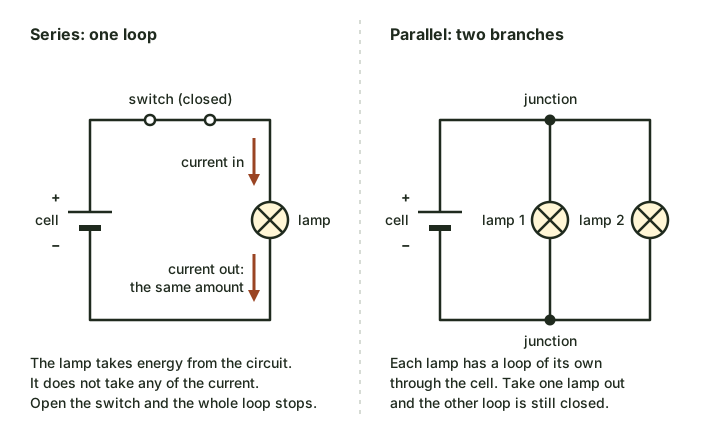
In a single loop, equal amounts of charge pass every point each second: before the lamp, after it and inside the cell. Charge cannot pile up in the lamp, so as much leaves as enters. A bicycle chain is a useful comparison: every link moves at once, no links are used up, and energy passes from the pedals to the wheel. In the parallel diagram, each lamp has its own route between the junctions, and the two branch currents add up to the current through the cell.
Three misconceptions and what to say
"The bulb burns up some of the electricity, so the wire after it carries less."
Physics education research lists this among the standard student models: current shrinks at each part it passes until none is left. It is tempting because something clearly does run out. Give the lamp numbers: "Ten units of charge go into the lamp every second and six come out. Where are the other four after one minute?" They would be piling up in the lamp. The lamp takes energy, not charge.
"One wire from the battery to the bulb is enough."
A lamp cord looks like a single wire, and students think of electricity as a delivery that ends at the bulb. Researchers report that some students cannot identify the two contacts on a bulb. Sketch a flashlight bulb and mark them: the tip at the bottom and the metal side of the base. Ask: "Charge comes in at the tip. Where does it go next?" It needs a way out and a way home.
"A battery is a tank of electricity that empties into the wires."
Everyday words teach this: a battery is "dead", a phone is "out of charge". What a cell stores is chemical energy. It moves charge that is already in the circuit and gives it energy. Say: "A used-up cell is not out of electrons. Its chemicals can no longer push."
A 10-minute mini-lesson
- (1 minute) Draw a cell symbol and a lamp symbol far apart on the board, with no wires. Ask: "How many wires must I draw before this lamp can light?"
- (2 minutes) Draw one wire from the cell to the lamp and stop. Ask: "Can charge keep moving if it has nowhere to go next?" Draw the second wire and trace the full loop.
- (2 minutes) Write "10 each second" beside the wire going into the lamp. Ask: "What number belongs on the wire coming out?" Take a vote: 10, fewer than 10, or 0. Then ask: "If it is fewer, where is the missing charge?" Write 10, and write "energy out: light and heat" next to the lamp.
- (2 minutes) Add a second lamp to the loop. Ask: "Compare the current between the lamps with the current after both." It does not change anywhere in the loop. With two lamps that current is smaller than before, so both are dimmer.
- (2 minutes) On paper, students redraw the circuit with the two lamps on separate branches. They cross out one lamp and check whether the other still has a closed loop.
- (1 minute) Exit question: "Name one thing a cell runs out of and one thing it does not."
Quick check
- In a one-loop circuit, 4 units of charge pass a point just before a buzzer each second. How many pass a point just after it, and what did the buzzer take?
- A student tapes one end of a wire to the top of a D cell and holds the other end against the tip of a flashlight bulb. Nothing else is connected. Will it light? What must be added?
- Mia says a dead AA cell has "no electricity left inside it". What has the cell actually run out of?
Answers: 1. 4 units each second. The buzzer took energy, not charge. 2. No: there is no way back to the cell. Add a second wire from the metal side of the bulb's base to the bottom of the cell. 3. Stored chemical energy. The charge is still there; nothing is left to push it.
Sources
- OpenStax, Physics, section 19.2 "Series Circuits": https://openstax.org/books/physics/pages/19-2-series-circuits
- OpenStax, Physics, section 19.3 "Parallel Circuits": https://openstax.org/books/physics/pages/19-3-parallel-circuits
- OpenStax, College Physics 2e, section 20.1 "Current": https://openstax.org/books/college-physics-2e/pages/20-1-current
- OpenStax, University Physics Volume 2, section 10.1 "Electromotive Force": https://openstax.org/books/university-physics-volume-2/pages/10-1-electromotive-force
- P. V. Engelhardt and R. J. Beichner, "Students' understanding of direct current resistive electrical circuits", American Journal of Physics 72 (2004), copy hosted by Kansas State University: https://web.phys.ksu.edu/papers/2004/englehardt-beichner-ajp-1-04.pdf
The full unit
Electricity & Circuits Science Lessons | Series and Parallel | Grades 6-8
29 pages, grades 6-8, answer key included with rubric. USD 4.50
Get the full unit on TPT (USD 4.50)
Next topics
- Before this topicSimple Machines Worksheets for Grades 6-8 (Free Sample + Full Unit)
- After this topicDigital and Analog Signals Worksheets, Grades 6-8 (Free Sample + Unit)
- All topics in this lineMiddle School Physical Science Worksheets (Grades 6-8)