Photosynthesis Worksheets for Grades 6-8 (Free Sample + Full Unit)
Download a free photosynthesis worksheet for Grades 6-8 below: one student page with an answer key, ready to print. The full unit is two illustrated lessons on photosynthesis and respiration, one on matter, energy and carbon and one on evidence from mass and gas, with guided notes, check pages, a worked carbon model, model repair, two invented data cases, a draw-and-explain task, a transfer case, an exit check and vocabulary cards, for USD 4.50 on TPT.
Free sample worksheet
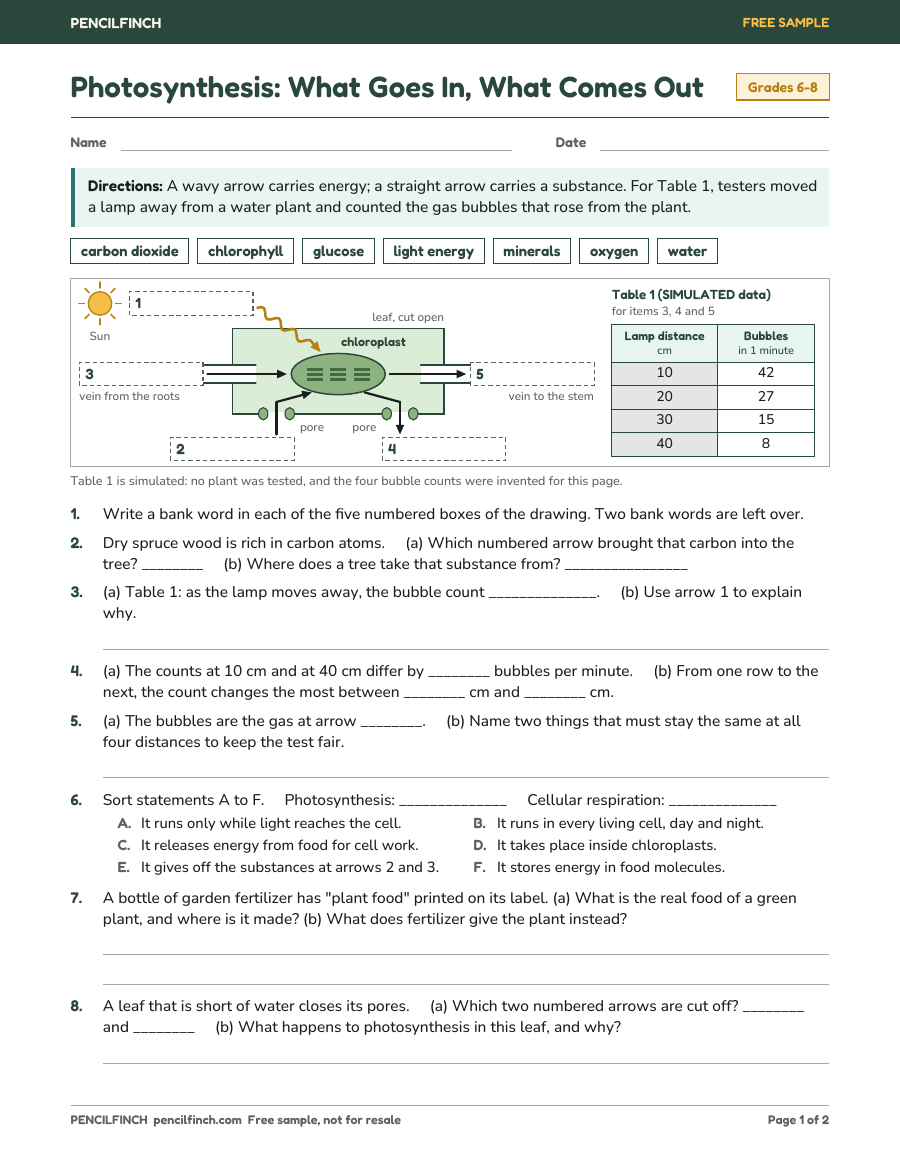 Download the free sample (PDF, 8 items with answer key)
Free to download, no email needed. These problems are not in the paid unit.
What is in the full unit
| Full unit | Photosynthesis & Respiration Science Lessons | Matter & Energy | Grades 6-8 |
|---|---|
| Pages | 28 pages in one PDF |
| Standards | Focused practice connected to NGSS MS-LS1-6 and MS-LS1-7 (not complete coverage of either performance expectation) |
| Grades | 6-8 |
| Price on TPT | USD 4.50 |
Get the full unit on TPT (USD 4.50)
- Lesson 1, matter, energy and carbon: the roles of CO2, water, minerals and light; photosynthesis compared with aerobic cellular respiration; following six carbon atoms through a worked partial model; repairing three common misconceptions.
- Lesson 2, evidence from mass and gas: dry mass, controlled comparisons and means; net versus separate CO2 uptake and release rates; drawing and explaining independently; a germinating seed in darkness; an exit check.
- A draw-and-explain task with a supported planner that can replace it, so the same task can be given with more support. The numerical cases are original invented classroom models, not measured research data.
- Explanation pages with labeled diagrams and a seedling illustration (the teacher pages say the seedling illustration was made with an AI image generator and reviewed; the diagrams are vector drawings), guided notes, check pages and eight picture vocabulary cards.
- Answer key for every question with scoring rules, completed notes and model drawings; two lesson plans, an eight-point rubric with scored examples, misconceptions, printing notes and standards connections for the teacher.
Pages from the unit
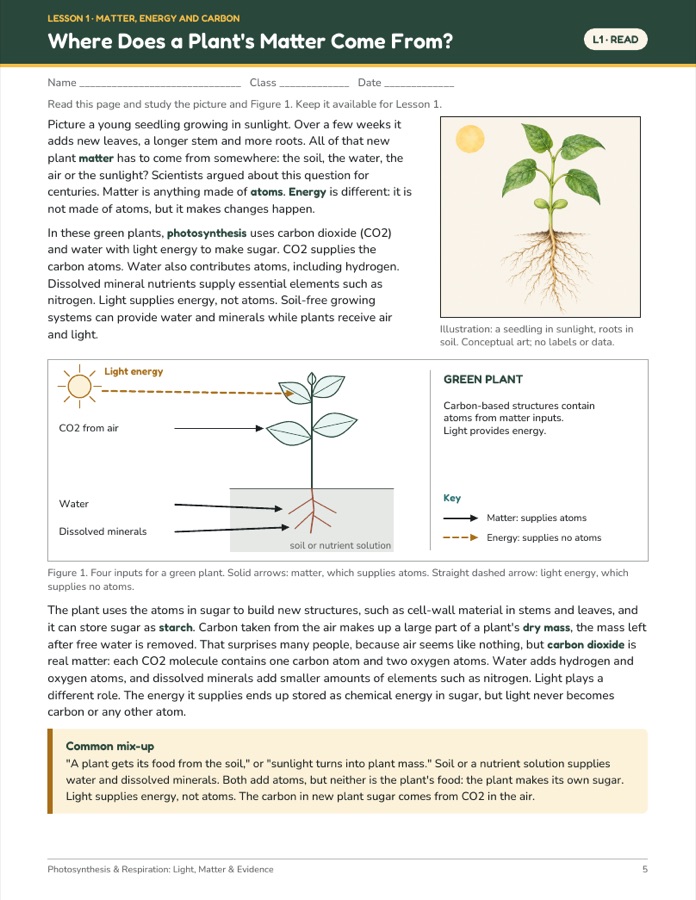
Page 5 of 28 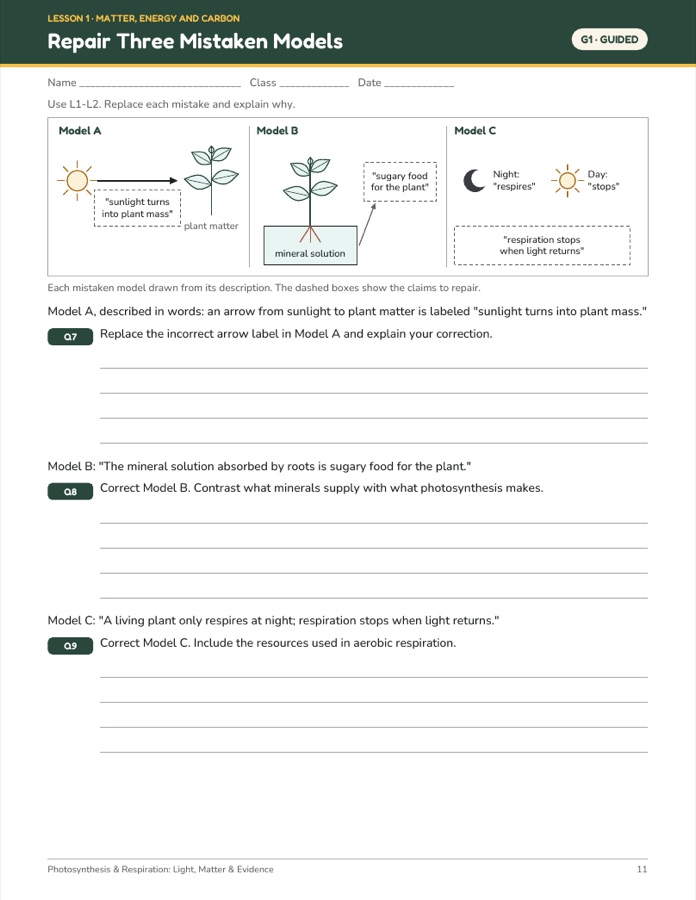
Page 11 of 28 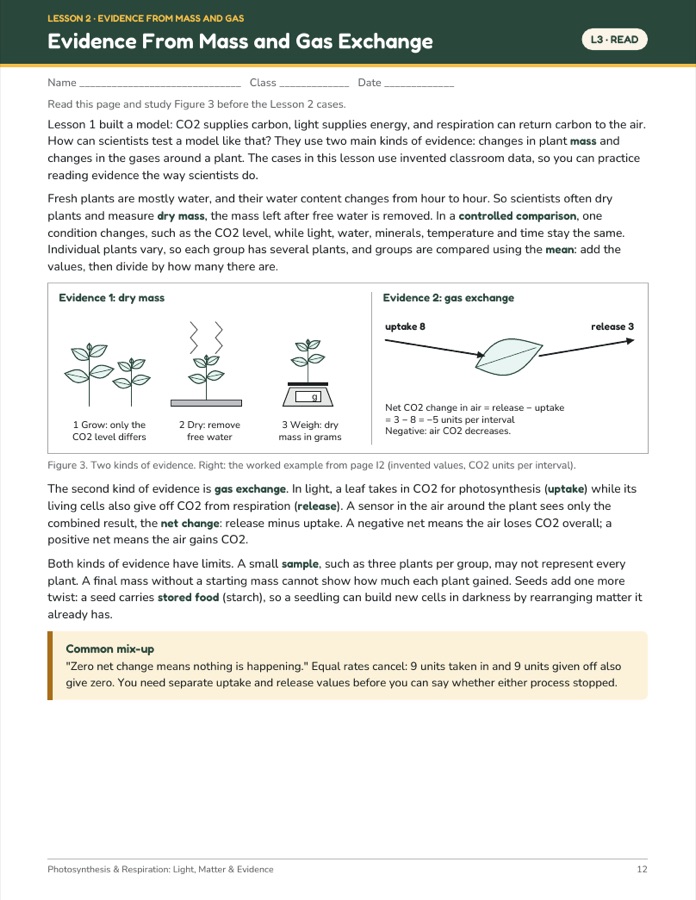
Page 12 of 28
Student pages are designed for grayscale: matter arrows and energy arrows look different, and all labels, numbers and diagrams are printed text and vector drawings.
How teachers use it
Photosynthesis is the process in which the green cells of a plant use carbon dioxide and water, with light energy, to make sugar and oxygen. Each lesson is planned for about 50 minutes. Students read the explanation pages and their labeled diagrams first, then work the guided notes and check pages, study a worked model, repair three mistaken models, read two invented data cases, and draw and explain a model of their own.
The free sample on this page is a one-page practice set on photosynthesis with an answer key. Its items are new and are not in the paid unit, so it can serve as a pre-check before the unit or a review after it without repeating anything students will see in the lessons.
The unit is built around one question: where does the carbon in a growing plant come from? Students keep matter and energy apart throughout. Carbon dioxide, water and dissolved minerals supply atoms; light supplies energy and no atoms. The carbon in new plant sugar comes from CO2 in the air, not from soil. Lesson 1 also sets photosynthesis beside aerobic cellular respiration and corrects the idea that plants respire only at night. Lesson 2 has students read dry-mass comparisons and CO2 uptake and release rates, including a case where the net change is zero while both processes are still running.
No laboratory equipment, online student account or other purchase is required. The unit gives focused practice connected to NGSS MS-LS1-6 (photosynthesis, matter and energy) and MS-LS1-7 (food matter, growth and respiration). It is not complete coverage of either performance expectation or a validated mastery test.
Before and after this topic
In the order used on this site, this page comes after human body systems and before food webs, which begin with the producers that make their own food.
- Before this topicHuman Body Systems Worksheets, Grades 6-8 (Free Sample + Full Unit)
- After this topicFood Webs Worksheets for Grades 6-8 (Free Sample + Full Unit)
- All topics in this lineMiddle School Life Science Worksheets (Grades 6-8)
Common questions
Is the free worksheet the same as a page from the paid unit?
No. The sample is written separately for this site, and its items are not in the unit. It uses the same page style, so you can see what the student pages look like before you buy.
Do students balance the chemical equation for photosynthesis?
No. The explanation pages give word summaries of photosynthesis and aerobic respiration and label them as not balanced equations. The worked model tracks carbon only: six CO2 molecules, six carbon atoms, one sugar molecule with six carbon atoms. The page says it is a carbon-only model, not a full reaction diagram.
Do I need plants, sensors or lab equipment?
No. Every data case is printed on the page and is an invented classroom model, labeled that way, so students practice reading evidence without running a lab. The listing states that no laboratory equipment is required.