Human Body Systems Worksheets, Grades 6-8 (Free Sample + Full Unit)
Download a free human body systems worksheet for Grades 6-8 below: one student page with an answer key, ready to print. The full unit is two illustrated lessons on how the digestive, respiratory, circulatory and excretory systems interact, with guided notes, check pages, a worked model, a modeling task, a simulated recovery-data page, vocabulary cards and an exit check, for USD 4.50 on TPT. A one-day body systems sub plan is sold separately for USD 4.50.
Free sample worksheet
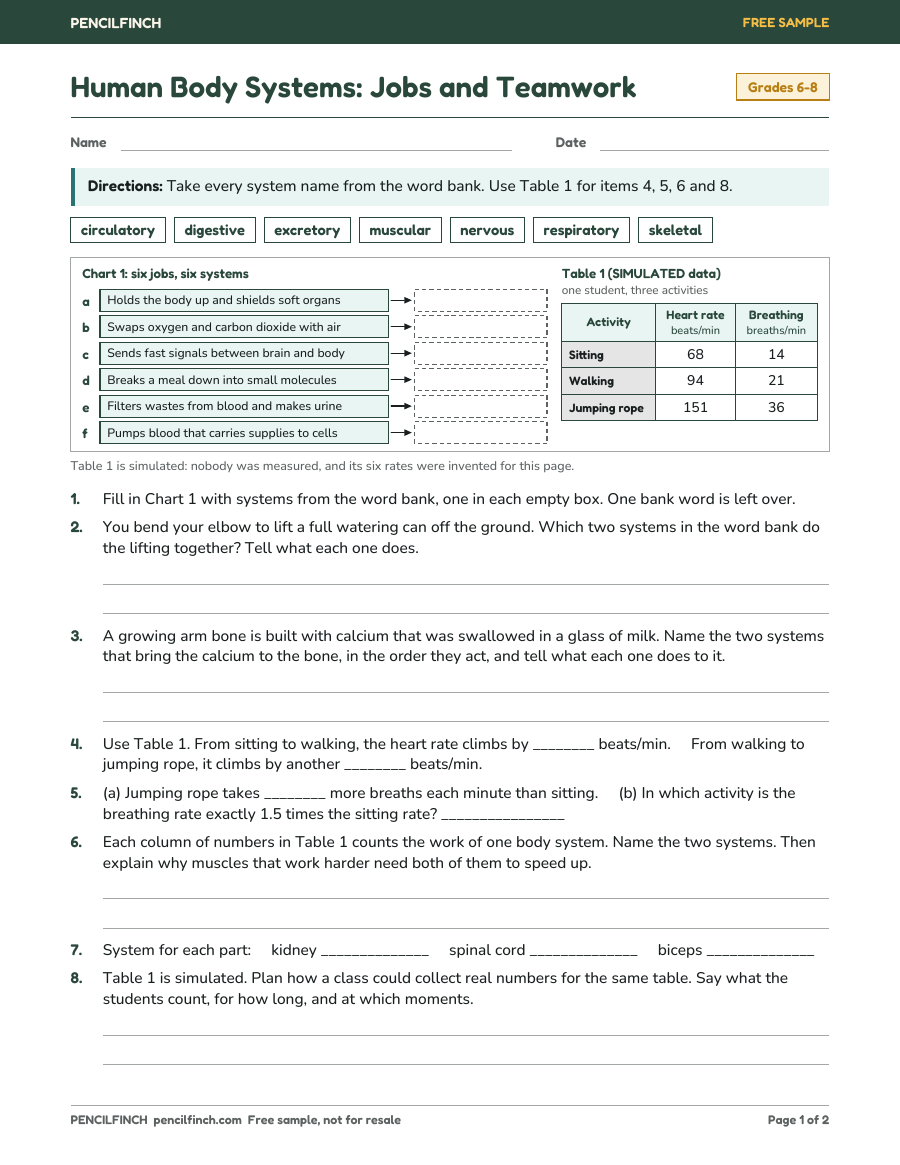 Download the free sample (PDF, 8 items with answer key)
Free to download, no email needed. These problems are not in the paid unit.
What is in the full unit
| Full unit | Human Body Systems Science Worksheets & Lessons | Interactions | Grades 6-8 |
|---|---|
| Pages | 27 pages in one PDF |
| Standards | Partial practice connected to NGSS MS-LS1-3 (no claim of full coverage) |
| Grades | 6-8 |
| Price on TPT | USD 4.50 |
Get the full unit on TPT (USD 4.50)
- Lesson 1, tracing matter between subsystems: subsystem roles, boundaries (air stays in air spaces; whole food does not enter blood), oxygen and carbon dioxide routes, nutrient absorption, dissolved wastes and urine, a worked model and a critique of models that skip transfers.
- Lesson 2, recovery data and evidence: a simulated breathing and pulse recovery table and graphs, observation versus explanation, co-variation versus causation, an independent hiker model, a change-in-one-subsystem transfer page and an exit check.
- A modeling task with a supported alternative page, so the same task can be given at two levels of support, plus a model-language reference page.
- Explanation pages with labeled diagrams and a torso illustration (the torso illustration was made with an AI image generator and reviewed; the diagrams are vector drawings), guided notes, check pages and eight picture vocabulary cards.
- Answer key for every question with rubrics, completed notes, a completed model and completed pathway frames; a two-lesson plan with misconceptions, scoring and scope notes for the teacher.
Goes with
-
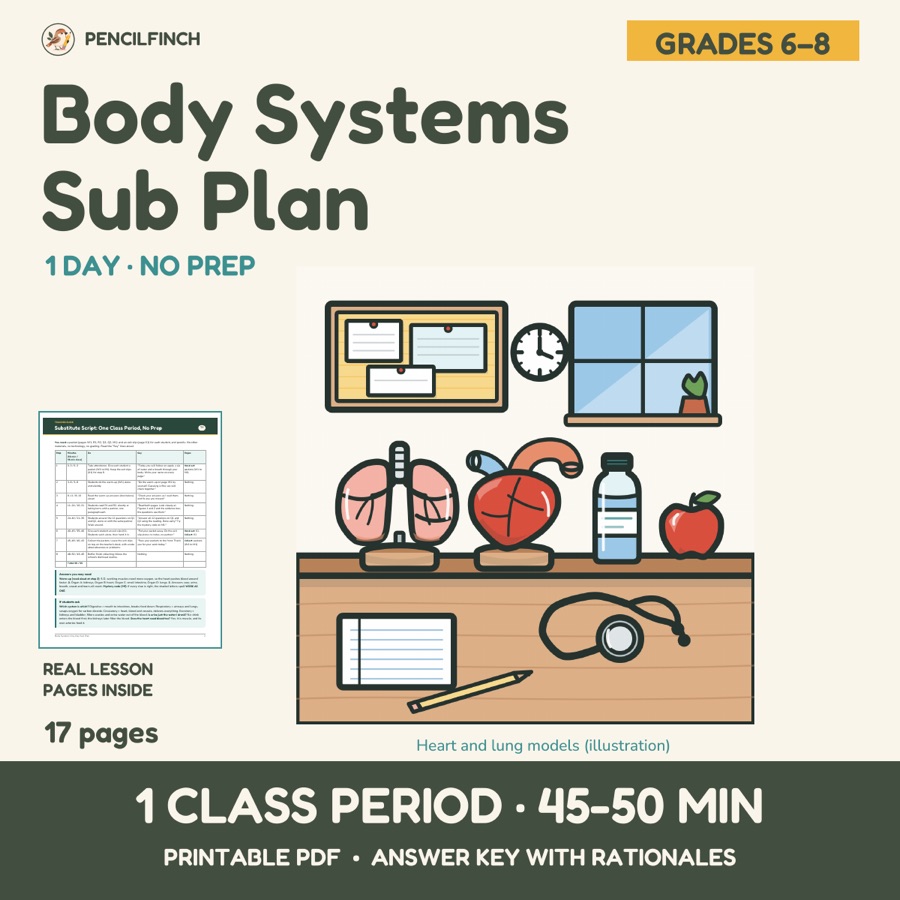
Body Systems Science Sub Plan | One Day, No Prep | Grades 6-8
Companion. 17 pages, grades 6-8, answer key included. USD 4.50
View on TPT
Pages from the unit
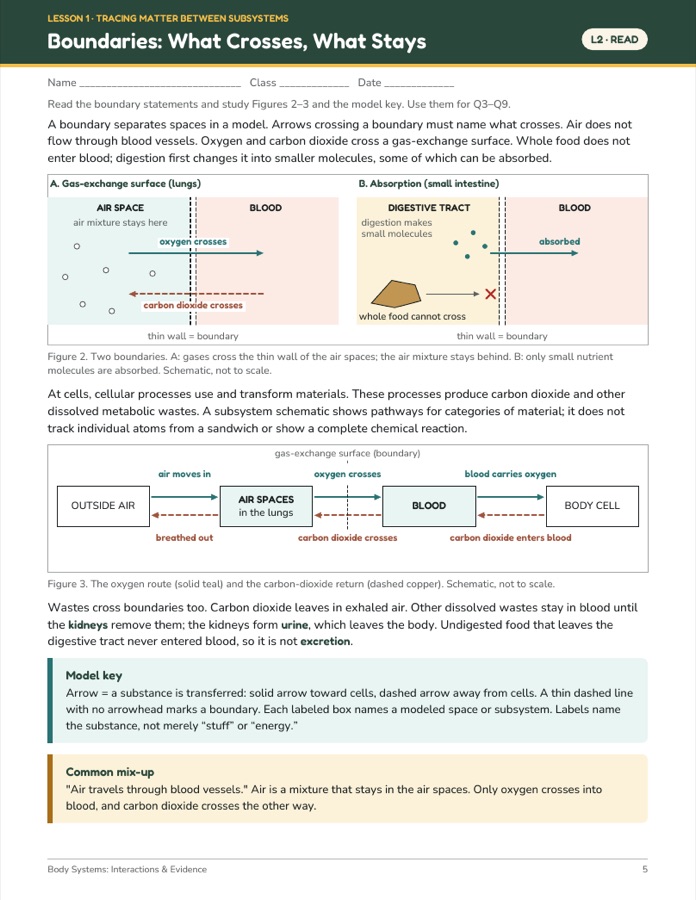
Page 5 of 27 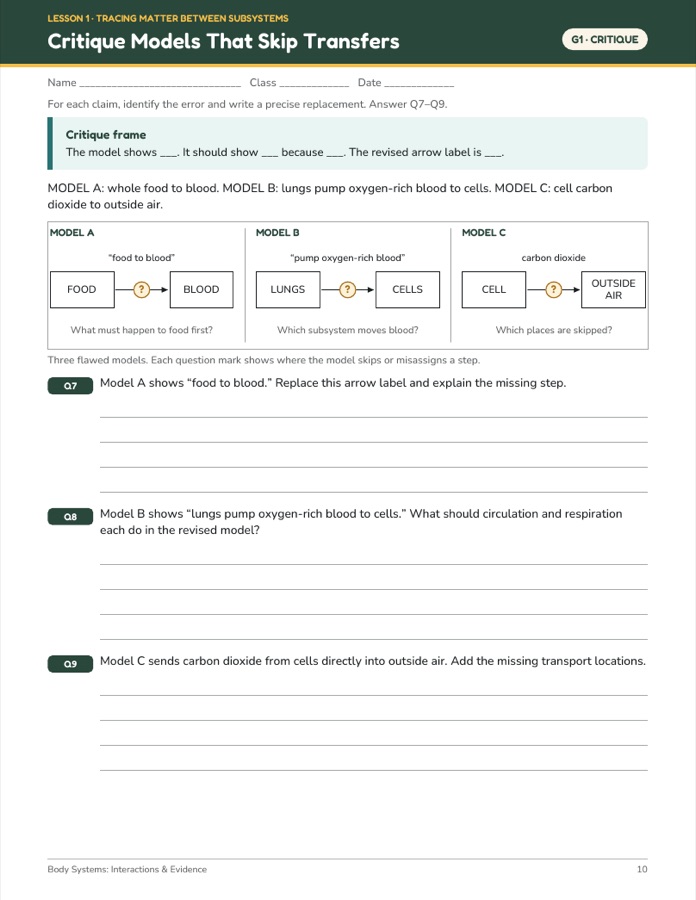
Page 10 of 27 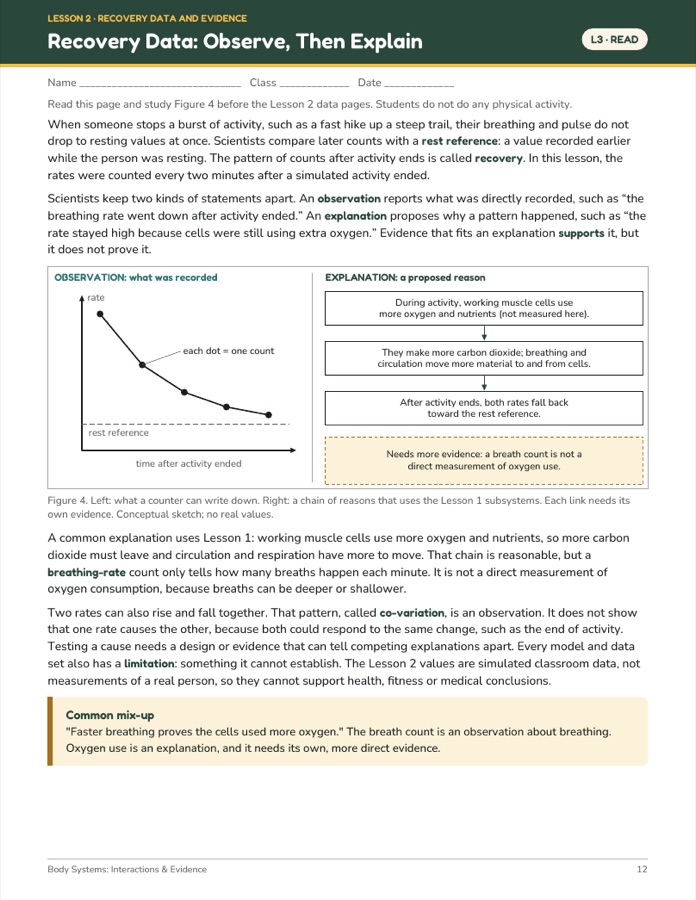
Page 12 of 27
Student pages are designed to print in black and white; all labels, numbers, graphs and diagrams are printed text and vector drawings. The diagrams are schematic and not to scale.
How teachers use it
A body system is a group of parts that does one major job for the whole organism, and the body's systems interact: each one affects and depends on the others. Each lesson is planned for about 45 to 50 minutes. Students read the explanation pages and their labeled diagrams first, then work the guided notes and check pages, study a worked model, critique models that skip transfers, and build and defend a model of their own.
The free sample on this page is a one-page practice set on human body systems with an answer key. Its items are new and are not in the paid unit, so it can serve as a pre-check before the unit or a review after it without repeating anything students will see in the lessons. The sample also touches the skeletal, muscular and nervous systems, which the unit does not teach.
The unit is about interactions, not a tour of organs. In Lesson 1 students trace what crosses from one subsystem to another: oxygen into the blood, carbon dioxide out, small nutrient molecules absorbed, dissolved wastes removed by the kidneys. In Lesson 2 they read a simulated table of breathing and pulse rates after activity and practice telling an observation from an explanation. Students need only basic table reading and whole-number subtraction, and no lab materials, medical measurements or exercise participation are required.
The unit provides partial practice connected to NGSS MS-LS1-3: students model how digestion, respiration, circulation and excretion interact, and use evidence to critique subsystem relationships. It does not claim full coverage of the performance expectation.
Before and after this topic
In the order used on this site, this page comes after the scientific method and before photosynthesis. The sub plan listed above covers the same four systems in one class period with a different reading, different figures and all-new questions.
- Before this topicScientific Method Worksheets for Grades 6-8 (Free Sample + Full Unit)
- After this topicPhotosynthesis Worksheets for Grades 6-8 (Free Sample + Full Unit)
- All topics in this lineMiddle School Life Science Worksheets (Grades 6-8)
Common questions
Is the free worksheet the same as a page from the paid unit?
No. The sample is written separately for this site, and its items are not in the unit. It uses the same page style, so you can see what the student pages look like before you buy.
Do students have to exercise or take their own pulse?
No. The recovery values are simulated and printed on the page; no exercise participation or medical measurements are required. The pages say that the simulated values are not real-person data and cannot support health, fitness or medical conclusions.
Which body systems does the unit cover?
Four: digestive, respiratory, circulatory and excretory, with body cells as the place where the transported materials are used. The unit follows the transfers between these four subsystems; it is not a tour of every organ system.