Scientific Method Worksheets for Grades 6-8 (Free Sample + Full Unit)
Download a free scientific method worksheet for Grades 6-8 below: one student page with an answer key, ready to print. The full unit is two illustrated lessons, one on questions, hypotheses and variables and one on trials, means and conclusions, with guided notes, diagram tasks, reading checks, two Prove-it data tasks with CER, vocabulary cards and a quiz, for USD 4.50 on TPT.
Free sample worksheet
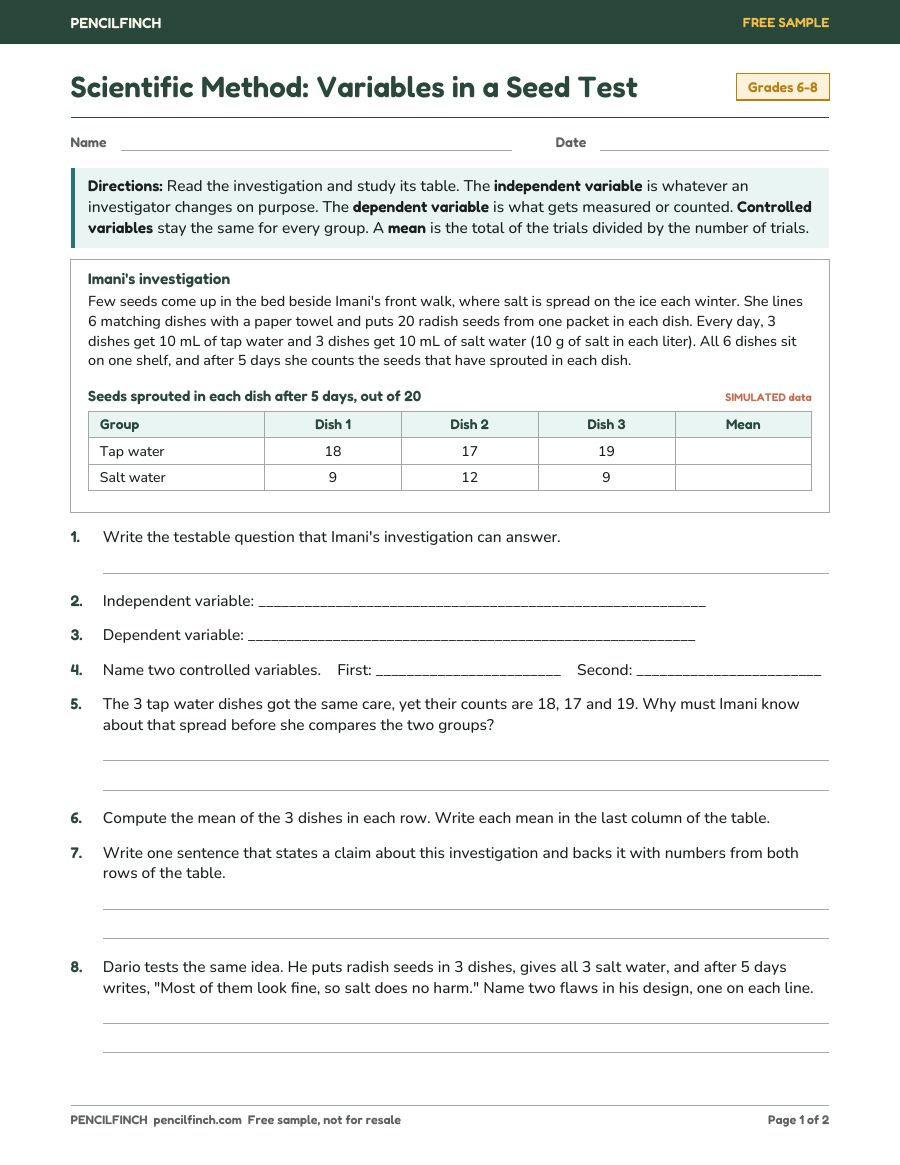 Download the free sample (PDF, 8 items with answer key)
Free to download, no email needed. These problems are not in the paid unit.
What is in the full unit
| Full unit | Scientific Method Science Worksheets & Lessons | Variables & CER | Grades 6-8 |
|---|---|
| Pages | 28 pages in one PDF |
| Standards | Supports and connects to the NGSS practices Planning and Carrying Out Investigations and Analyzing and Interpreting Data (not a claim of full alignment) |
| Grades | 6-8 |
| Price on TPT | USD 4.50 |
Get the full unit on TPT (USD 4.50)
- Lesson 1, questions, hypotheses and variables: observations and testable questions, the practices of science as a loop rather than a fixed list, hypotheses as testable explanations, "If ... then ..." predictions, independent, dependent and controlled variables, control groups and fair tests. Students plan a fair sugar-cube dissolving test and judge two teams' bounce tests.
- Lesson 2, trials, means and conclusions: repeated trials, the mean and the range, outliers, random and systematic sources of error, and claim-evidence-reasoning conclusions that say whether data support a hypothesis. Students find the errors in a bounce setup and use pendulum data to test the hypothesis "a heavier bob swings faster."
- Two Prove-it data tasks with CER. All data are simulated class data and are labeled that way.
- Explanation pages with three scene illustrations (made with an AI image generator and reviewed) and vector diagrams, guided notes, diagram tasks, reading checks, two pages of picture vocabulary cards (16 words) and a 10-question quiz.
- Answer key for every question with scoring rules, completed notes and diagrams, and model CER answers; a two-lesson plan with an optional pendulum demo, misconceptions, scoring and printing notes for the teacher.
Pages from the unit
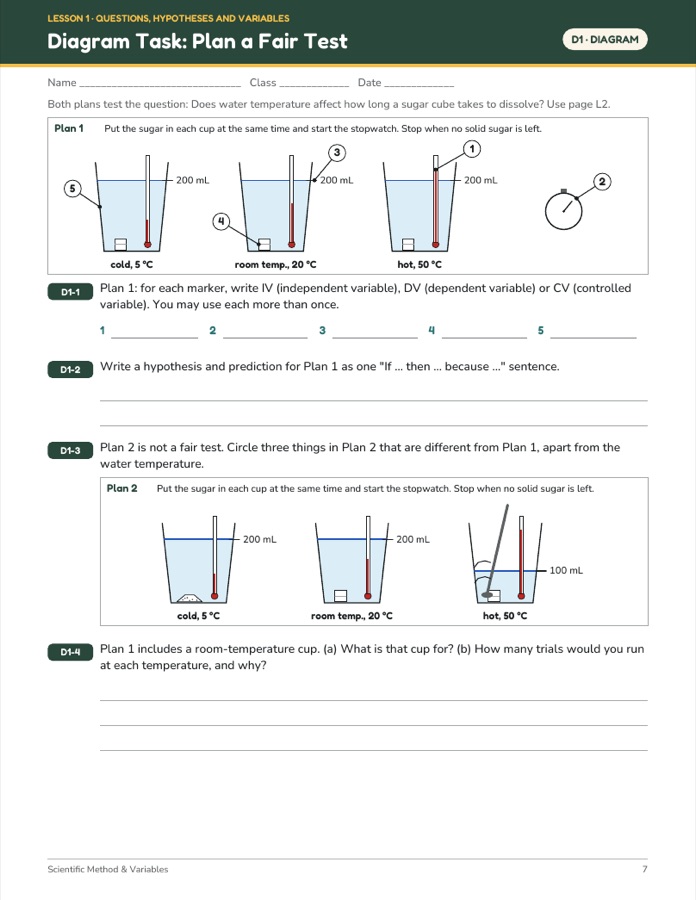
Page 7 of 28 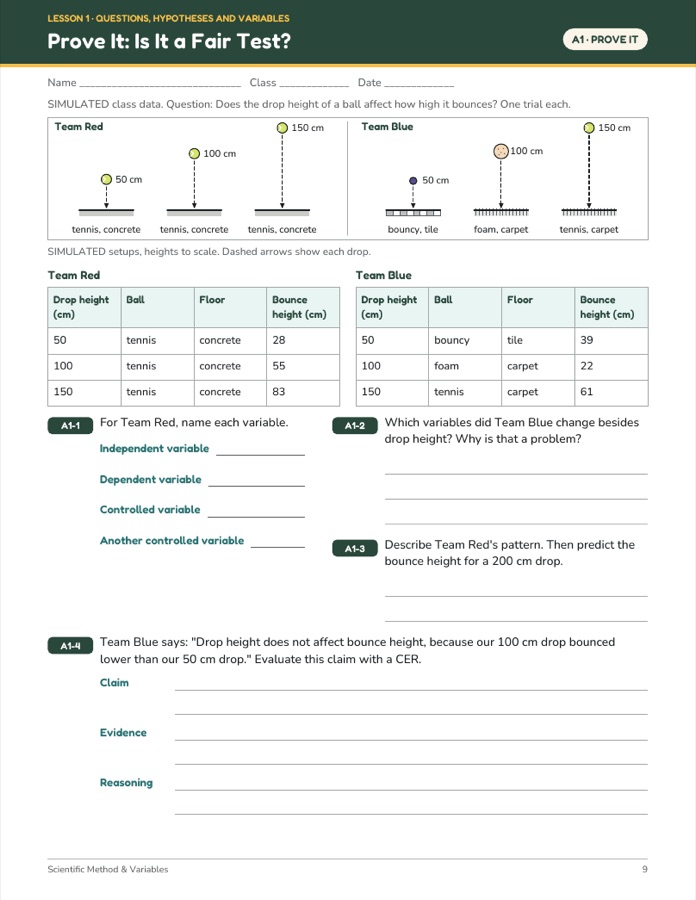
Page 9 of 28 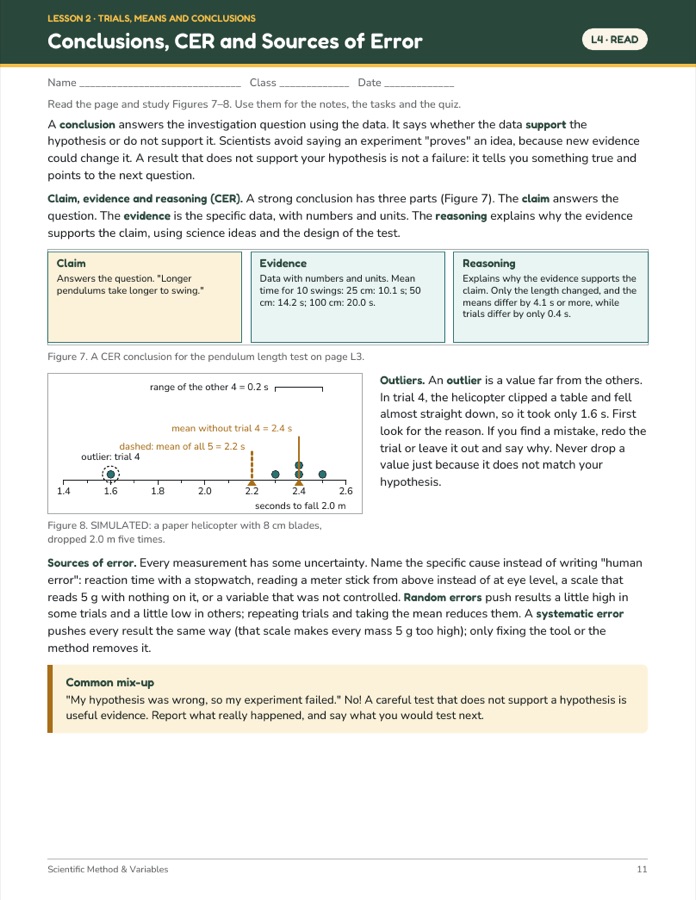
Page 11 of 28
Student pages are designed to work in black and white; all labels, numbers and data displays are printed text and vector drawings.
How teachers use it
The scientific method is the set of practices scientists use to answer a question with evidence: asking a testable question, proposing a hypothesis, planning a fair test, collecting and analyzing data, and sharing a conclusion. Each lesson is planned for about 50 minutes, and the teacher pages call the timings suggestions. Students read the explanation pages and their figures first, then work the guided notes, the diagram task and the reading check, and finish with a Prove-it data task and a claim-evidence-reasoning write-up.
The free sample on this page is a one-page practice set on the scientific method with an answer key. Its items are new and are not in the paid unit, so it can serve as a quick check before the unit or a review after it without repeating anything students will see in the lessons.
The unit treats the practices as a loop, not a recipe: a surprising result can send a scientist back to a new question or a better test. Lesson 1 separates the words students blend, such as hypothesis and prediction, or controlled variables and a control group. Lesson 2 asks why one careful trial is not enough, what to do with an outlier, and why data support a hypothesis and do not prove it. A result that does not support the hypothesis is treated as useful evidence, not as a failed experiment.
The listed prerequisites are adding and dividing decimals to find a mean (calculators optional) and reading a simple table. The unit supports and connects to the NGSS Science and Engineering Practices Planning and Carrying Out Investigations and Analyzing and Interpreting Data (grades 6-8). That is not a claim of full alignment.
Before and after this topic
In the order used on this site, this page opens the life science sequence as a science-skills starter, and human body systems comes next. The examples in the unit itself are physical ones: dissolving sugar, bouncing balls, paper helicopters and a pendulum.
- After this topicHuman Body Systems Worksheets, Grades 6-8 (Free Sample + Full Unit)
- All topics in this lineMiddle School Life Science Worksheets (Grades 6-8)
Common questions
Is the free worksheet the same as a page from the paid unit?
No. The sample is written separately for this site, and its items are not in the unit. It uses the same page style, so you can see what the student pages look like before you buy.
Do students run their own experiments?
Not in the printed lessons. Students analyze supplied class data, which are simulated and labeled that way. The teacher pages describe an optional pendulum demo of about 10 minutes, made from a string, a pencil, a paper clip and metal washers, if you want hands-on time.
Does the unit teach the scientific method as a fixed list of steps?
No. The first explanation page shows the practices as a loop with paths back to earlier steps, and the first misconception the teacher pages list is "the scientific method is one fixed list of steps." Students still learn each part by name, from testable question to conclusion.