Food Webs Worksheets for Grades 6-8 (Free Sample + Full Unit)
Download a free food web worksheet for Grades 6-8 below: one student page with an answer key, ready to print. The full unit is two illustrated lessons, one on building a food web and one on evidence and ecosystem change, with guided notes, a worked diagram, guided repairs, model space, independent writing, a transfer task, an exit check and picture vocabulary cards, for USD 4.50 on TPT.
Free sample worksheet
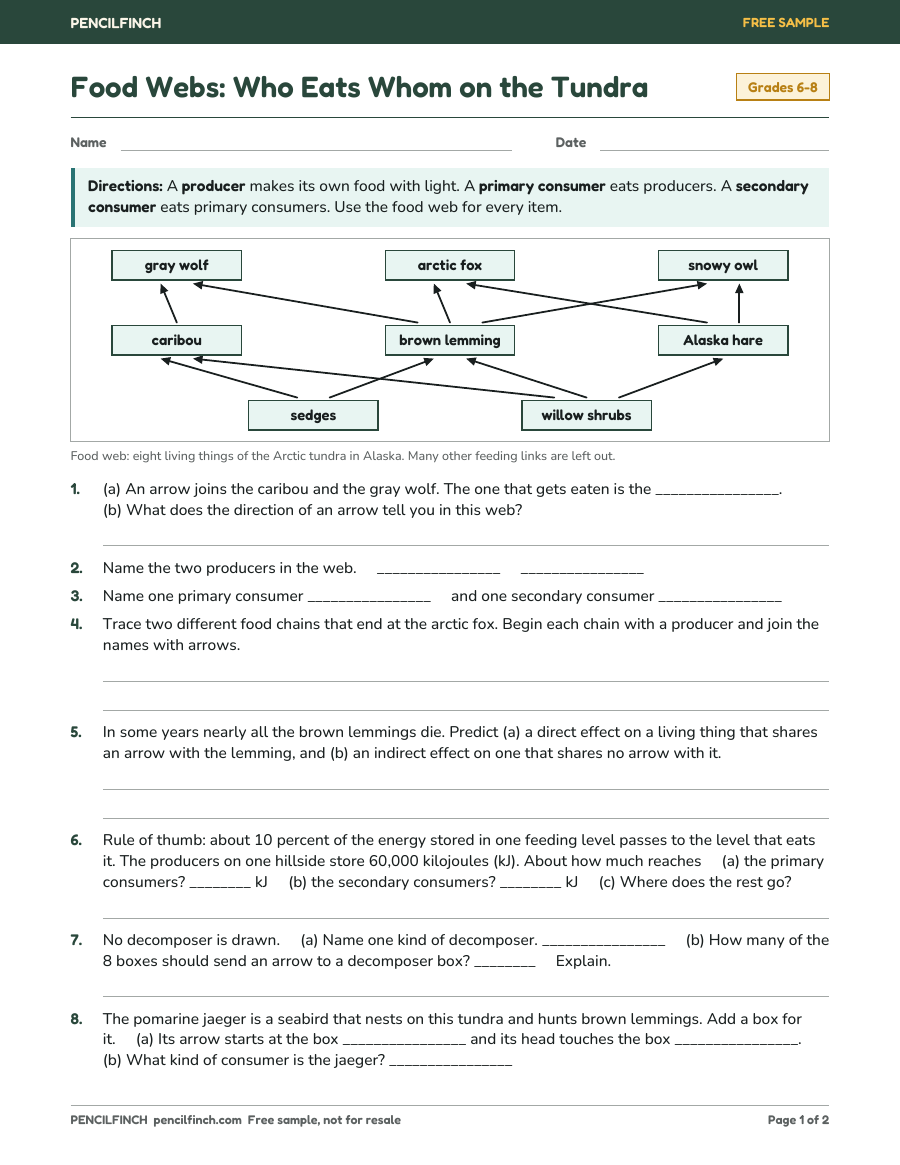 Download the free sample (PDF, 8 items with answer key)
Free to download, no email needed. These problems are not in the paid unit.
What is in the full unit
| Full unit | Food Webs Science Lessons | Energy Flow & Ecosystem Change | Grades 6-8 |
|---|---|
| Pages | 30 pages in one PDF |
| Standards | Focused NGSS MS-LS2-3 modeling practice with CCSS RST.6-8.7 and RST.6-8.8 practice (not full NGSS alignment; no whole-standard mastery claim) |
| Grades | 6-8 |
| Price on TPT | USD 4.50 |
Get the full unit on TPT (USD 4.50)
- Lesson 1, build the food web: students read a pond model, learn what a food arrow shows, connect living and nonliving parts, distinguish nutrient cycling from energy flow, trace two food pathways and build a food web from feeding rules.
- Lesson 2, evidence and ecosystem change: students compare a prediction with new observations, and explain what the evidence can and cannot establish, qualifying conclusions from limited observations.
- Each lesson opens with an illustrated explanation page and labeled diagrams. The two illustrations were made with an AI image generator and reviewed; the diagrams are vector drawings.
- Guided notes, a worked diagram, guided repairs, a reusable reference page, a supported alternative for the independent writing task, a transfer task, an exit check and a picture-vocabulary page. All feeding rules and observations are original simplified classroom models, not universal species diets or field data.
- Answer key for every question with completed notes and completed model drawings; teacher pages with two suggested 50-minute lessons, an 8-point rubric, full-credit and common-error examples and reteaching guidance.
Pages from the unit
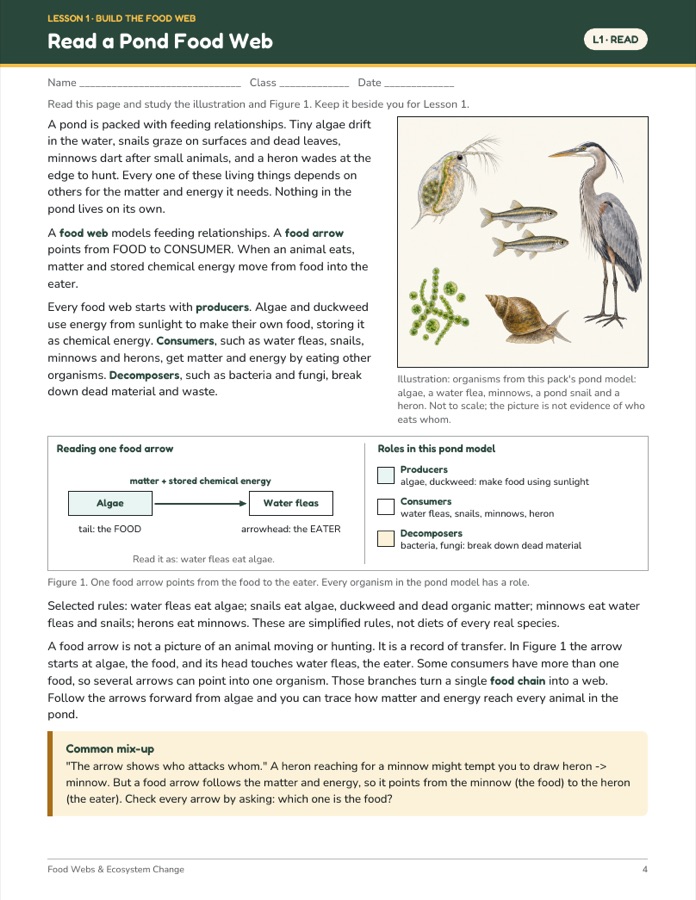
Page 4 of 30 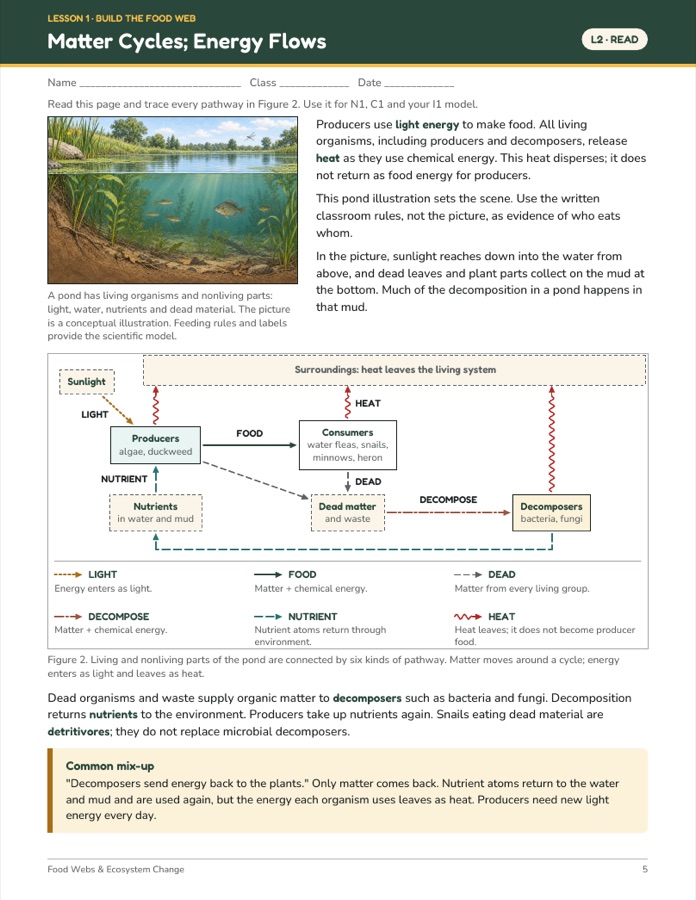
Page 5 of 30 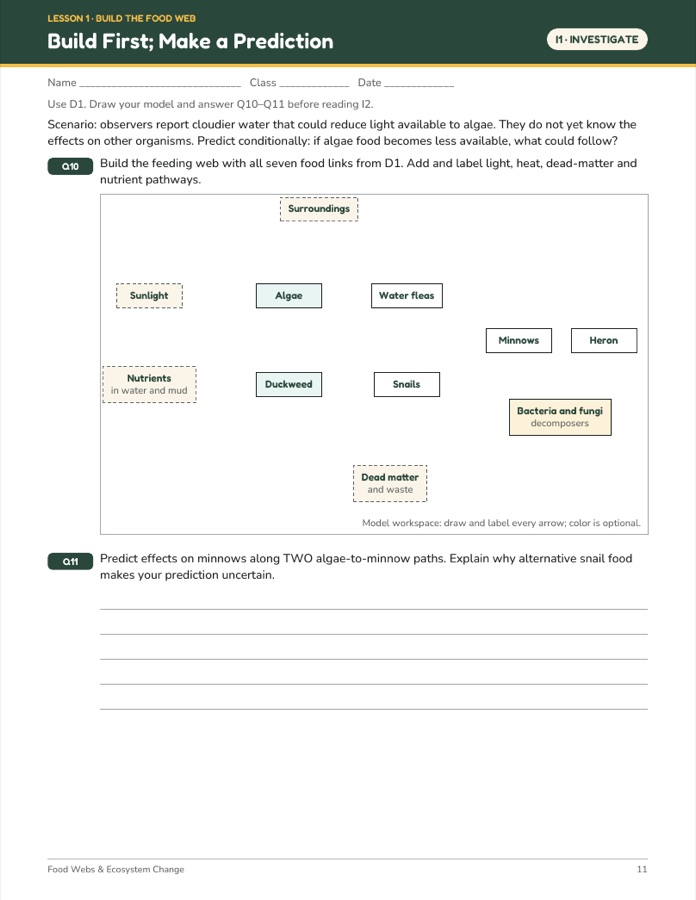
Page 11 of 30
Student pages work in grayscale; the labels, arrows and diagrams are printed text and vector drawings. The feeding rules, not the pictures, are the evidence of who eats whom, and the pages say so.
How teachers use it
A food web is a model of the feeding relationships in an ecosystem, in which each arrow points from the food to the organism that eats it. Two 50-minute lessons are suggested; adjust the drawing and writing time for your class. Students read the explanation pages first, then work the guided notes and a check page, trace a worked model, repair three flawed drawings, build the web themselves and make a prediction, and in Lesson 2 test that prediction against new observations.
The free sample on this page is a one-page practice set on food webs with an answer key. Its items are new and are not in the paid unit, so it can serve as a pre-check before the unit or a review after it without repeating anything students will see in the lessons.
The unit goes beyond arrow direction. The pond model has producers (algae and duckweed), consumers (water fleas, snails, minnows and a heron) and decomposers (bacteria and fungi), and students add the nonliving parts: sunlight, nutrients in water and mud, dead matter and the surroundings. They show that matter cycles, since nutrient atoms return to producers, while energy enters as light and leaves as heat. In Lesson 2 they read a small table of invented pond observations and practice careful wording: a pattern can be consistent with a mechanism without proving it.
No lab equipment or online student account is needed. The listing describes the standards connection as focused MS-LS2-3 modeling practice, not full NGSS alignment, with RST.6-8.7 practice (combining written rules and diagrams) and RST.6-8.8 practice (distinguishing observations, reasoned mechanisms and speculation). It makes no whole-standard mastery claim.
Before and after this topic
In the order used on this site, this page comes after photosynthesis, the process that makes the food at the start of every food web here, and is the last life science page so far.
- Before this topicPhotosynthesis Worksheets for Grades 6-8 (Free Sample + Full Unit)
- All topics in this lineMiddle School Life Science Worksheets (Grades 6-8)
Common questions
Is the free worksheet the same as a page from the paid unit?
No. The sample is written separately for this site, and its items are not in the unit. It uses the same page style, so you can see what the student pages look like before you buy.
Which ecosystem does the unit use?
A pond: algae, duckweed, water fleas, snails, minnows and a heron, with bacteria and fungi as decomposers. A transfer task near the end moves the same reasoning to a stream. The feeding rules are simplified classroom rules, and the pages say they are not the diets of every real species.
Are the observations real field data?
No. The observations in Lesson 2 are invented classroom data and are labeled "not field data" on the page. They are there so students can practice comparing a prediction with evidence and stating what the evidence cannot establish.