Moon Phases Worksheets for Grades 6-8 (Free Sample + Full Unit)
Download a free moon phases worksheet for Grades 6-8 below: one student page with an answer key, ready to print. The full unit is three illustrated lessons on the Earth-Sun-Moon model, Moon phases, Eclipses and Seasons, with guided notes, diagram tasks, reading checks, three Prove-it data tasks, vocabulary cards and a quiz, for USD 4.50 on TPT. A one-day moon phases and eclipses sub plan is sold separately for USD 4.50.
Teaching notesHow to Teach Moon Phases in Middle School (Grades 6-8)
Free sample worksheet
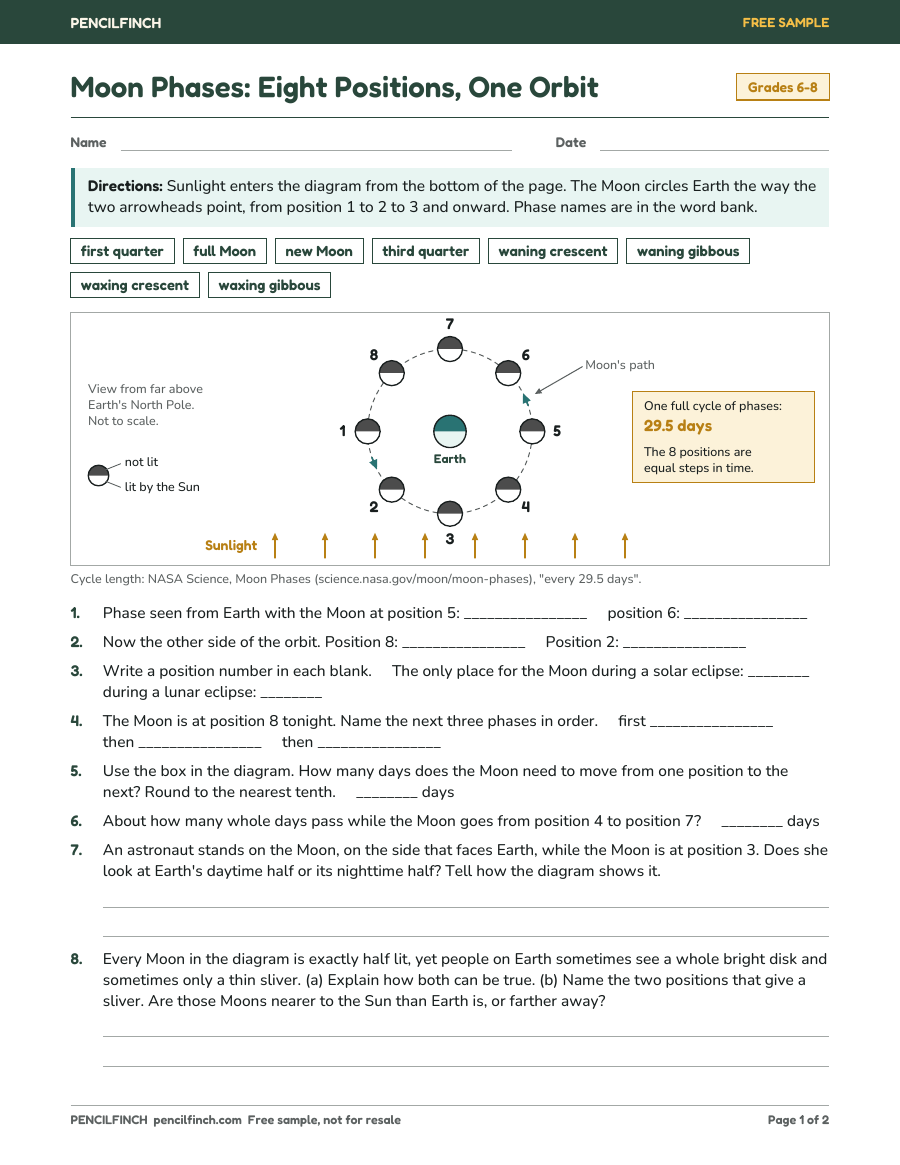 Download the free sample (PDF, 8 items with answer key)
Free to download, no email needed. These problems are not in the paid unit.
What is in the full unit
| Full unit | Moon Phases, Eclipses & Seasons Science Lessons | Earth-Sun-Moon | Grades 6-8 |
|---|---|
| Pages | 38 pages in one PDF |
| Standards | NGSS MS-ESS1-1 |
| Grades | 6-8 |
| Price on TPT | USD 4.50 |
Get the full unit on TPT (USD 4.50)
- Lesson 1, Moon phases: why the Moon is always half-lit, the eight phases in order, waxing and waning (Northern Hemisphere view), and a simulated Moon-observation log.
- Lesson 2, Eclipses: solar vs. lunar eclipses, umbra and penumbra, eclipse eye safety, and why eclipses do not happen every month (the Moon's orbit is tilted about 5°), with a 12-full-Moon data task.
- Lesson 3, Seasons: Earth's 23.4° tilt, solstices and equinoxes, direct vs. spread-out sunlight and day length, and a data task that refutes the "closer to the Sun" idea.
- Three Prove-it data tasks with CER. The data are simulated or calculated from simple models and are labeled that way.
- Explanation pages with labeled diagrams on every page and four scene illustrations (the scene illustrations were made with an AI image generator and reviewed; the diagrams are vector drawings), guided notes, diagram tasks, reading checks, two pages of picture vocabulary cards and a 10-question quiz.
- Answer key for every question with scoring rules, completed notes, completed diagrams and model CER answers; a three-lesson plan with an optional lamp-and-ball demo, misconceptions and printing notes for the teacher.
Goes with
-
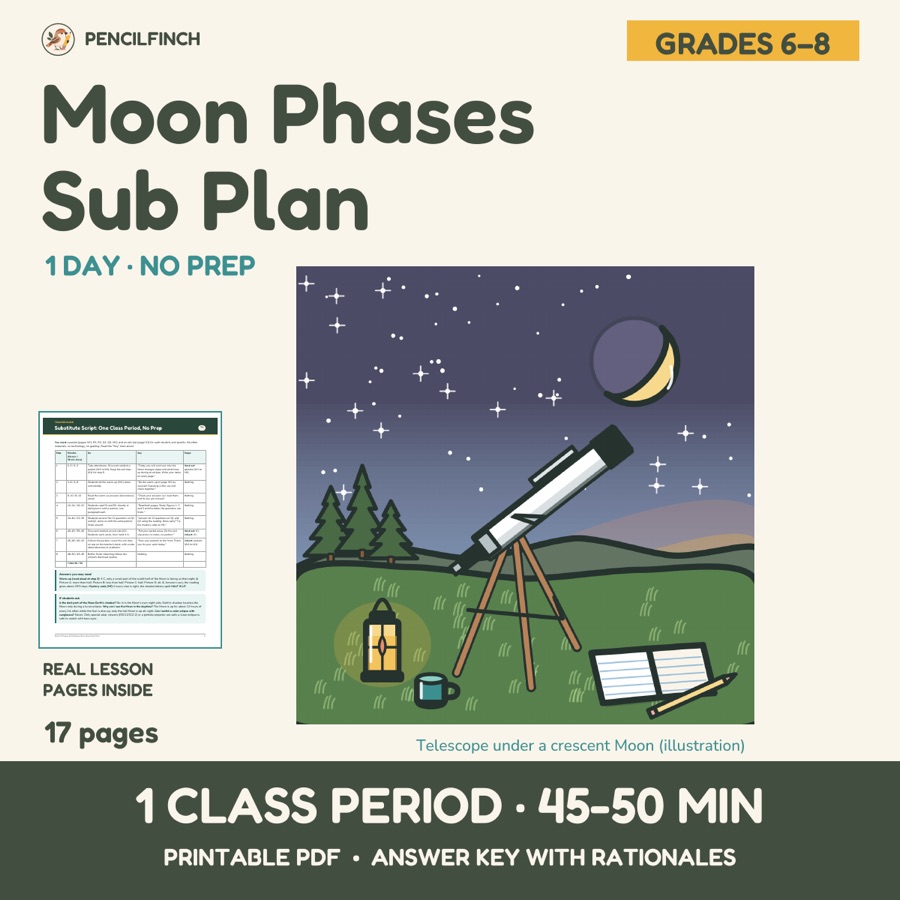
Moon Phases & Eclipses Science Sub Plan | One Day, No Prep | Grades 6-8
Companion. 17 pages, grades 6-8, answer key included. USD 4.50
View on TPT
Pages from the unit
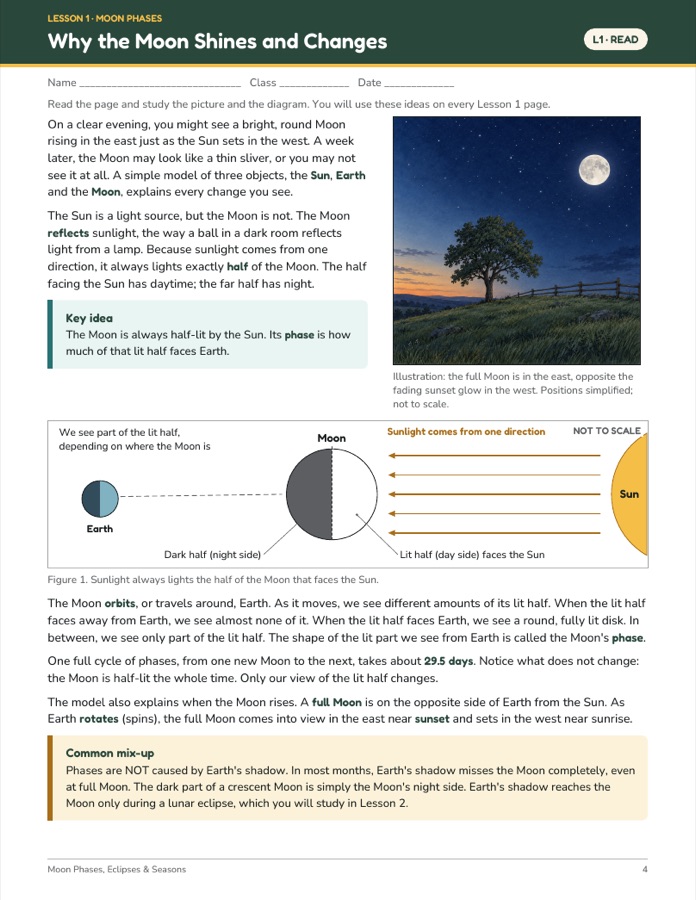
Page 4 of 38 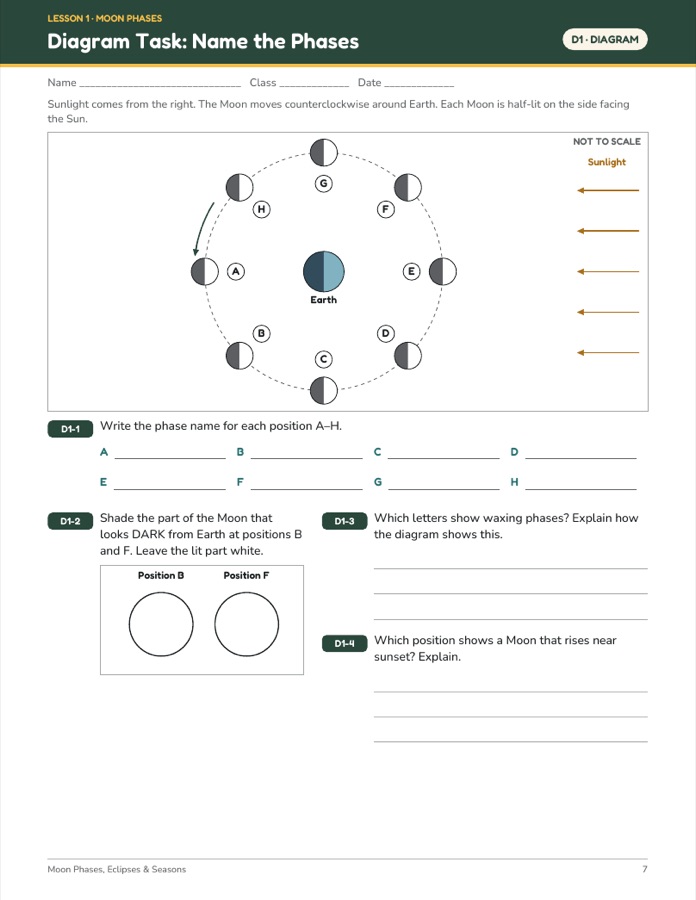
Page 7 of 38 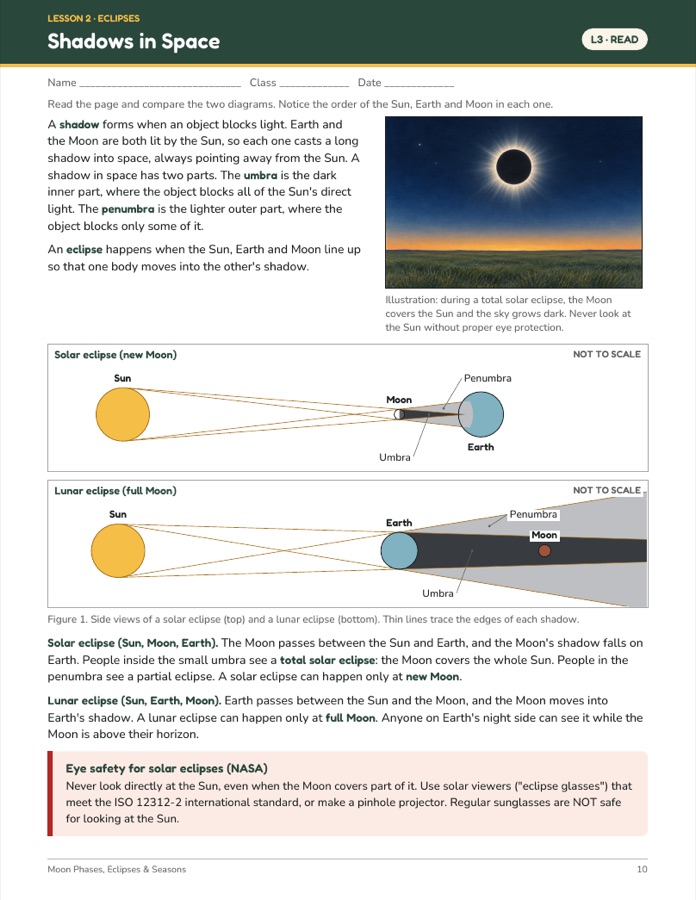
Page 10 of 38
Student pages are designed to print in black and white; all labels, numbers and diagrams are printed text and vector drawings. The diagrams are not to scale and are labeled that way.
How teachers use it
A moon phase is how much of the Moon's sunlit half faces Earth; the Moon itself is always half lit by the Sun. Each lesson is planned for about 45 minutes. Students read the explanation pages and their diagrams first, then work the guided notes, the diagram task and the reading check, and finish with a Prove-it data task and a claim-evidence-reasoning write-up.
The free sample on this page is a one-page practice set on moon phases with an answer key. Its items are new and are not in the paid unit, so you can use it as a pre-check or an exit ticket and still teach the full lessons afterward.
The three lessons use one model for three patterns. Lesson 1 has students name and shade phases from the Moon's position around Earth. Lesson 2 uses the same positions to explain eclipses and takes on the question students ask next: if a new Moon passes between the Sun and Earth every month, why is there no eclipse every month? Lesson 3 moves to Earth's tilt and the seasons. The listed prerequisite is reading a simple table; orbit, rotation and the Sun as a light source are reviewed in the pages.
The unit supports and connects to NGSS MS-ESS1-1 (an Earth-Sun-Moon model of lunar phases, eclipses and seasons). Students use and interpret supplied models; that is not a claim of full alignment.
Before and after this topic
In the order used on this site, this page comes after natural resources and is the last Earth and space page so far. The sub plan listed above covers phases and eclipses in one class period; it does not cover seasons.
- Teaching notes for this topicHow to Teach Moon Phases in Middle School (Grades 6-8)
- Before this topicNatural Resources Worksheets for Grades 6-8 (Free Sample + Full Unit)
- All topics in this lineMiddle School Earth and Space Science Worksheets (Grades 6-8)
Common questions
Is the free worksheet the same as a page from the paid unit?
No. The sample is written separately for this site, and its items are not in the unit. It uses the same page style, so you can see what the student pages look like before you buy.
Do I need a lamp and a ball, or a clear night sky?
No. The lessons run from the printed diagrams, and the Moon-observation log students analyze is simulated and labeled that way. The teacher pages describe an optional lamp-and-ball demo if you want one.
Does the unit cover eclipses and seasons too?
Yes. Lesson 2 covers solar and lunar eclipses, umbra and penumbra, and eclipse eye safety, and Lesson 3 covers Earth's 23.4° tilt, solstices, equinoxes and day length. Waxing and waning are taught from the Northern Hemisphere view.