How to Teach Moon Phases in Middle School (Grades 6-8)
By the end of this topic, students should explain a thin crescent, a half disk and a full disk with one model: a ball that is always half lit, seen from a viewpoint that keeps changing. They get stuck on the dark part of the disk, which many of them put down to Earth's shadow. This note gives you the idea, a diagram, three wrong ideas with replies, a board lesson and three check questions.
Printable for this topic: Moon Phases Worksheets for Grades 6-8 (Free Sample + Full Unit) (free sample page and the full unit).
The idea in plain words
The Moon gives off no light; moonlight is sunlight bouncing off its surface. The Sun shines on it from one side, so half of the Moon is in daylight at any moment and the other half is dark.
A Moon phase is the bright shape that the Moon shows to Earth at one place in its orbit, set by how much of its sunlit half is turned our way. The Moon travels around Earth, and a full round of phases lasts about 29.5 days. With the Moon roughly between us and the Sun, the bright half points away (new Moon). With Earth in the middle instead, the whole bright half points at us (full Moon). In between, we see a slice.
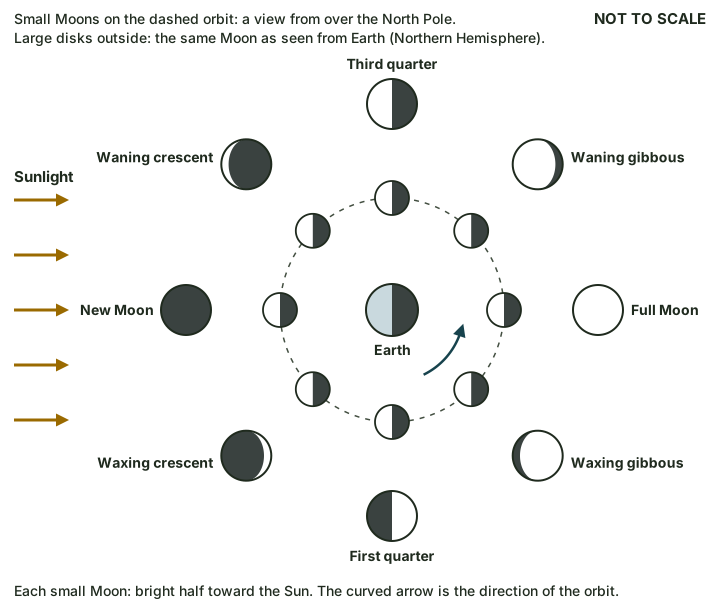
On the dashed orbit, all eight Moons look alike: bright on the left, because the Sun is to the left. Waxing means the bright part we see is growing and waning means it is shrinking; a crescent is under half of the disk and a gibbous Moon is over half. South of the equator, people see the same phase upside down, so the bright edge is on the other side.
Three misconceptions and what to say
"The dark part is Earth's shadow covering the Moon."
Shadows are the everyday reason things look dark, and eclipses are often taught the same week. NASA answers directly: Earth's shadow changes our view of the Moon during a lunar eclipse and at no other time, and lunar eclipses come at full Moon. That shadow stretches out behind Earth, opposite the Sun (toward the right edge of the diagram). Ask: "Find the crescent Moons. Are they on the shadow side of Earth or the sunny side?" What looks dark on a crescent is lunar night.
"The Moon glows by itself, like a weak Sun."
The Moon is the brightest thing in the night sky, and no lamp is in view. One question fixes it: "If the Moon were its own lamp, what shape would we see every night?" A full disk. Phases exist only because the light comes from somewhere else.
"The Moon's far side never gets any sunlight."
The phrase "dark side of the Moon" teaches this by mixing up two things: the side we never see and the side that is unlit. The Moon turns once for each trip around Earth, so one face always points at us. NASA states that there is no permanent dark side: the Moon's far side receives just as much sunlight as the face we see. Ask: "Find the new Moon in the diagram. Which half is bright?" The half we never see.
A 10-minute mini-lesson
- (1 minute) Draw five arrows from the left edge of the board, labeled sunlight, and a small circle for Earth. Ask: "Light comes from one side only. How much of a ball can it light at once?"
- (2 minutes) Draw a Moon to the right of Earth and one to the left. Shade the half of each that faces away from the arrows. Ask: "Is one more lit than the other? Then why do they look different from Earth?"
- (2 minutes) Add a Moon below Earth, shaded the same way, and say the Moon circles counterclockwise here. Ask: "From Earth, how much of its bright half can you see?" Half of the bright half, so the disk looks cut in two. Write first quarter and ask why it is not called a half Moon: one fourth of the orbit is done.
- (3 minutes) On paper, students copy the board, add the other five positions, shade all eight Moons and sketch beside any two the disk Earth sees. Check one rule: every Moon is shaded on the same side.
- (1 minute) Ask: "Which way does Earth's shadow fall?" Draw it from Earth toward the right. Ask: "Which of your Moons could ever be inside it?" Only the full Moon, and in most months it passes above or below the shadow.
- (1 minute) Exit question: "At new Moon, which side of the Moon is having daytime?"
Quick check
- A classmate writes: "The Sun lights more than half of a gibbous Moon." Correct the sentence.
- Tonight is first quarter. A spacecraft is circling above the Moon's far side. How much of that side is in sunlight?
- One afternoon a thin crescent Moon is up in the blue sky. Does its rounded outer edge face toward the Sun or away from it? Explain.
Answers: 1. Half of the Moon is sunlit at all times; at a gibbous phase, most of that half is turned toward Earth. 2. Half of it. At first quarter the line between day and night crosses the middle of both faces. 3. Toward the Sun: the bright part is the Moon's daytime half.
Sources
- NASA Science, "Moon Phases": https://science.nasa.gov/moon/moon-phases/
- NASA Science, "Top Moon Questions": https://science.nasa.gov/moon/top-moon-questions/
- NASA Science, "Eclipses and the Moon": https://science.nasa.gov/moon/eclipses/
- NASA Science, "Tidal Locking": https://science.nasa.gov/moon/tidal-locking/
The full unit
Moon Phases, Eclipses & Seasons Science Lessons | Earth-Sun-Moon | Grades 6-8
38 pages, grades 6-8. USD 4.50
Get the full unit on TPT (USD 4.50)
Next topics
- Before this topicNatural Resources Worksheets for Grades 6-8 (Free Sample + Full Unit)
- All topics in this lineMiddle School Earth and Space Science Worksheets (Grades 6-8)