How to Teach Density in Middle School (Grades 6-8)
Students should leave this topic able to say that density tells how much mass a material has in each unit of volume, and that the number is set by the material, however big or small the piece is. Most can do the division long before they believe that: they still expect a bigger lump to be denser and a heavy object to sink. This note gives you the idea in brief, three wrong ideas with a reply for each, a board lesson built on one graph and three check questions.
Printable for this topic: Density Worksheets for Grades 6-8 (Free Sample + Full Unit) (free sample page and the full unit).
The idea in plain words
Density is the mass of a material in each unit of its volume: mass divided by volume. The usual unit is g/cm³; for liquids, g/mL gives the same number, because NIST lists 1 cm³ as equal to 1 mL.
The number describes the stuff, not the object. Any solid piece of aluminum, small or large, comes out near 2.7 g/cm³, and any piece of ice near 0.92 g/cm³ (OpenStax values). Plot mass against volume and all the pieces of one material land on a single straight line through zero. A steeper line means a denser material.
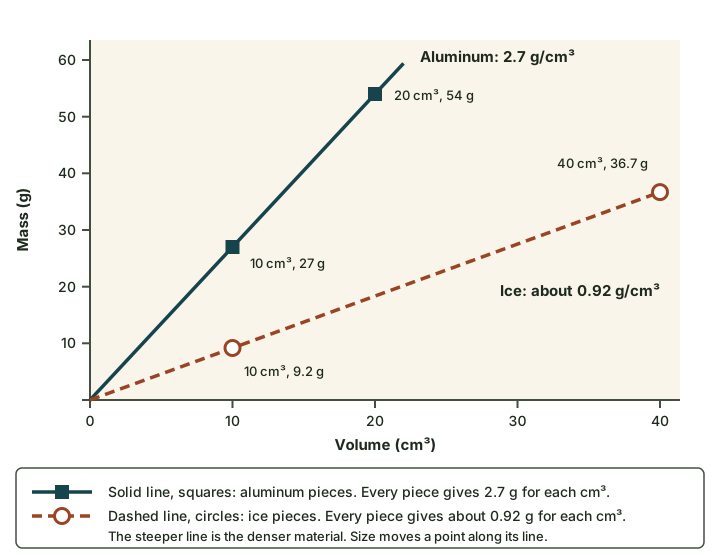
Density also settles sinking and floating. An object floats in a liquid when its average density is lower than the liquid's and sinks when it is higher. Water is close to 1 g/cm³, so ice floats and solid aluminum sinks at any size.
Three misconceptions and what to say
"It sinks because it's heavy."
Rocks and coins are the sinkers students know, and they feel heavy for their size, so "heavy" becomes the cause. Use two points on the graph: the 40 cm³ piece of ice has more mass (36.7 g) than the 10 cm³ piece of aluminum (27 g), yet the ice floats and the aluminum sinks. Demonstration: show a brick-sized block of wood and a small coin, ask which has more mass, then lower both into a tub of water.
"The bigger piece is denser."
Bigger really does mean more mass, and students carry "more" over to every number attached to the object. Have them divide for the two aluminum points: 27 ÷ 10 and 54 ÷ 20 both give 2.7. Say: "Twice the volume came with twice the mass, so the answer did not move."
"If you cut it in half, the density is cut in half too."
Halving works for the mass and for the volume, so students apply it to the third number as well. Demonstration: snap a stick of chalk and ask whether either half is now made of something different. Then give made-up numbers: a 9 g stick that takes up 6 cm³ has a density of 1.5 g/cm³, and each half is 4.5 g and 3 cm³, which is 1.5 g/cm³ again.
A 10-minute mini-lesson
- (1 minute) Draw two axes on the board: volume in cm³ across to 40, mass in g up to 60. Ask: "If I take a bigger piece of the same metal, which of these two numbers changes?" Wait for "both".
- (2 minutes) Give two aluminum pieces: 10 cm³ has 27 g, and 20 cm³ has 54 g. Volunteers plot them. Ask: "Where does a piece with no volume go?" Draw the line from zero through both points.
- (2 minutes) Ask: "Divide mass by volume for each piece. What do you notice?" Write "density = mass ÷ volume" and "2.7 g in every cm³" next to the line.
- (2 minutes) Give two ice pieces: 10 cm³ has 9.2 g, and 40 cm³ has 36.7 g. Before anyone plots, ask: "Will these sit on the aluminum line, above it or below it? Why?" Plot them and draw a dashed line from zero. Ask: "What does the steeper line tell you?"
- (2 minutes) Ask: "Which has more mass, the 40 cm³ of ice or the 10 cm³ of aluminum? Which of the two floats?" Draw a line for water from zero to the point (40, 40). Ask: "Where are the floaters compared with the water line?" (Below it; sinkers are above it.)
- (1 minute) On paper, students finish this sentence: "Density depends on the ___, not on the ___, because ___."
Quick check
- An apple wedge: 42 g and 50 cm³. A pebble: 13 g and 5 cm³. Which has more mass? Which is denser? Which one floats in water?
- A block of modeling clay has a mass of 90 g and a density of 1.8 g/cm³. A student pinches off a 9 g piece. Give the density and the volume of the small piece.
- On a graph of mass against volume, sample X is at 30 cm³ and 24 g. Sample Y is at 8 cm³ and 24 g. Could X and Y be the same material? Explain.
Answers: 1. The apple wedge has more mass. The pebble is denser: 13 ÷ 5 = 2.6 g/cm³ against 42 ÷ 50 = 0.84 g/cm³. The wedge floats (0.84 is below water's 1 g/cm³); the pebble sinks. 2. Still 1.8 g/cm³, because the material is the same. Its volume is 9 ÷ 1.8 = 5 cm³. 3. No. X is 24 ÷ 30 = 0.8 g/cm³ and Y is 24 ÷ 8 = 3 g/cm³, so the points lie on different lines through zero.
Sources
- OpenStax, College Physics 2e, section 11.2 "Density" (definition and Table 11.1): https://openstax.org/books/college-physics-2e/pages/11-2-density
- OpenStax, College Physics 2e, section 11.7 "Archimedes' Principle" (average density and floating): https://openstax.org/books/college-physics-2e/pages/11-7-archimedes-principle
- National Institute of Standards and Technology, "SI Units: Volume": https://www.nist.gov/pml/owm/si-units-volume
- U.S. Geological Survey, Water Science School, "Water Density": https://www.usgs.gov/water-science-school/science/water-density
The full unit
Density Science Lessons | Mass, Volume, Sink or Float & Layers | Grades 6-8
29 pages, grades 6-8, answer key included with rubric. USD 4.50
Get the full unit on TPT (USD 4.50)
Next topics
- Before this topicMetric Conversions Worksheets for Grades 6-8 (Free Sample + Full Unit)
- After this topicAtoms, Elements and Molecules Worksheets, Grades 6-8 (Free Sample)
- All topics in this lineMiddle School Physical Science Worksheets (Grades 6-8)