Life Cycles Worksheets for Grade 3 (Free Sample + Full Unit)
Download a free life cycles worksheet for Grade 3 below: one student page with an answer key, ready to print. The full unit is two illustrated lessons, one on life cycles and one on traits and the environment, with short Read It passages, Word Cards, cut-and-paste sorts, a Label It page, two Try It investigations, a life cycle wheel to build, Check It pages and a riddle match, for USD 4.50 on TPT. A one-day life cycles sub plan is sold separately for USD 4.50.
Free sample worksheet
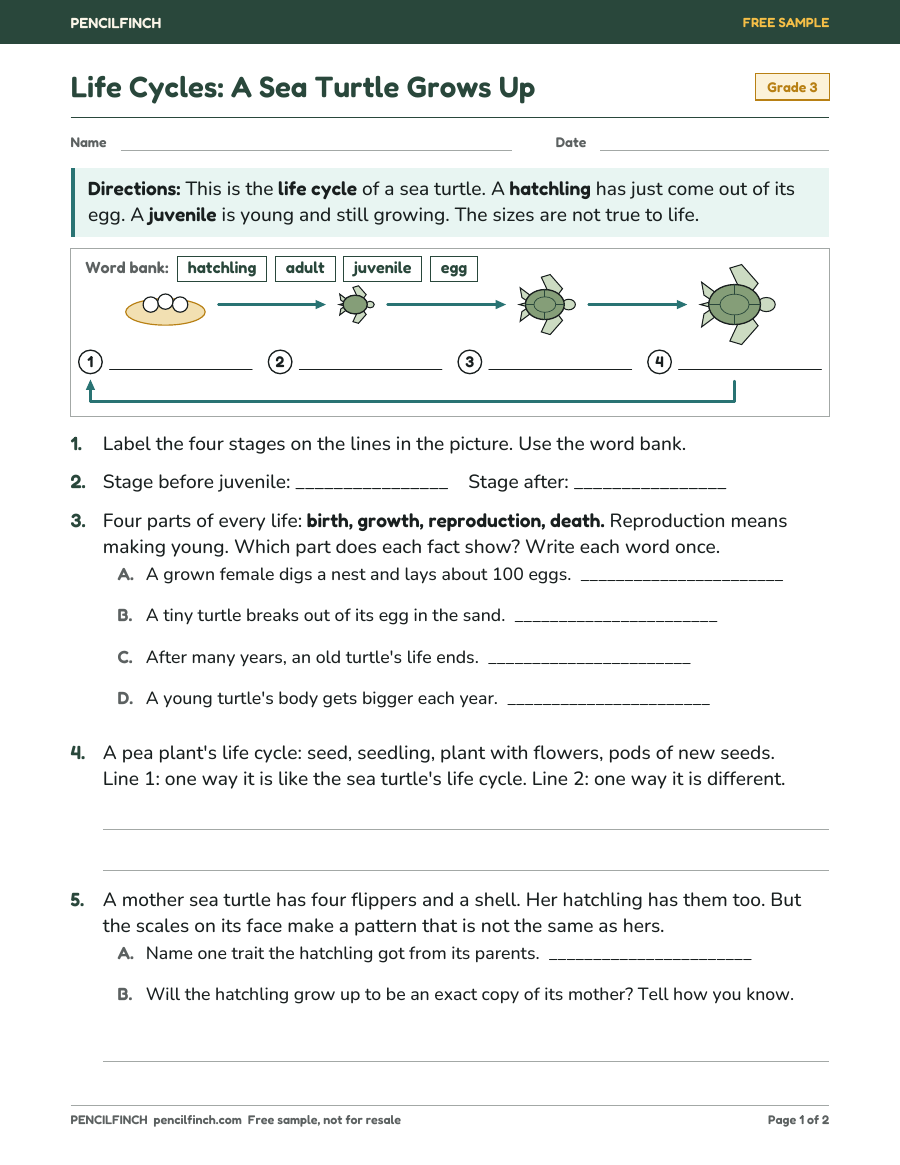 Download the free sample (PDF, 5 items with answer key)
Free to download, no email needed. These problems are not in the paid unit.
What is in the full unit
| Full unit | Life Cycles 3rd Grade Science Lessons | Inherited Traits & Environment | Grade 3 |
|---|---|
| Pages | 30 pages in one PDF |
| Answer key | Included with Rubric |
| Standards | Supports and connects to NGSS 3-LS1-1, 3-LS3-1 and 3-LS3-2 (not a claim of full alignment) |
| Grade | 3 |
| Price on TPT | USD 4.50 |
Get the full unit on TPT (USD 4.50)
- Lesson 1, life cycles: birth, growth, reproduction and death; the pumpkin plant (seed, seedling, flower, fruit); metamorphosis in the monarch butterfly (egg, larva, pupa, adult) and the frog (egg, tadpole, froglet, adult); a chicken that simply grows. Students sort 12 stage cards, label two cycles, open a soaked bean seed to find the tiny plant inside, build a monarch wheel and use real hatching times to test the claim "all bird eggs hatch in 21 days."
- Lesson 2, traits and the environment: traits, offspring, inheriting traits and siblings; variation shown with real flipper lengths of wild Adélie penguins; how water, light and food change traits (stunted plants, leaning stems, pink flamingos, an overweight dog). Students sort 10 trait cards into "from parents" or "from the environment" and use a class fair test of bean plants to answer "I think ___ because ___."
- Read It pages in three short chunks, two Word Cards pages (12 words) and bold-outline pictures to color. The coloring pictures are line drawings made in code; no AI image generator was used.
- Real data: bird hatching times (Mississippi State University Extension) and penguin flipper lengths (Palmer Station Antarctica research program). All numbers are whole numbers. The bean plant heights are simulated and say so.
- Answer key for every question with filled sort mats, labeled diagrams and sample answers; a two-lesson plan with a prep and materials list, safety, misconceptions, scoring and data notes for the teacher.
Goes with
-
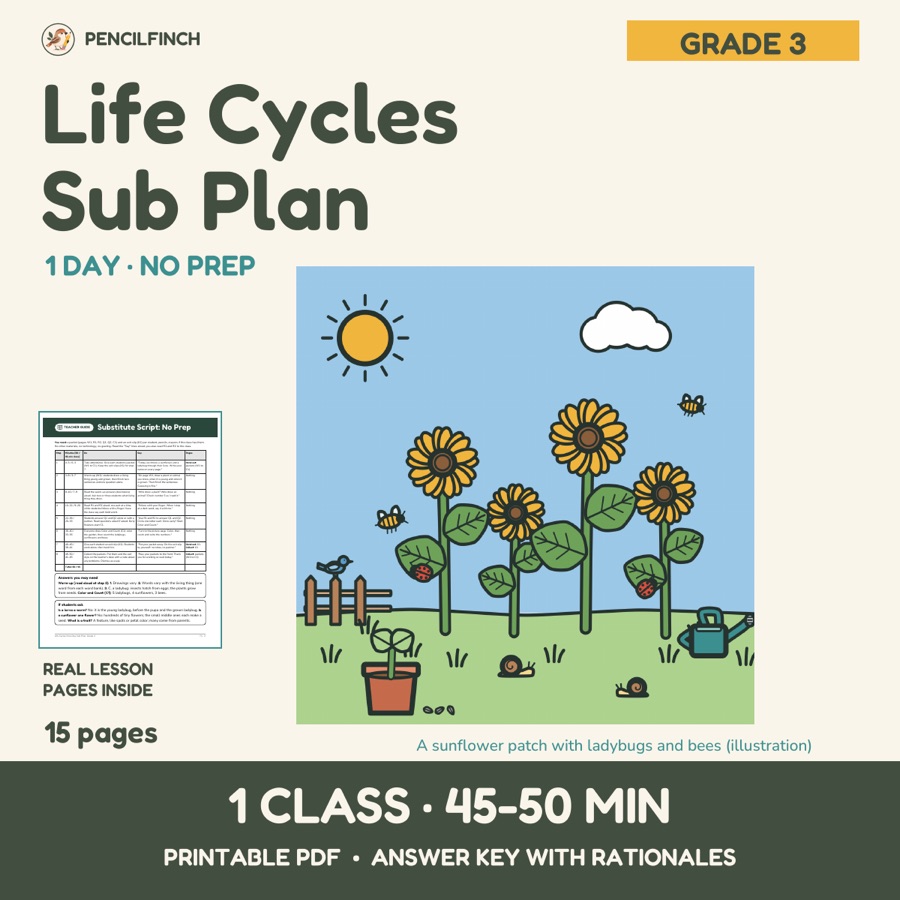
Life Cycles 3rd Grade Science Sub Plan | One Day, No Prep | Grade 3
Companion. 15 pages, grade 3, answer key included. USD 4.50
View on TPT
Pages from the unit
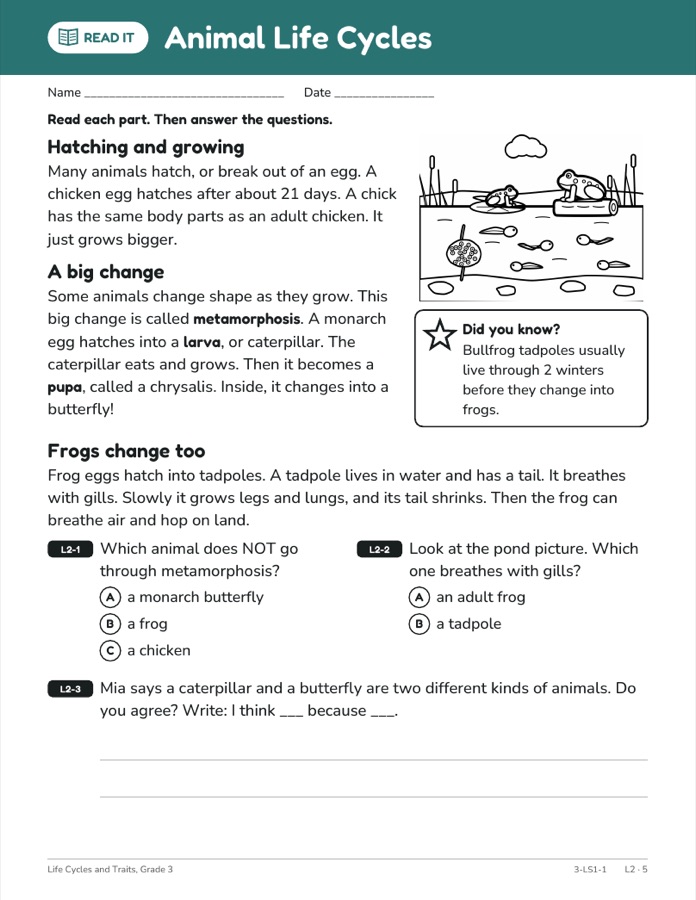
Page 5 of 30 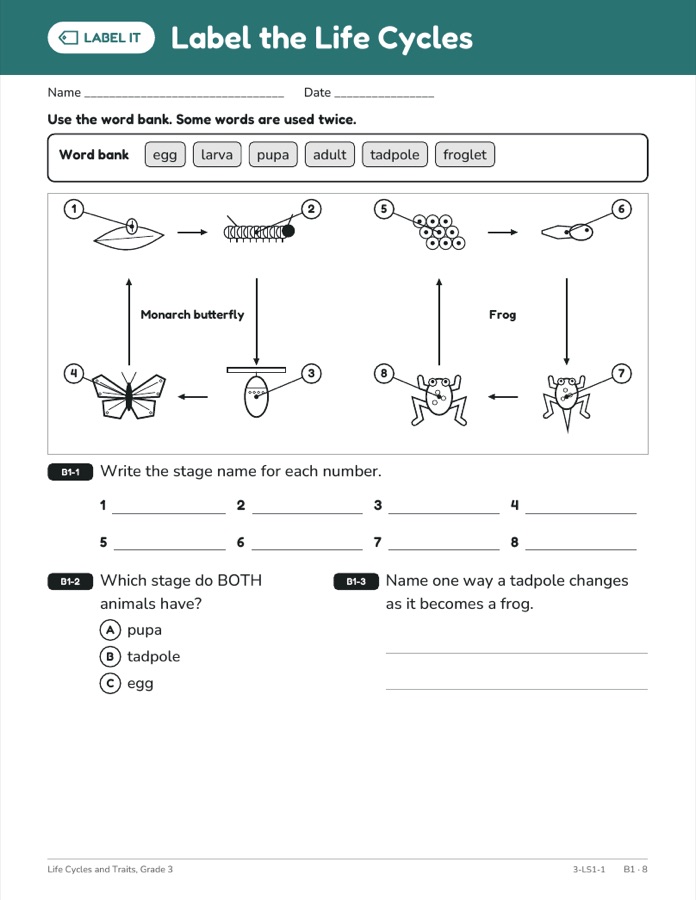
Page 8 of 30 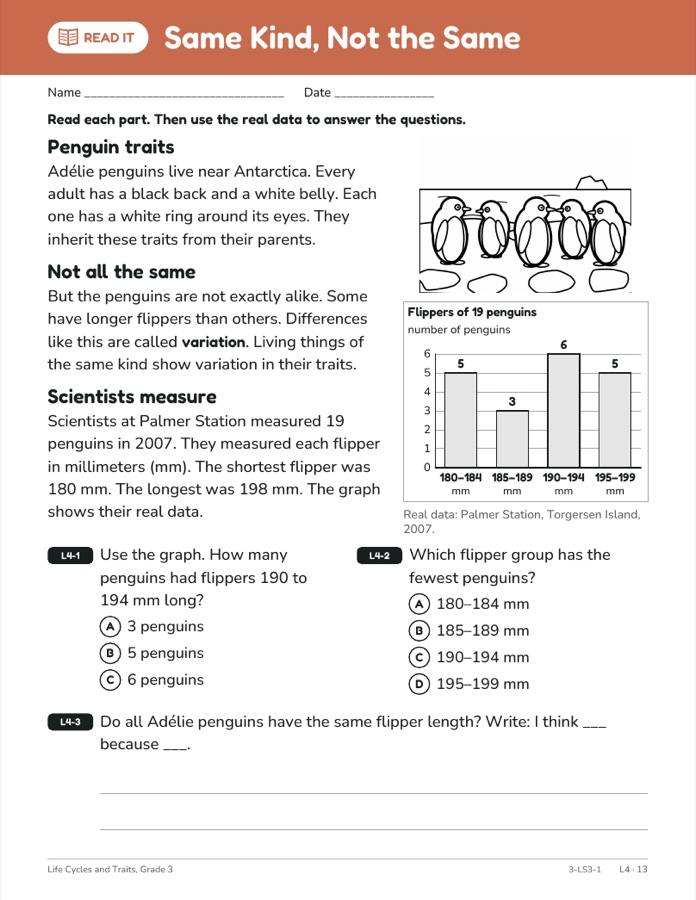
Page 13 of 30
Student pages are black and white except a colored page header, so they print on any printer. The type is large Grade 3 type (14 pt) with writing space under each written question.
How teachers use it
A life cycle is the set of changes a living thing goes through as it grows: it starts life, grows, can reproduce and, in time, dies. Each lesson is planned over two sessions of about 45 minutes. Students hear or read the Read It pages in short chunks and answer together, then cut, color and sort, label two cycles, run a Try It investigation and finish with a Check It page.
The free sample on this page is a one-page practice sheet on life cycles with an answer key. Its items are new and are not in the paid unit, so you can use it as a warm-up before the unit or a quick review after it and still teach the full lessons.
Lesson 1 compares four living things, so students see that life cycles differ. A pumpkin plant goes from seed to fruit, a monarch and a frog change body shape (metamorphosis), and a chick has the same body parts as an adult chicken and just grows bigger. The pages call the monarch pupa a chrysalis, and the teacher pages flag the cocoon mix-up. Lesson 2 moves to traits: what offspring inherit from parents, that siblings are alike but never exactly the same, and how water, light and food can change a living thing. The teacher pages note the unit's limits: flowering plants only, no human examples and no genetic mechanisms.
You will need scissors, glue sticks, crayons and one brad (paper fastener) per student, plus soaked large dry beans and hand lenses for the seed investigation. The unit supports and connects to NGSS 3-LS1-1 (life cycle models), 3-LS3-1 (data on inherited traits and variation) and 3-LS3-2 (traits influenced by the environment). That is not a claim of full alignment.
Before and after this topic
In the order used on this site, this page comes after weather and climate for Grade 3 and is the last elementary science page so far. The sub plan listed above fits one class period and uses different organisms (a sunflower and a ladybug), data, text and questions, with no scissors or glue.
- Before this topicWeather and Climate Worksheets for Grade 3 (Free Sample + Full Unit)
- All topics in this lineElementary Science and Social Studies Worksheets (Grades 2-5)
Common questions
Is the free worksheet the same as a page from the paid unit?
No. The sample is written separately for this site, and its items are not in the unit. It uses the same page style, so you can see what the student pages look like before you buy.
Do I need live animals, or time to grow plants?
No. The animal life cycles are taught from the printed pages, sorts and the monarch wheel. The seed investigation needs only large dry beans (the teacher pages suggest lima beans) soaked for several hours or overnight, paper towels and hand lenses. The bean plant fair test uses simulated class results printed on the page; the teacher pages describe an optional real version that takes about 4 weeks.
Does the unit use human examples or teach genes?
No. The teacher pages state both limits: no human examples and no genetic mechanisms. Traits are shown with animals and plants, such as rabbit ear shape, penguin flipper length and bean plant height.