French Direct and Indirect Object Pronouns Worksheets (Free Sample)
Download one free direct and indirect object pronouns worksheet for French 2 (student page and answer key, no sign-up). The full pack, Les pronoms COD et COI, is one PDF of 17 pages with five student pages in French, the same five with English directions, and one answer key for both, for USD 2.50 on TPT. A Quiz A/B companion checks the same choices with two parallel one-page quizzes.
Teaching notesHow to Teach French Direct and Indirect Object Pronouns
Free sample worksheet
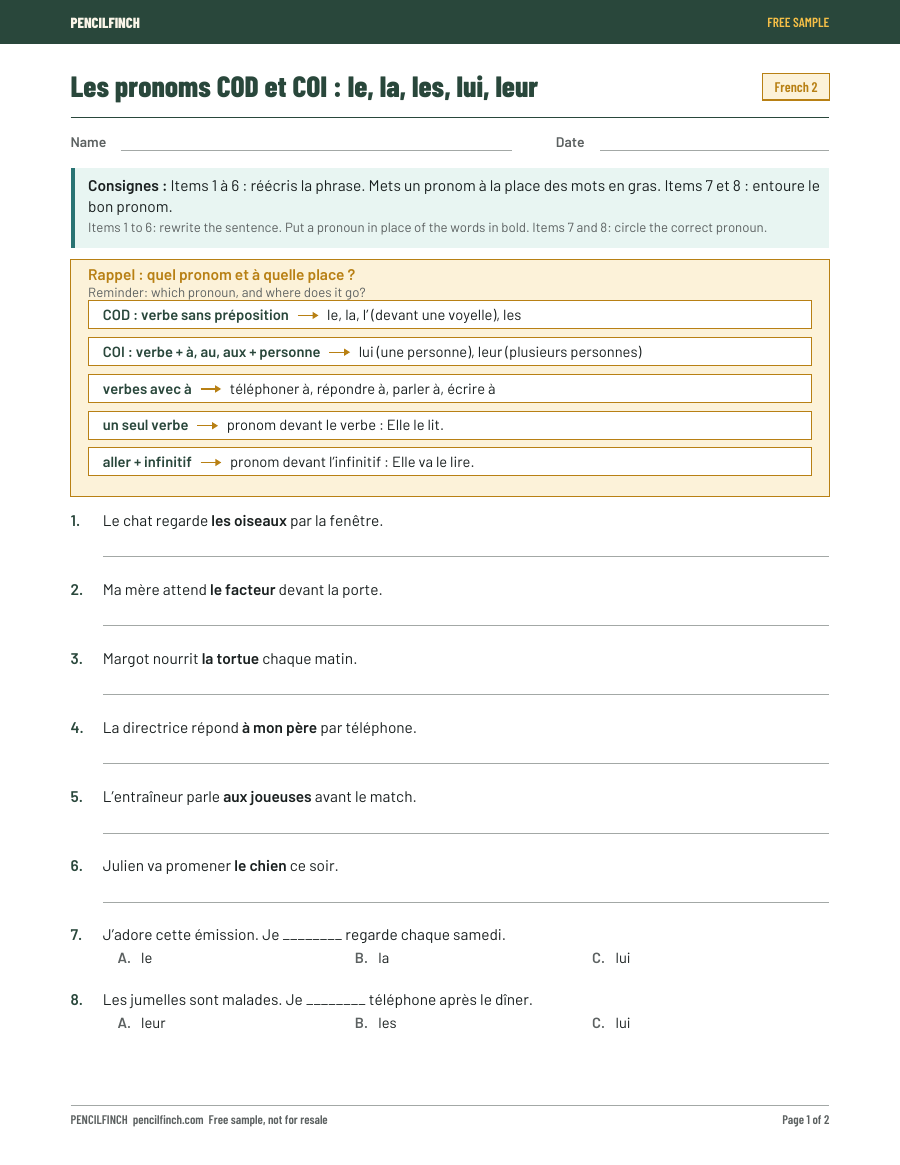 Download the free sample (PDF, 8 items with answer key)
Free to download, no email needed. These problems are not in the paid unit.
What is in the full unit
| Full unit | Les pronoms COD et COI - French 2 Worksheets en français - Grades 7-10 |
|---|---|
| Pages | 17 pages in one PDF |
| Grades | 7-10 |
| Price on TPT | USD 2.50 |
Get the full unit on TPT (USD 2.50)
- A rule chart (R1) with the ten forms me, te, le, la, l’, les, lui, nous, vous, leur, a table that sets each sentence with a noun beside the same sentence with a pronoun, and two À retenir notes: COD or COI, and where the pronoun goes.
- Ten fill-ins where students replace the complement with a pronoun.
- Two identify items (COD or COI), then a six-pair draw-a-line match from a phrase to its pronoun.
- Six rewrites that swap a complement for a pronoun.
- Four English-to-French sentences and a nine-clue mystery code: when every clue is right, the code spells a French phrase, so students check their own work.
Every student page is printed twice, with French directions and then with English directions and English rule explanations, and one answer key serves both. Nothing is cut or glued. The Quiz A/B companion (12 pages) is a quiz in two parallel versions: a one-page Rappel to study from, then Quiz A and Quiz B with 13 items each, where item 1 of A tests the same skill as item 1 of B with a different sentence, so you can alternate rows or keep B as a retake.
Goes with
-
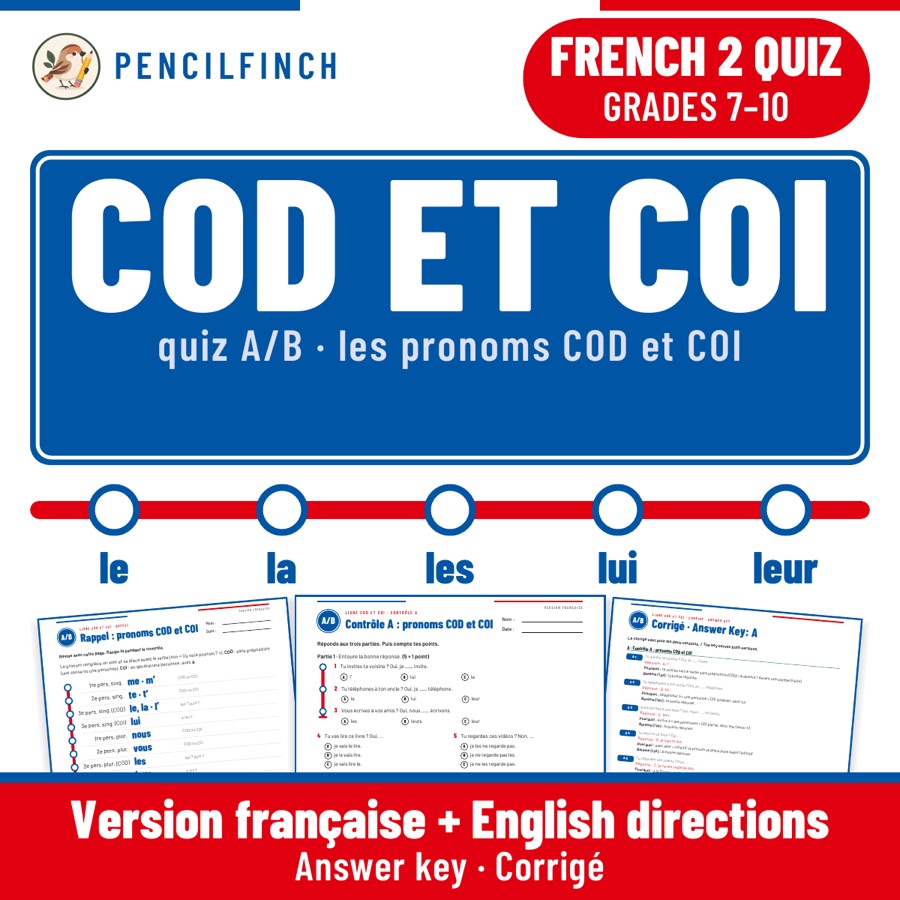
Les pronoms COD et COI - French 2 Quiz A/B en français - Grades 7-10
Companion. 12 pages, grades 7-10, answer key included. USD 3.00
View on TPT
Pages from the unit
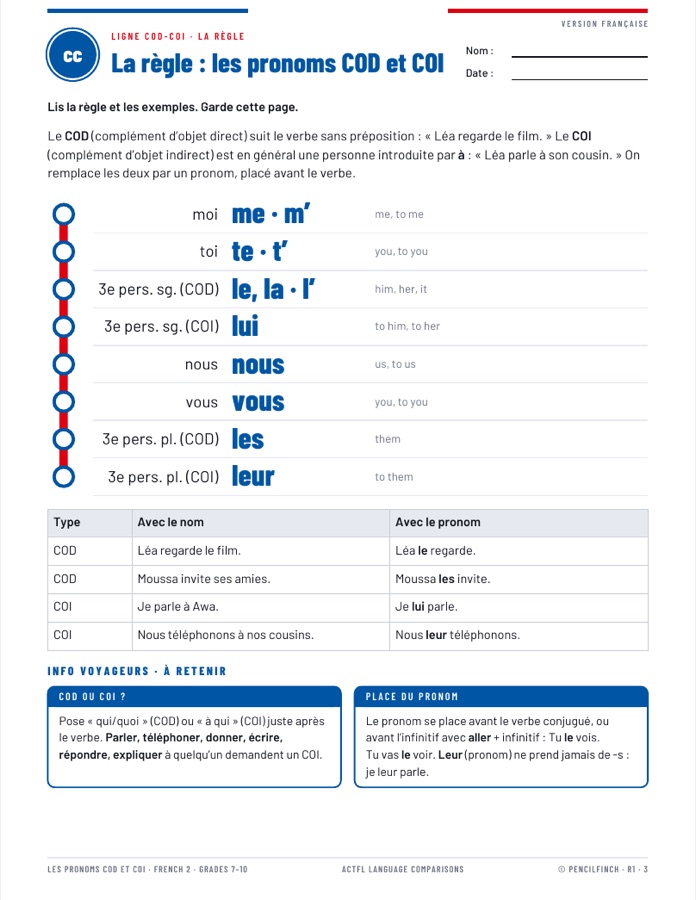
Page 3 of 17 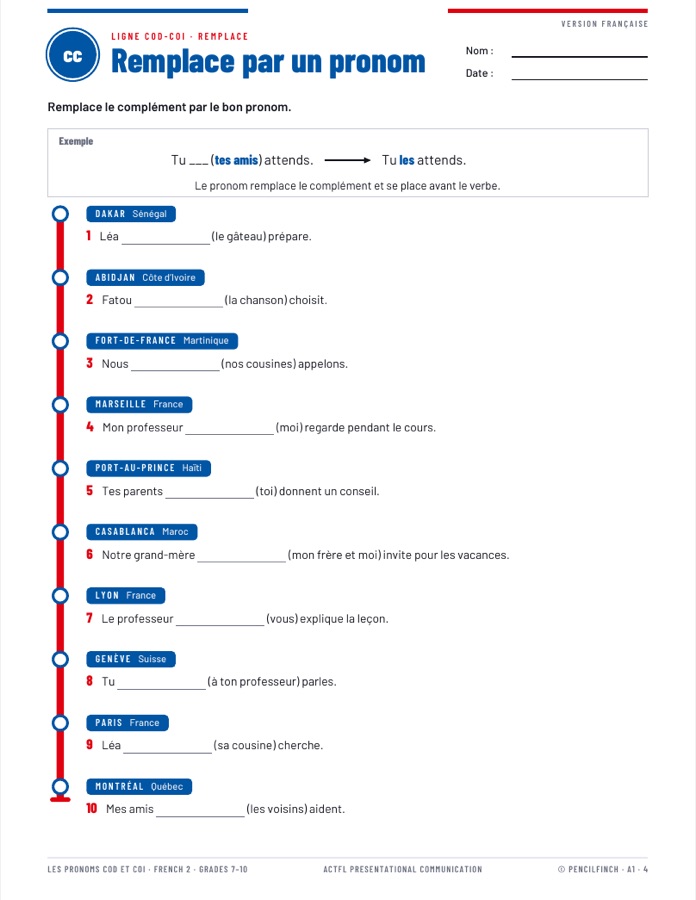
Page 4 of 17 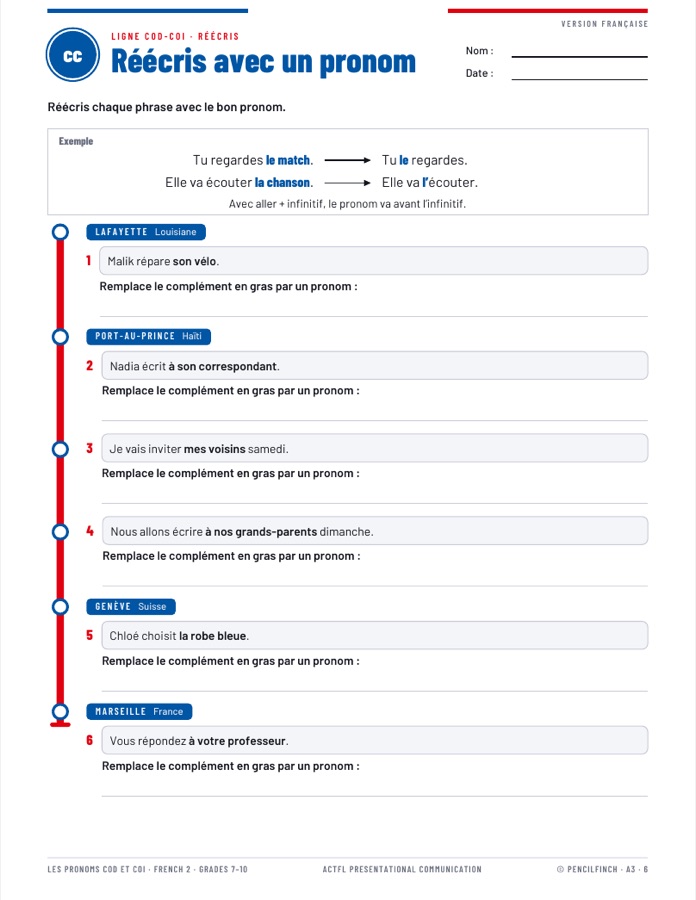
Page 6 of 17 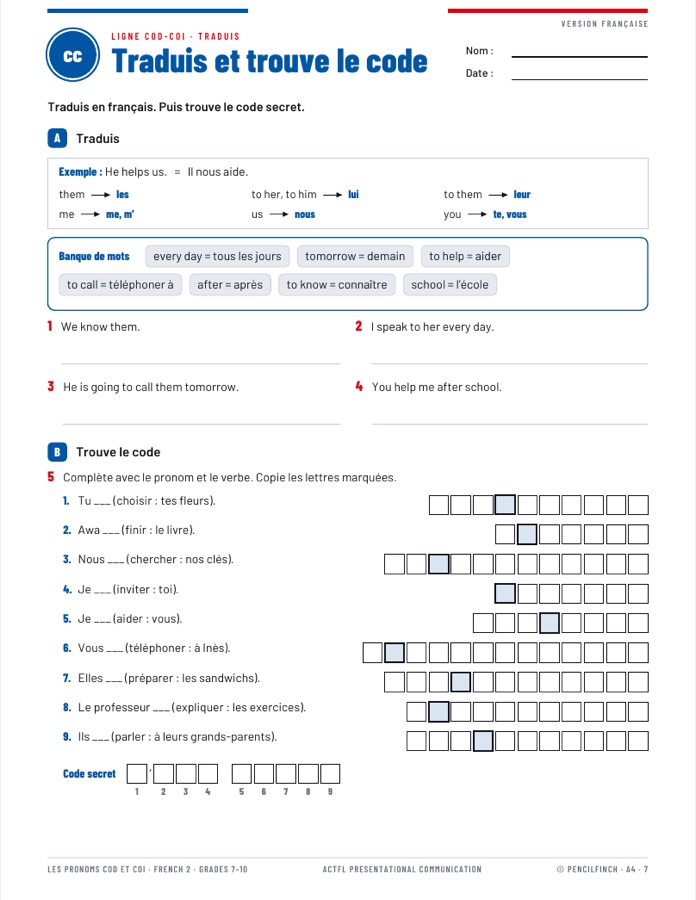
Page 7 of 17
How teachers use it
A direct object (COD, complément d’objet direct) follows the verb with no preposition, and le, la, l’ or les replaces it (Ma mère signe la lettre. Elle la signe.). An indirect object (COI, complément d’objet indirect) is usually a person introduced by à, and lui or leur replaces it (Le chien obéit à Sarah. Il lui obéit.). Me, te, nous and vous serve for both.
In a statement or a question, the pronoun goes before the conjugated verb (the affirmative imperative, as in Regarde-le, is not in this pack). With aller + infinitive it goes before the infinitive (Nous allons les revoir en juin.).
Start with the rule chart (R1) and keep it on the desk. The fill-in page and the match build the forms; the rewrite page asks for the whole sentence, which is where placement errors show. Every sentence in the pack is in the present or uses aller + infinitive. The teacher page gives the reason: with no passé composé, students place the pronoun without also having to handle agreement of the past participle.
The Quiz A/B set follows the pack and checks le, la, l’, les, lui and leur; me, te, nous and vous are on its Rappel page but are not keyed. Its teacher page maps each quiz part to the practice page to reteach, and every quiz sentence is new.
Before and after this topic
In the order used on this site, object pronouns come after depuis, il y a and pendant and close the French 2 pages for now.
- Teaching notes for this topicHow to Teach French Direct and Indirect Object Pronouns
- Before this topicDepuis, Il y a and Pendant Worksheets, French 2 (Free Sample + Pack)
- All topics in this lineFrench 2 Worksheets, Quizzes and Games
Common questions
How do students decide between le and lui?
The chart gives one test: ask "whom or what?" (COD) or "to whom?" (COI) right after the verb. It also names six verbs that take à before a person, so they call for a COI: parler, téléphoner, donner, écrire, répondre, expliquer. The identify items on the second practice page drill that decision, and the first three items of each quiz check it.
Does the pack use the passé composé?
No. The practice pack and the quiz stay in the present and aller + infinitive, so agreement of the past participle with a preceding direct object never comes up. Plan a separate lesson for object pronouns before a passé composé (Ces lettres, je les ai lues.).
Where does the pronoun go in a negative sentence?
Between ne and the verb (Je ne lui prête pas mon vélo.). The quiz tests this and its Rappel page teaches it, but the practice pack has no negative sentence; the quiz’s teacher page points to the Rappel for that item. Show one or two negative examples before the quiz if you use both.