How to Teach Weathering, Erosion and Deposition (Grades 6-8)
Students should finish this topic able to look at a landform or a photo and say which of three things happened: rock broke, pieces moved, or pieces settled. The trouble is that the three usually happen close together, and everyday speech uses "eroded" for all of them. This note gives you a way to separate the three, wrong ideas you are likely to hear with a reply for each, a short board lesson and three check questions.
Printable for this topic: Weathering, Erosion, Deposition Worksheets Grades 6-8 (Free Sample) (free sample page and the full unit).
The idea in plain words
Weathering breaks rock down in place, erosion moves the broken material somewhere else, and deposition is that material coming to rest. One question separates the first two: did the pieces go anywhere? The National Park Service is direct about it: weathering involves no movement of sediment.
Weathering comes in two kinds. Mechanical (physical) weathering breaks rock into fragments without changing what the minerals are made of, for example when water freezes and expands in a crack. Chemical weathering changes at least some of the minerals, for example when water and acid slowly dissolve part of the rock.
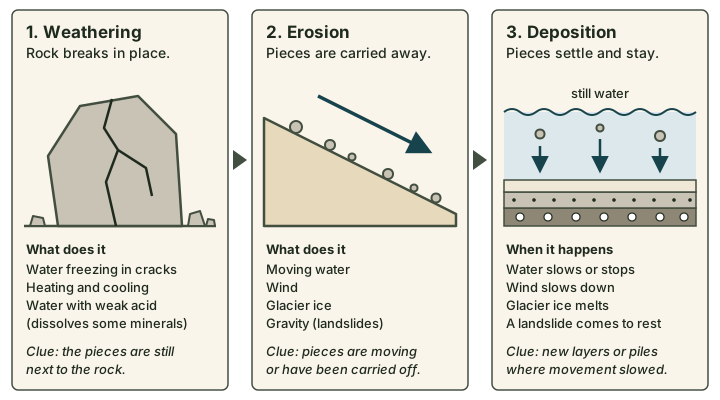
Erosion needs something to do the carrying: moving water, wind, glacier ice, or gravity pulling material down a slope. Deposition happens when the carrier loses energy. Fast water can pick up and move larger particles than slow water can, so when a stream slows down its load drops out.
Three misconceptions and what to say
"Weathering is just another word for erosion."
The two words are swapped freely outside science class, and in the field one follows the other so quickly that they look like a single event. Demonstration: snap a piece of chalk in half over a sheet of paper and leave it there. "Broken, but still here: weathering." Tilt the paper so the pieces and dust slide. "Now they are moving: erosion." Point to where they stop. "They settled: deposition."
"Erosion is what rivers do."
Rivers are the example in nearly every textbook photo, so students stop at water. The National Park Service describes wind eroding, carrying and dropping sediment, and glaciers scratching bedrock with the debris in their base and plucking out whole chunks. The USGS describes landslides as rock, debris or earth moving down a slope under gravity. Say: "Erosion is the moving. Anything that can carry rock can do it." Then ask for the four carriers by name.
"The dirt in a muddy river just goes away."
Once sediment is out of sight downstream, students tend to treat it as gone. Demonstration: put a spoonful of sandy soil in a clear jar of water, close the lid, shake it and set it on the desk. While the water swirls it stays brown. Within a minute the larger grains have dropped to the bottom, and the water above keeps clearing. Moving water carries sediment; still water drops it. That settled layer is deposition, and every grain is accounted for.
A 10-minute mini-lesson
- (1 minute) Write three column heads on the board: Breaks, Moves, Settles. Ask: "If I find a cracked rock and all the pieces are still next to it, which column?"
- (2 minutes) Add the science words under each head: weathering, erosion, deposition. Ask: "What question could you ask about any rock to choose between the first two columns?" Lead them to "Did the pieces go anywhere?"
- (3 minutes) Read these clues one at a time. Students write B, M or S on paper, then you place each on the board (in order: B, M, S, M, S):
- a sidewalk slab split by water that froze in a crack
- brown water rushing down a ditch in a storm
- a layer of mud left on a road after floodwater drains away
- long scratches on bedrock where a glacier once passed
- a heap of loose rock lying where a landslide stopped
- (2 minutes) Ask: "For each M, what did the moving?" (Water in the ditch; ice for the scratches, because the glacier dragged rock over the bedrock.) Write water, wind, ice and gravity along the side. Ask which one has not come up yet (wind) and have students suggest an example for it.
- (2 minutes) Ask: "Pick one S. What had to happen first for that material to be there?" Students write one sentence that uses all three terms in order.
Quick check
- After a dry, windy day, a thin layer of dust covers a parked car. Name the process that made the tiny grains to begin with, the process that brought them, and the process that left them on the car.
- A stream runs fast and brown during a storm, then slow and clear a week later. On which day is it eroding more, and how can you tell?
- A puddle in a dirt lot dries up and leaves a smooth skin of fine mud in the low spot. Which process put the mud there, and why in the low spot?
Answers: 1. Weathering broke rock into small grains, erosion by wind carried them, and deposition left them when the air slowed. 2. During the storm. Fast water picks up and carries more sediment, which is what turns it brown. 3. Deposition. Runoff carried fine particles downhill to the low spot, and when the water stopped moving they settled out.
Sources
- National Park Service, "Weathering": https://www.nps.gov/subjects/erosion/weathering.htm
- National Park Service, "Erosion: Water, Wind and Weather": https://www.nps.gov/subjects/erosion/index.htm
- National Park Service, "Aeolian (Dunes) Landforms": https://www.nps.gov/subjects/geology/aeolian-landforms.htm
- National Park Service, "How Glaciers Change the Landscape": https://www.nps.gov/articles/howglacierchangethelandscape.htm
- U.S. Geological Survey, Water Science School, "Sediment and Suspended Sediment": https://www.usgs.gov/water-science-school/science/sediment-and-suspended-sediment
- U.S. Geological Survey, "What is a landslide and what causes one?": https://www.usgs.gov/faqs/what-a-landslide-and-what-causes-one
The full unit
Weathering and Erosion Science Worksheets & Lessons | Deposition | Grades 6-8
30 pages, grades 6-8, answer key included with rubric. USD 4.50
Get the full unit on TPT (USD 4.50)
Next topics
- Before this topicWater Cycle Worksheets for Grades 6-8 (Free Sample + Full Unit)
- After this topicGeologic Time Scale Worksheets, Grades 6-8 (Free Sample + Full Unit)
- All topics in this lineMiddle School Earth and Space Science Worksheets (Grades 6-8)