Geologic Time Scale Worksheets, Grades 6-8 (Free Sample + Full Unit)
Download a free geologic time scale worksheet for Grades 6-8 below: one student page with an answer key, ready to print. The full unit is two illustrated lessons, one on reading rock layers and one on the geologic time scale, with guided notes, diagram tasks, reading checks, two Prove-it tasks, vocabulary cards and a quiz, for USD 4.50 on TPT.
Free sample worksheet
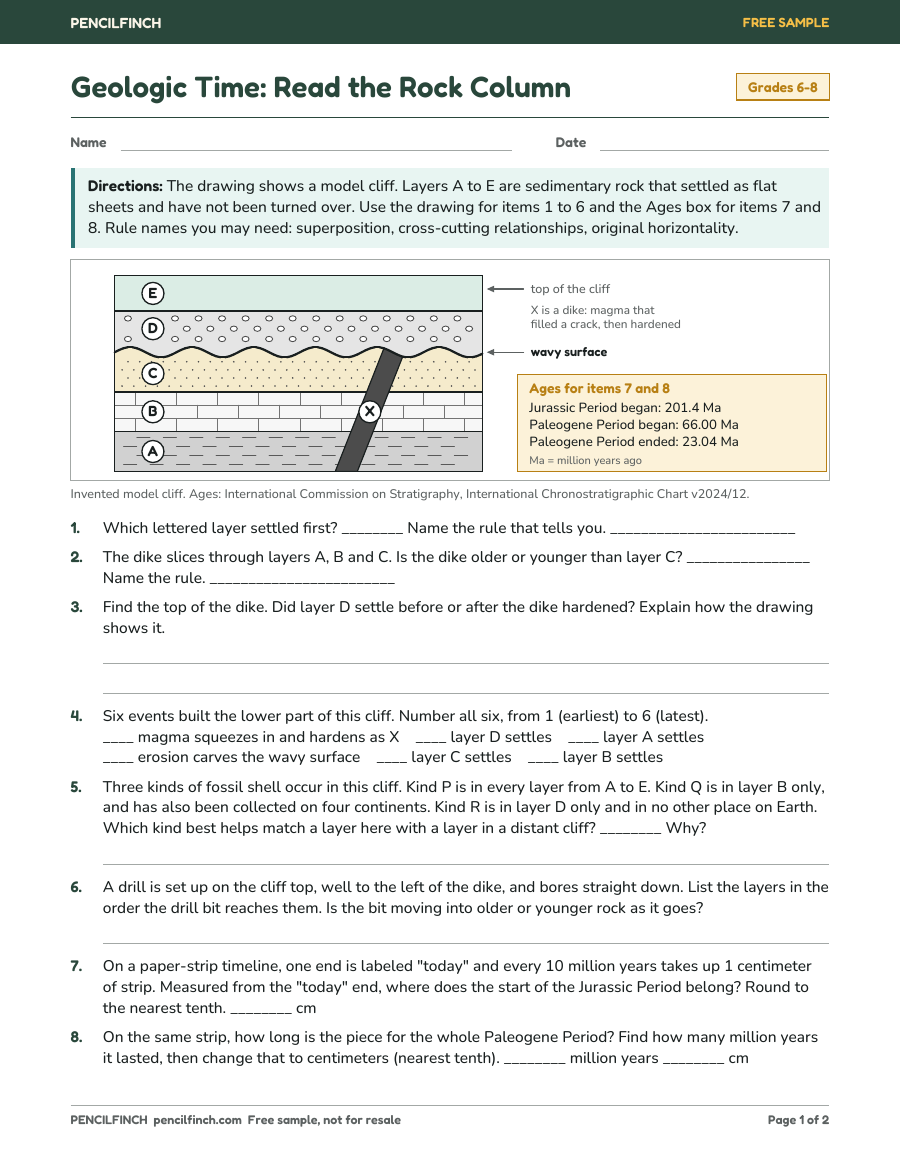 Download the free sample (PDF, 8 items with answer key)
Free to download, no email needed. These problems are not in the paid unit.
What is in the full unit
| Full unit | Geologic Time Scale Science Lessons | Relative Dating & Fossils | Grades 6-8 |
|---|---|
| Pages | 29 pages in one PDF |
| Answer key | Included with Rubric |
| Standards | NGSS MS-ESS1-4 |
| Grades | 6-8 |
| Price on TPT | USD 4.50 |
Get the full unit on TPT (USD 4.50)
- Lesson 1, reading rock layers: strata, superposition, original horizontality, relative vs. numerical age, dikes and faults (cross-cutting relationships), unconformities as missing time (the Grand Canyon's Great Unconformity), index fossils and correlation. Students order seven events in a drawn rock column, read a tilted-and-faulted section, and use simulated fossil finds at three sites to choose an index fossil and defend a correlation.
- Lesson 2, the geologic time scale: eons, eras and periods, how boundaries were placed at changes in the fossil record and numerical ages added later, major events as evidence in strata (oldest rocks, earliest stromatolites, the Cambrian, two great mass extinctions, the Ice Age, earliest Homo sapiens), the Grand Canyon's three rock sets, and a scale model (1 m = 100 million years). Students compute scale distances, mark a to-scale bar, compute period lengths from real ICS ages and refute the claim "all periods are equal".
- Two Prove-it tasks with CER. Real data: International Commission on Stratigraphy chart v2024/12 base ages for every period, era and eon; NPS Grand Canyon ages; USGS, NASA, NPS and Smithsonian ages for the major events. The rock-column models and the three-site fossil data are drawn models and say so.
- Explanation pages with two scene illustrations drawn in code (no AI image generator), block cross-sections, a correlation figure, a to-scale time bar and a Grand Canyon column; guided notes, reading checks, two pages of picture vocabulary cards and a 10-question quiz.
- Answer key for every question with scoring rules, completed notes figures, the marked rock column, the completed scale bar and chart, and model CER answers; a two-lesson plan with an optional warm-up, misconceptions and data notes for the teacher.
Pages from the unit
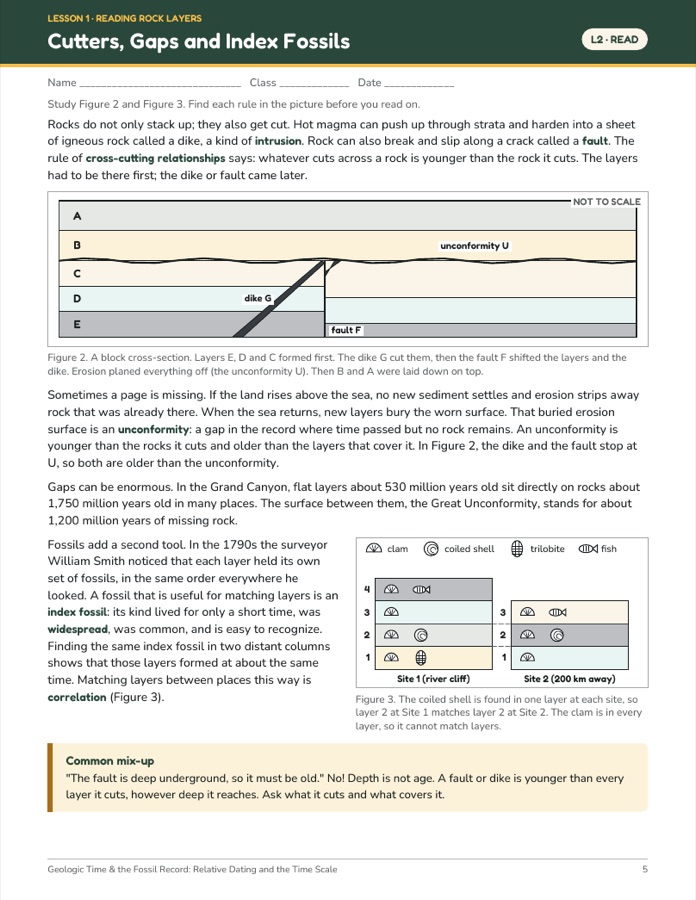
Page 5 of 29 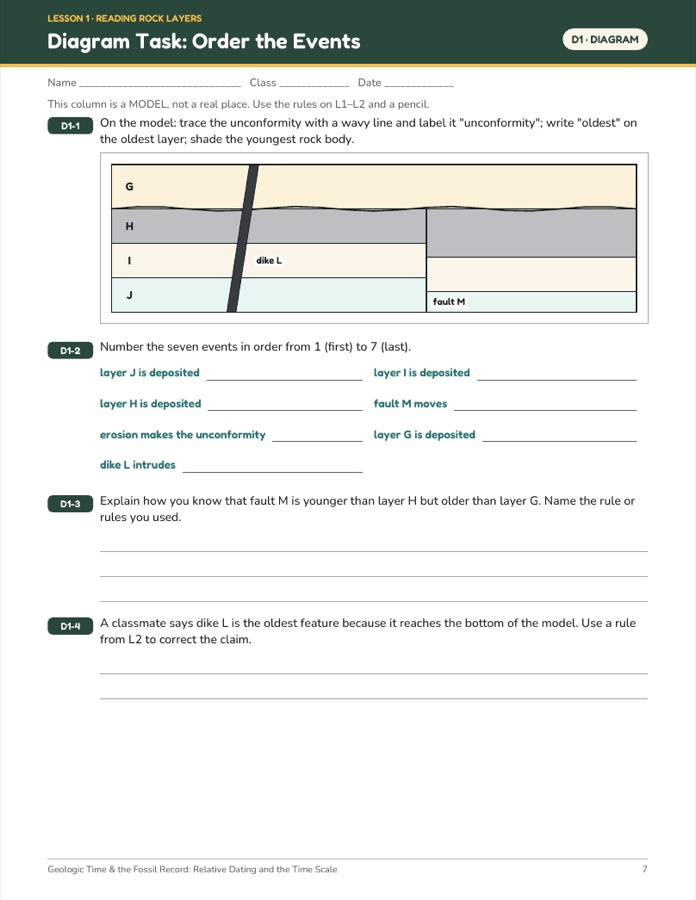
Page 7 of 29 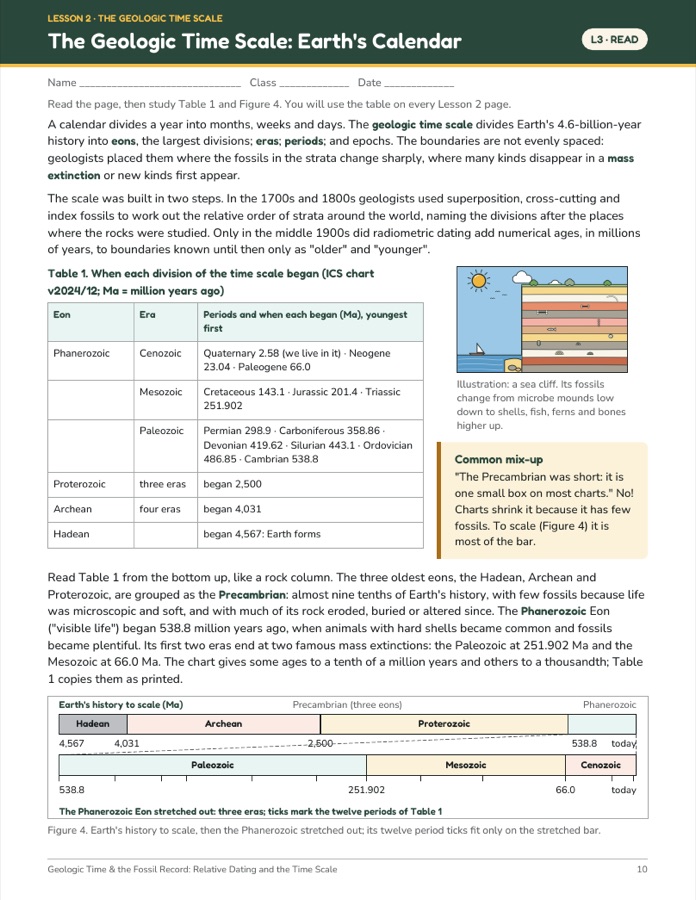
Page 10 of 29
Student pages are designed to print in black and white; all labels, letters, ages, symbols and diagrams are printed text and vector drawings.
How teachers use it
The geologic time scale divides Earth's 4.6-billion-year history into eons, eras and periods, with many of its boundaries placed where the fossils in the rock layers change sharply. Each lesson is planned for about 50 minutes. Students read the explanation pages, then work the guided notes, a diagram task and a reading check, and close with a Prove-it task and a claim-evidence-reasoning write-up.
The free sample on this page is a one-page practice set on the geologic time scale and relative dating with an answer key. Its items are new and are not in the paid unit, so you can use it as a pre-check or an exit ticket and still teach the full lessons afterward.
The unit teaches the evidence before the chart. Lesson 1 gives students the rules for ordering layers and events (superposition, original horizontality, cross-cutting relationships, unconformities) and uses index fossils to match layers between sites. Lesson 2 then shows how that evidence was organized into the time scale, and a scale model of 1 meter for 100 million years lets students see how much of Earth's history is Precambrian. The listed prerequisites are reading a table and a diagram, subtracting decimals, dividing by 100 and using a ruler.
The unit supports and connects to NGSS MS-ESS1-4 (construct an explanation from evidence in rock strata for how the geologic time scale organizes Earth's 4.6-billion-year history). Following the assessment boundary, no question asks students to recall a period name from memory. That is not a claim of full alignment.
Before and after this topic
In the order used on this site, this page comes after weathering, erosion and deposition, the processes that make the sediment and the erosion surfaces students read in rock layers here.
- Before this topicWeathering, Erosion, Deposition Worksheets Grades 6-8 (Free Sample)
- All topics in this lineMiddle School Earth and Space Science Worksheets (Grades 6-8)
Common questions
Is the free worksheet the same as a page from the paid unit?
No. The sample is written separately for this site, and its items are not in the unit. It uses the same page style, so you can see what the student pages look like before you buy.
Do students have to memorize the names of the periods?
No. Following the MS-ESS1-4 assessment boundary, no question asks students to recall a period name from memory. Students read the names and ages from a table printed on the pages.
Are the ages real?
Yes. The period, era and eon ages are the base ages from the International Commission on Stratigraphy chart v2024/12, the Grand Canyon ages come from the National Park Service, and the major-event ages come from USGS, NASA, NPS and Smithsonian sources. The rock-column models and the three-site fossil data are drawn models and are labeled that way.