How to Teach Metric Conversions in Middle School (Grades 6-8)
Students need to leave this topic able to rewrite a measurement in another metric unit and to tell, before they calculate, whether the number should come out larger or smaller. The usual sticking point is not the arithmetic but direction: they shift the decimal point the wrong way, or the right way by the wrong number of places. This note gives you the idea in plain words, three wrong ideas with a reply for each, a short board lesson and three check questions.
Printable for this topic: Metric Conversions Worksheets for Grades 6-8 (Free Sample + Full Unit) (free sample page and the full unit).
The idea in plain words
A metric conversion rewrites the same measurement in a unit of a different size by multiplying or dividing by a power of 10. The amount does not change. Only the size of the unit changes, and the number changes to make up for it.
The prefixes tell you the unit size. In the NIST table, kilo is 1000 of the unit with no prefix (meter, gram or liter), hecto is 100 and deka is 10; deci is a tenth of it, centi a hundredth and milli a thousandth. This note calls that unprefixed unit the base unit, as many classroom charts do; in the SI itself, the base unit of mass is the kilogram. Put in order, each prefix is 10 times the one after it, which is why they can be drawn as a staircase.
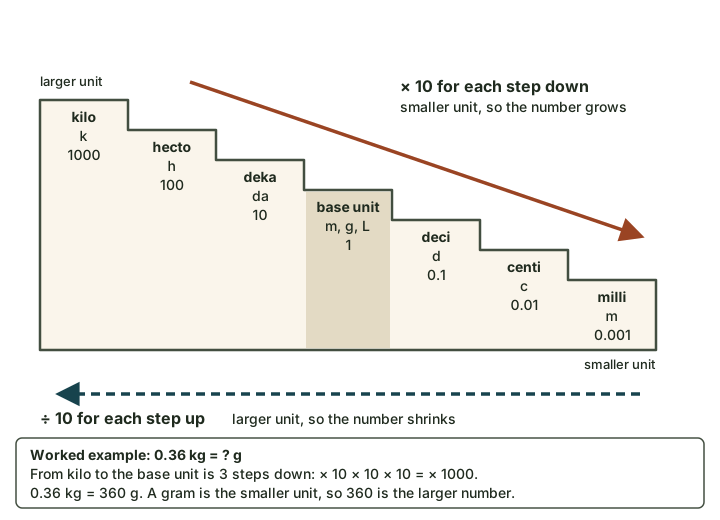
Going down the stairs, the unit gets smaller, so it takes more of them and the number grows. Going up, the unit gets larger, so it takes fewer and the number shrinks. Everything else in this topic is counting steps.
Three misconceptions and what to say
"The number went up, so now there is more."
In everyday life a larger number does mean more, as long as the unit stays the same. Here the unit changes too. Demonstration: have two students measure the same pencil, one in centimeters and one in millimeters. They might report 17 and 170. Hold up the pencil and ask: "Did it grow?" Then ask which they would rather have, 1 dollar or 100 cents.
"A kilometer is big, so to get kilometers I multiply."
Students link "big unit" with "big answer" and multiply when they should divide. The fix is one question asked before any calculation: "Will it take more of the new unit, or fewer?" Fewer large units are needed to cover the same amount, so the number must shrink. Have students write "more" or "fewer" in the margin first; a wrong direction then shows up before the arithmetic starts.
"Kilo, centi, milli: that is three prefixes, so each one is one jump."
Many classes use only three prefixes, so students picture them side by side and move the decimal one place from centimeters to meters. Keep hecto, deka and deci on the staircase even if you never measure with them. They hold the places. With all seven steps drawn, students can count that centi to the base unit is two steps and milli to the base unit is three.
A 10-minute mini-lesson
- (1 minute) Write "1 m = 100 cm" on the board. Ask: "Which side has the larger unit? Which side has the larger number?" Let students notice that they are opposite sides.
- (2 minutes) Draw the seven-step staircase and have students copy it at the top of their paper. Ask: "If I walk down one step, are the units getting larger or smaller?"
- (1 minute) Write three questions to ask every time:
- Which unit is smaller?
- So will the number grow or shrink?
- How many steps apart are the two units?
- (2 minutes) Model 0.36 kg in grams with the three questions: grams are smaller, the number grows, three steps, so 360 g. Then model 480 mm in meters: meters are larger, the number shrinks, three steps, so 0.48 m. Point out the zero written before the decimal point.
- (3 minutes) Students try two on paper: 7.3 m in centimeters and 85 mL in liters. They must write the answers to the three questions before the result. Check together: 730 cm and 0.085 L.
- (1 minute) Ask one student to explain why 730 cm and 7.3 m describe the same length.
Quick check
- Which is the longer distance, 0.9 km or 950 m? Show the conversion you used.
- Put these masses in order from least to greatest: 3 g, 250 mg, 0.04 kg.
- A medicine cup holds 15 mL. Write that volume in liters, and say how many steps you counted and in which direction.
Answers: 1. 950 m is longer, because 0.9 km = 900 m (three steps down, so multiply by 1000). 2. 250 mg, 3 g, 0.04 kg. In grams they are 0.25 g, 3 g and 40 g. 3. 0.015 L. Milliliters to liters is three steps up, so divide by 1000.
Sources
- National Institute of Standards and Technology (NIST), "Metric (SI) Prefixes": https://www.nist.gov/pml/owm/metric-si-prefixes
- National Institute of Standards and Technology (NIST), "Writing with Metric Units": https://www.nist.gov/pml/owm/writing-si-metric-system-units
The full unit
Lab Safety & Metric Measurement Science Lessons | Lab Equipment | Grades 6-8
28 pages, grades 6-8, answer key included with rubric. USD 4.50
Get the full unit on TPT (USD 4.50)
Next topics
- After this topicDensity Worksheets for Grades 6-8 (Free Sample + Full Unit)
- All topics in this lineMiddle School Physical Science Worksheets (Grades 6-8)