How to Teach the French Plus-que-parfait (French 3)
French 3 students should come away able to step back from a moment in the past and say what had already happened by then. The form costs them little, because it reuses what they know from the passé composé. The idea of a reference point is harder, and without it they use the tense for anything that feels far away. This page gives you the rule with its limits, three wrong ideas with a reply for each, and a short board lesson.
Printable for this topic: Plus-que-parfait Worksheets for French 3 (Free Sample + Pack) (free sample page and the full unit).
The idea in plain words
The plus-que-parfait puts avoir or être in the imparfait and adds the past participle; it marks an action as already complete before another past action or moment. English does the same job with "had" + participle: Quand j’ai allumé mon téléphone, ma mère m’avait déjà envoyé trois messages.
Nothing else about the verb changes. Each verb keeps the helping verb it has in the passé composé, and its participle agrees in the same cases: Quand le proviseur a commencé son discours, Margaux et sa sœur étaient déjà entrées dans la salle. Short adverbs such as déjà go between the helping verb and the participle, as in that sentence.
The tense needs a past reference point, stated or clear from context. Two past actions told in the order they happened do not call for it: Julien a dîné, puis il a fait la vaisselle. French uses the plus-que-parfait in other places too, in si clauses about the past for example, but the earlier-of-two-actions use is the one to secure first.
Three misconceptions and what to say
"Plus-que-parfait means more past, so I use it for things that happened a long time ago."
The name invites this reading. A student will write *Mon arrière-grand-mère avait quitté l’Italie en 1950. as a sentence standing alone, because 1950 feels remote. Distance from today does not matter; the passé composé handles any finished event, however old: Mon arrière-grand-mère a quitté l’Italie en 1950. Ask, "Before what?" If the student cannot name a second past moment, the plus-que-parfait has nothing to stand on.
*Manon avait allé à la pharmacie avant le dîner.
English "had" looks like avoir, so students write avait in front of every participle. Put the passé composé beside it: Manon est allée becomes Manon était allée. The helping verb keeps its identity and only its tense moves, from present to imparfait; the agreement on allée stays exactly where it was. Students who convert from the passé composé instead of translating from English rarely make this error.
"After quand, any past tense will do. They all just mean it happened in the past."
Students hear three past tenses as three ways to say the same thing. Show that each one tells a different story about the same two people: Quand le directeur est entré, Mathilde distribuait les copies (she was in the middle of it). Quand le directeur est entré, Mathilde a distribué les copies (he came in, then she did it). Quand le directeur est entré, Mathilde avait distribué les copies (every desk already had one). Ask what is on the desks at the moment the door opens in each version.
A 10-minute mini-lesson
- (2 minutes) Draw a timeline with "now" at the right end. Mark an X and write 20 h : Julien est arrivé. Ask, "Which tense is this, and why?"
- (2 minutes) Mark a second X to the left: 19 h : son frère a réparé le vélo. Say, "Stand at eight o’clock with Julien and look back. How do we say the bike was already fixed?" Write Quand Julien est arrivé, son frère avait réparé le vélo.
- (2 minutes) Write a, then avait; est, then était. Ask, "What changed? What stayed?" On paper, students convert elle a vu, ils sont venus and nous avons reçu.
- (1 minute) Ask, "Where would déjà go?" Take one guess, then write avait déjà réparé and underline the position.
- (3 minutes) In pairs, students write two events with clock times on paper, swap with another pair, and join the two events they receive with quand. Ask two pairs to read theirs aloud and have the class say which event came first.
Quick check
Items 1 and 2 need a plus-que-parfait; the infinitive is in parentheses. For 3, answer in English.
- Baptiste a appelé l’hôtel parce qu’il ________ (laisser) son passeport dans la chambre.
- Heureusement, Clémence et Zoé ________ (rentrer) du lycée quand il a commencé à pleuvoir.
- Quand Élise est entrée dans la cuisine, son frère avait vidé le lave-vaisselle. Which of the two actions happened first?
Answers: 1. avait laissé: laisser takes avoir, so the imparfait of avoir plus laissé; leaving the passport came before the call. 2. étaient rentrées: rentrer takes être here, and the participle agrees with two girls, so -es; getting home came before the rain. 3. The brother emptied the dishwasher first: avait vidé is the plus-que-parfait, so that action was already complete when Élise came in.
Sources
- University of Texas at Austin, Tex’s French Grammar, "plus-que-parfait" (read 2026-11-22): auxiliary in the imparfait + past participle; same choice of auxiliary as the passé composé; an action that precedes another past action or moment; English had + past participle; often with déjà; also used in si clauses. https://www.laits.utexas.edu/tex/gr/tap9.html
- University of Texas at Austin, Tex’s French Grammar, "placement of adverbs with passé composé" (read 2026-11-22): in all compound tenses, adverbs are placed right after the auxiliary and just before the past participle; some longer adverbs in -ment may follow the participle. https://www.laits.utexas.edu/tex/gr/adv3.html
- CNRTL, Trésor de la langue française informatisé, « plus-que-parfait » (read 2026-11-22): "Temps composé du verbe servant à exprimer l’aspect accompli et l’antériorité d’une action passée par rapport à une autre action passée." https://www.cnrtl.fr/definition/plus-que-parfait/nom
- Le Robert, Dico en ligne, « plus-que-parfait » (read 2026-11-22): "Temps composé du passé dans lequel l’auxiliaire est à l’imparfait, qui exprime une action accomplie et antérieure à une autre action passée." https://dictionnaire.lerobert.com/definition/plus-que-parfait
- Office québécois de la langue française, Banque de dépannage linguistique, « Emploi des auxiliaires avoir et être » (read 2026-11-22): the auxiliaries form every compound tense; être serves certain intransitive verbs of movement or transformation, such as aller, arriver, entrer and venir. https://vitrinelinguistique.oqlf.gouv.qc.ca/24224/la-grammaire/le-verbe/auxiliaires/emploi-des-auxiliaires-avoir-et-etre
- Le Robert, conjugation tables (read 2026-11-22) for aller, venir, entrer, rentrer, arriver, laisser, appeler, commencer, pleuvoir, réparer, vider, distribuer, voir, recevoir, envoyer, allumer, quitter, faire: https://dictionnaire.lerobert.com/conjugaison/aller, https://dictionnaire.lerobert.com/conjugaison/venir, https://dictionnaire.lerobert.com/conjugaison/entrer, https://dictionnaire.lerobert.com/conjugaison/rentrer, https://dictionnaire.lerobert.com/conjugaison/arriver, https://dictionnaire.lerobert.com/conjugaison/laisser, https://dictionnaire.lerobert.com/conjugaison/appeler, https://dictionnaire.lerobert.com/conjugaison/commencer, https://dictionnaire.lerobert.com/conjugaison/pleuvoir, https://dictionnaire.lerobert.com/conjugaison/reparer, https://dictionnaire.lerobert.com/conjugaison/vider, https://dictionnaire.lerobert.com/conjugaison/distribuer, https://dictionnaire.lerobert.com/conjugaison/voir, https://dictionnaire.lerobert.com/conjugaison/recevoir, https://dictionnaire.lerobert.com/conjugaison/envoyer, https://dictionnaire.lerobert.com/conjugaison/allumer, https://dictionnaire.lerobert.com/conjugaison/quitter, https://dictionnaire.lerobert.com/conjugaison/faire
The full unit
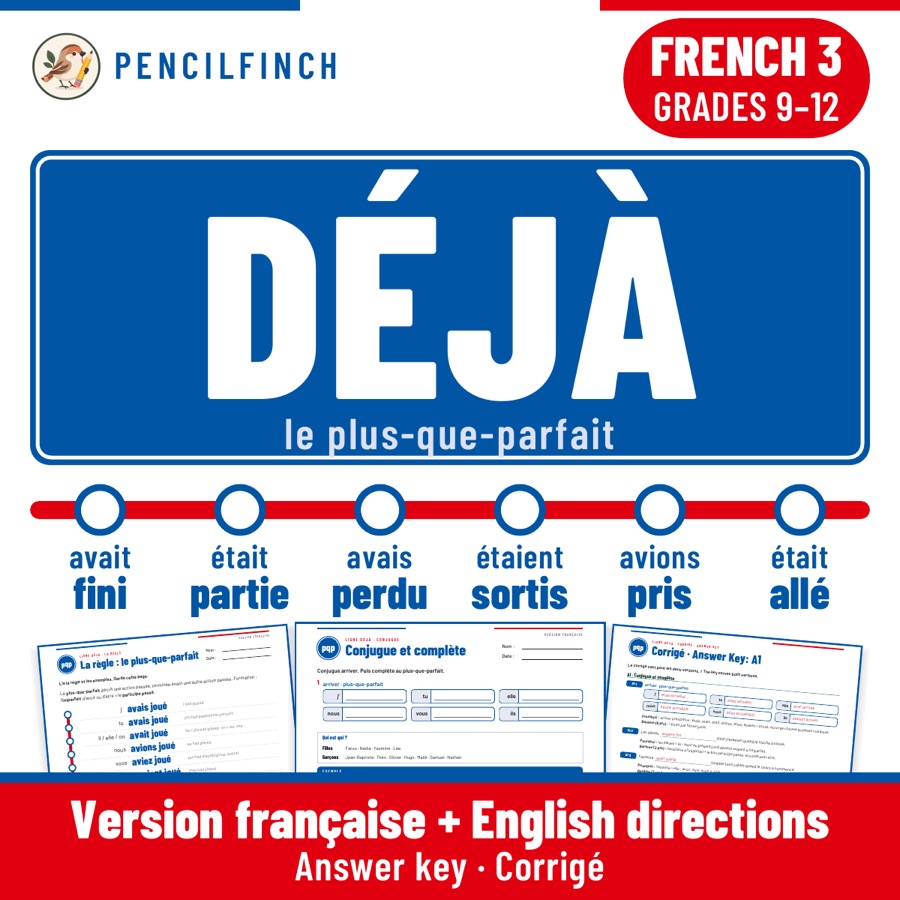
Le plus-que-parfait - French 3 Worksheets en français - Grades 9-12
17 pages, grades 9-12. USD 2.50
Get the full unit on TPT (USD 2.50)
Next topics
- All topics in this lineFrench 3 Worksheets and Quizzes