How to Teach Depuis, Il y a and Pendant (French 2)
French 2 students need two questions, not three rules: is the action still happening right now, and if not, does the number say when it happened or how long it lasted? Those two tests decide among depuis, pendant and il y a, yet most students default to whichever French word their textbook happened to introduce first for the English word "for." This page names the three mix-ups that keep showing up once students start writing their own sentences and gives you a short board lesson to run the day you introduce all three words together.
Printable for this topic: Depuis, Il y a and Pendant Worksheets, French 2 (Free Sample + Pack) (free sample page and the full unit).
The idea in plain words
Depuis gives the start or the length of something still true now; il y a counts back from now to when something happened (ago); pendant gives how long something lasted. Students ask first: is it still going on? If not: when, or how long?
| Word | Pairs with | What it marks |
|---|---|---|
| depuis | présent | action still going on (since / for) |
| il y a | passé composé | counted back from now (ago) |
| pendant | passé composé | how long a finished action lasted (for) |
These pairings are a classroom starting point, not the whole language: pendant works with other tenses (Je vais rester à Dakar pendant deux semaines), il y a with the imparfait (Il y a dix ans, mes parents habitaient à Lille), and depuis with a negative passé composé (Je n’ai pas mangé depuis ce matin).
Three misconceptions and what to say
*Il joue de la batterie pour trois ans. (il a commencé il y a trois ans)
English "for" maps to several French words, and pour is the one students meet first in vocabulary lists (pour + noun = "for" a purpose), so they reach for it even when the sentence is really about elapsed time. The drummer is still playing now, so the sentence needs depuis trois ans, present tense, not pour. Ask the test question out loud every time: is the action still happening? If yes, pour cannot be the answer, no matter how natural the English "for" sounds.
*J’ai habité à Québec depuis trois ans. (j’habite encore à Québec)
English says "I have lived," a compound shape, so students copy that structure straight into French and build a passé composé. But in an affirmative sentence, depuis with an action that is still true takes the présent, even though the English sounds like a past tense: J’habite à Québec depuis trois ans. Write the English sentence and the correct French side by side and circle only the verb tense in each, so students see that the two tenses are supposed to differ and that word-for-word translation causes the error.
*Mon cousin a trouvé ce travail trois mois il y a.
English puts ago after the number (three months ago), so students copy that order, and some avoid il y a altogether because they only know it as "there is." In French, il y a comes before the length of time: Mon cousin a trouvé ce travail il y a trois mois. Write three months ago on the board, draw an arrow that moves ago to the front, then swap it for il y a.
A 10-minute mini-lesson
- Write "Il y a un stylo sur le bureau." Ask what it means (there is). Then write "Il est arrivé il y a dix minutes." Ask if il y a still means "there is" here, and let students notice it does not.
- Teach the test question: « Est-ce que l’action continue maintenant ? » Write "oui" on one side of the board and "non" on the other.
- Say a true statement about yourself with depuis and a number of years. Ask the class, hands up, whether that sentence passes the test.
- Give pairs of students short English sentences with a finished action and ago or for (I slept for two hours; I left two hours ago). Ask « Quand ? » or « Combien de temps ? » and have them choose il y a or pendant, then share one answer each.
- Finish by asking students to write one sentence where il y a means "there is" and one where it means "ago," side by side, so the two jobs of the same two words stay separate.
Quick check
Complete each sentence with depuis, pendant or il y a.
- Mon frère joue aux jeux vidéo ________ une heure et il ne s’arrête pas.
- Mes parents ont acheté ce canapé ________ six mois.
- Les élèves de troisième ont nettoyé la plage ________ tout un samedi.
Answers: 1. depuis, because "il ne s’arrête pas" confirms the playing is still going on right now, so the verb stays in the présent (joue). 2. il y a, because acheter is a finished, dateable event counted back from now, not an ongoing state. 3. pendant, because the cleanup is over and the sentence states how long it lasted (tout un samedi), not when it happened.
Sources
- Larousse, dictionnaire de français, « depuis » (read 2026-11-22): sense 1, "indique le début, le point de départ dans le temps d’une action, d’un état qui dure jusqu’au moment où l’on parle." https://www.larousse.fr/dictionnaires/francais/depuis/23940
- Larousse, dictionnaire de français, « pendant » (read 2026-11-22): "durant tel espace de temps ou durant tout l’espace de temps occupé par une action…" https://www.larousse.fr/dictionnaires/francais/pendant/59176
- Lawless French, "Depuis vs Il y a" (read 2026-11-22): summary table showing depuis + présent for "for/since" an ongoing action, and past tense + il y a + duration for "ago." https://www.lawlessfrench.com/grammar/depuis-vs-il-y-a/
The full unit
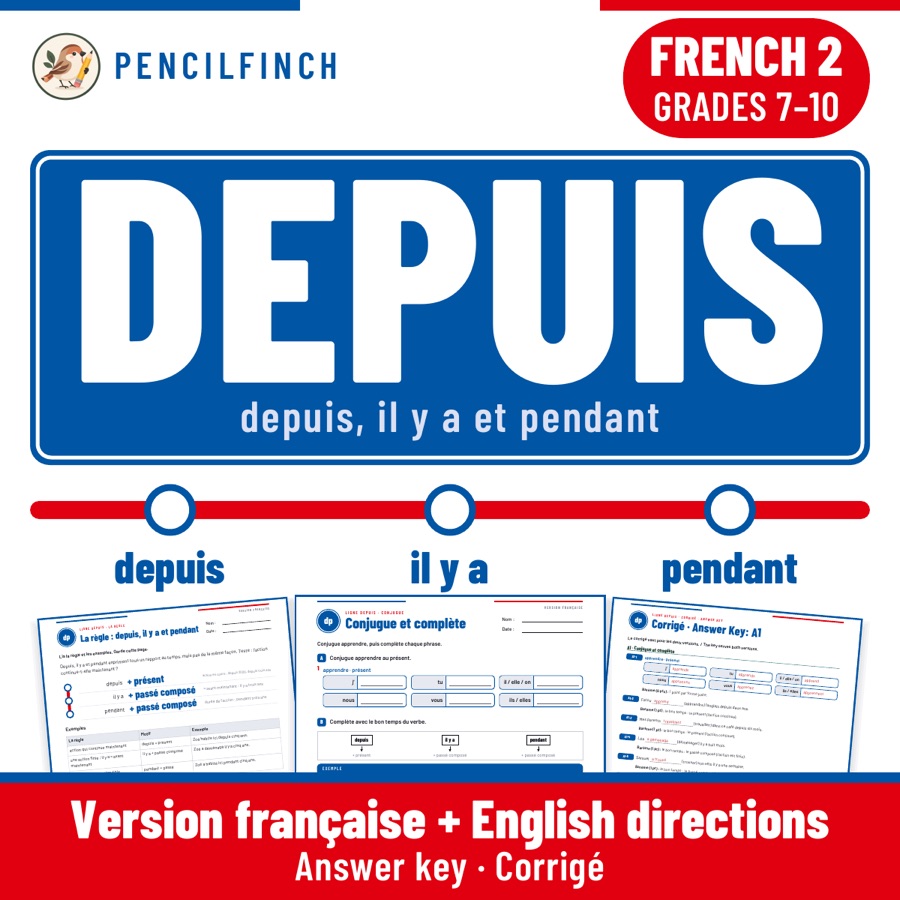
Depuis, il y a et pendant - French 2 Worksheets en français - Grades 7-10
17 pages, grades 7-10, answer key included with rubric. USD 2.50
Get the full unit on TPT (USD 2.50)
Next topics
- Before this topicFrench Imparfait Worksheets for French 2 (Free Sample + Pack)
- After this topicFrench Direct and Indirect Object Pronouns Worksheets (Free Sample)
- All topics in this lineFrench 2 Worksheets, Quizzes and Games