How to Teach the Water Cycle in Middle School (Grades 6-8)
By the end of this topic, students should be able to say what makes water go up, what makes it come down, and why two drops rarely take the same trip. Most of them arrive able to recite four or five process names in a circle, and that circle is exactly where they get stuck. This note gives you the core idea in a few sentences, three wrong ideas you are likely to hear with a reply for each, a short board lesson and three check questions.
Printable for this topic: Water Cycle Worksheets for Grades 6-8 (Free Sample + Full Unit) (free sample page and the full unit).
The idea in plain words
The water cycle is the continuous movement of water between the ocean, the atmosphere, the land surface and the ground. Water sits for a while in a storage place (the U.S. Geological Survey calls these pools), then moves to another one. The largest pool is the ocean, with about 96% of Earth's water.
Two things keep the water moving. Heat from the Sun changes liquid water into water vapor, an invisible gas, and plants add more vapor through their leaves. Gravity does the rest: rain and snow fall, water on the surface runs downhill, and some of it soaks into the soil and moves on through the ground.
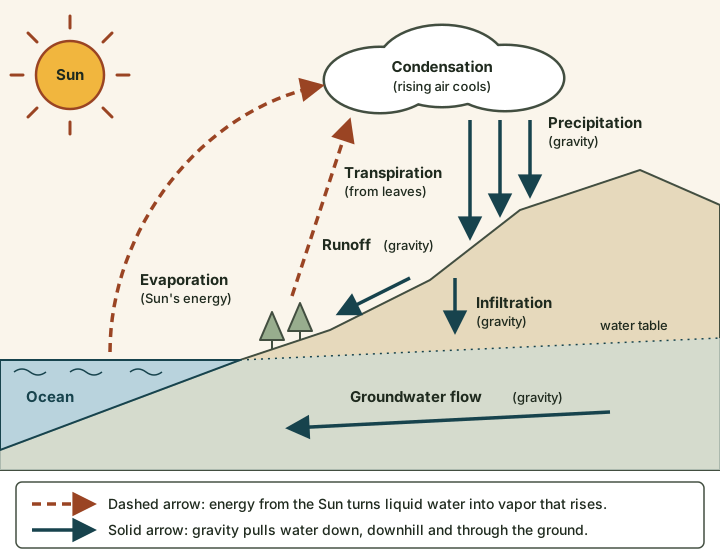
The step in between is condensation. Air that rises gets cooler, and the vapor in it collects on tiny bits of dust, salt and smoke as liquid droplets. Those droplets are the cloud. If students can sort every arrow on a diagram into "Sun" or "gravity", they have a model they can reason with, not only a list of words.
Three misconceptions and what to say
"Water has to boil before it can evaporate."
This is tempting because a steaming kettle is the only time many students have watched water leave. Boiling makes vapor quickly, with bubbles forming inside the liquid, but water also evaporates from its surface at ordinary temperatures, only more slowly. Demonstration: wipe a damp paper towel across the board and ask the class to time how long the wet streak lasts. It is usually gone within a minute or two, and nothing in the room came close to 100 °C.
"Clouds are water vapor."
Students say this because vapor and clouds are both "water up in the air". Vapor is separate water molecules, each one far too small for the eye to pick out. In a cloud they have joined into droplets or ice crystals that scatter light. Demonstration: set an ice-cold drink can on a desk. The film that forms on the outside is liquid that came out of clear air, which is what happens on dust particles inside a cloud. One sentence to repeat: "If you can see it, it is not vapor."
"Every drop goes ocean, cloud, rain, river and back to the ocean."
Textbook diagrams with one ring of arrows teach this by accident. NOAA notes that the simple circle is a useful model but the real cycle is much more complicated, and the USGS reports that most of what evaporates from the oceans falls right back into them; only about 10% is carried over land. Ask: "A raindrop lands in the sea. Which steps of your circle did it skip?" Then have students name a drop that stays in one place for a long time, such as water in a glacier or deep underground.
A 10-minute mini-lesson
- (1 minute) Sketch an ocean, a hill and one cloud on the board with no arrows. Ask: "Where is there water in this picture right now?" Push until someone says "in the air" and "under the ground".
- (2 minutes) Ask: "What could make water go up?" Draw dashed arrows from the ocean and from a plant. Label them evaporation and transpiration and write "Sun" beside both.
- (2 minutes) Ask: "The vapor is invisible. What has to change before we can see a cloud?" Take answers, then write condensation next to the cloud and "air cools as it rises".
- (2 minutes) Ask: "What pulls the water back down, and where can it go after it lands?" Draw solid arrows for precipitation, runoff, infiltration and groundwater flow. Write "gravity" beside all four.
- (2 minutes) On paper, each student writes the trip of one drop in four moves, starting anywhere they like, and marks each move S or G. Condensation gets no letter: it happens where rising air cools. Partners trade papers and find one difference.
- (1 minute) Ask: "Did every drop take the same route? So what is misleading about drawing the cycle as one circle?"
Quick check
- A wet swimsuit hangs in the shade on a cool day and is dry by evening. Name the process and explain how it can happen without boiling.
- After a hot shower, the bathroom mirror is fogged. Is the fog on the mirror water vapor? Explain.
- Rain soaks into a field. Months later, some of that water seeps out of a spring lower on the slope. Name the two processes in order and say what drives both.
Answers: 1. Evaporation. Liquid water changes to vapor at any ordinary temperature when it takes in heat from its surroundings; boiling is not needed. 2. No. The fog is tiny drops of liquid water that condensed when warm, moist air touched the cooler glass; vapor itself is invisible. 3. Infiltration, then groundwater flow. Gravity drives both.
Sources
- U.S. Geological Survey, Water Science School, "Water cycle": https://www.usgs.gov/water-science-school/science/water-cycle
- U.S. Geological Survey, Water Science School, "Evaporation and the Water Cycle": https://www.usgs.gov/water-science-school/science/evaporation-and-water-cycle
- U.S. Geological Survey, Water Science School, "Condensation and the Water Cycle": https://www.usgs.gov/water-science-school/science/condensation-and-water-cycle
- U.S. Geological Survey, Water Science School, "Evapotranspiration and the Water Cycle": https://www.usgs.gov/water-science-school/science/evapotranspiration-and-water-cycle
- U.S. Geological Survey, Water Science School, "Infiltration and the Water Cycle": https://www.usgs.gov/water-science-school/science/infiltration-and-water-cycle
- U.S. Geological Survey, Water Science School, "Groundwater Flow and the Water Cycle": https://www.usgs.gov/water-science-school/science/groundwater-flow-and-water-cycle
- U.S. Geological Survey, Water Science School, "Surface Runoff and the Water Cycle": https://www.usgs.gov/water-science-school/science/surface-runoff-and-water-cycle
- U.S. Geological Survey, Water Science School, "Precipitation and the Water Cycle": https://www.usgs.gov/water-science-school/science/precipitation-and-water-cycle
- NOAA, "The water cycle": https://www.noaa.gov/education/resource-collections/freshwater/water-cycle
- NOAA JetStream, "The Hydrologic Cycle": https://www.noaa.gov/jetstream/atmosphere/hydro
The full unit
Water Cycle Science Lessons | Evaporation, Condensation & Runoff | Grades 6-8
29 pages, grades 6-8, answer key included with rubric. USD 4.50
Get the full unit on TPT (USD 4.50)
Next topics
- After this topicWeathering, Erosion, Deposition Worksheets Grades 6-8 (Free Sample)
- All topics in this lineMiddle School Earth and Space Science Worksheets (Grades 6-8)