How to Teach the French Verb Être in the Present (French 1)
After the first lessons on être, students should produce its six present-tense forms without a chart and attach the right one to any subject: a pronoun, a noun, a pair of people or on. The forms themselves are rarely the hard part; students get stuck where English says to be and French does not, and where the meaning is we but the pronoun is on. This page gives you the rule in plain language with its limits, three mix-ups to expect from English speakers and a short board lesson.
Printable for this topic: French Verb Être Worksheets, Present Tense (Free Sample + Pack) (free sample page and the full unit).
The idea in plain words
Être is the French verb for to be, and it is irregular: its six present-tense forms follow no pattern, so each one is memorized together with its subject pronoun.
| One | More than one |
|---|---|
| je suis | nous sommes |
| tu es | vous êtes |
| il, elle, on est | ils, elles sont |
A noun subject takes a third-person form: est for one (Le tiroir est vide.) and sont for several (Les tiroirs sont vides.). A name plus moi counts as nous, and a name plus toi counts as vous.
On needs a closer look. It always takes est, the singular verb, even when it means nous in everyday speech (On est en retard can mean we are late). The adjective after it usually agrees with the people meant: Paul et moi, on est occupés.
Two facts about sound help with spelling. Es and est are pronounced the same, so only the eye can tell tu es from il est. In vous êtes, the s of vous links to the verb with a z sound; the same link separates ils sont (s sound) from ils ont (z sound), a pair worth contrasting aloud as soon as avoir arrives.
Three misconceptions and what to say
*Je suis quatorze ans.
English gives age with to be (I am fourteen), so students reach for je suis. French treats age as something a person has, and the verb is avoir: J’ai quatorze ans. Write I am 14 and J’ai 14 ans one above the other, box am and ai, and say: in French you have your years. Être is still right with an adjective (Mon chien est vieux.); the number of years goes with avoir.
*Je suis mange une pomme.
English builds I am eating from to be plus a second verb, and students translate word by word. The French present is one word that covers both I eat and I am eating: Je mange une pomme. Give students a habit: when am, is or are comes before an -ing verb, cross out the helper and conjugate only the main verb. In the present tense, a form of être is followed by an adjective, a noun or a place, not by a second conjugated verb.
*Ce soir, on sommes chez Hugo.
The student is thinking we, and sommes is the form learned for we. But the verb goes with the pronoun written on the page, not with the meaning in the writer’s head, and on is always followed by est: Ce soir, on est chez Hugo. Write nous sommes and on est one above the other, put an equals sign between them for the meaning, then circle the two different verbs.
A 10-minute mini-lesson
- (2 minutes) Build the two-column chart on the board with the class, one form at a time. Ask: "Which two forms sound exactly the same?" (es and est) "Which form has an accent, and what is its last letter?" (êtes, with s).
- (2 minutes) Say five subjects aloud: ma tante, mes voisins, Lucas et moi, ta sœur et toi, on. For each one ask: "Which form goes with it? Which pronoun in the chart shares that form?" Students write only the form on paper and hold it up (est, sont, sommes, êtes, est).
- (3 minutes) Write three starters on the board: « Mon sac est ________. », « Les chaises sont ________. », « Nous sommes ________. » Students finish each with a place, not an adjective, so agreement does not get in the way (sous ma chaise, près du tableau, au premier étage). Ask two students to read theirs.
- (2 minutes) Trap round. Write in English: I am thirty. I am reading. We are here (with on). Ask: "Which of these three needs être in French?" Only the last one: On est ici. The other two are J’ai trente ans and Je lis.
- (1 minute) Exit line on paper: the form that goes with on and the form that goes with vous.
Quick check
Items 1 and 3: complete with the present tense of être. Item 2: one sentence should not use être; find it and correct it.
- Avec ma voisine, on ________ dans le même bus le matin.
- a. Ma sœur est très patiente. b. Ma sœur est dix-neuf ans. c. Ma sœur est sur le balcon.
- Les lumières de la rue ________ allumées ce soir.
Answers: 1. est, because the verb goes with on, which takes the singular form even though two people are meant. 2. Sentence b, because age takes avoir: Ma sœur a dix-neuf ans; a (a description) and c (a place) are correct uses of être. 3. sont, because the subject is les lumières, a plural noun; la rue only completes it.
Sources
- University of Texas at Austin, Tex’s French Grammar, "être (to be)" (read 2026-11-22): the six present-tense forms, with on in the il/elle row, and the z-sound liaison in vous êtes. https://www.laits.utexas.edu/tex/gr/virr1.html
- University of Texas at Austin, Tex’s French Grammar, "avoir (to have)" (read 2026-11-22): "the verb avoir expresses age in French, unlike the English equivalent, which uses the verb to be"; liaison distinguishes ils ont from ils sont. https://www.laits.utexas.edu/tex/gr/virr2.html
- University of Texas at Austin, Tex’s French Grammar, "present tense" (read 2026-11-22): one French present form translates the English simple, progressive and emphatic present. https://www.laits.utexas.edu/tex/gr/tapr1.html
- Académie française, Dictionnaire, 9e édition, « on » (read 2026-11-22): "il est toujours suivi d’un verbe à la troisième personne du singulier"; the adjective may agree with the meaning (« Comme on est contents de se retrouver si nombreux ! »). https://www.dictionnaire-academie.fr/article/A9O0421
- Le Robert, guide de grammaire, « Accord de l’adjectif qualificatif avec on (pronom indéfini) » (read 2026-11-22): when on stands for particular people, the adjective agrees with the real subject. https://dictionnaire.lerobert.com/guide/accord-de-l-adjectif-qualificatif-avec-on-pronom-indefini
The full unit
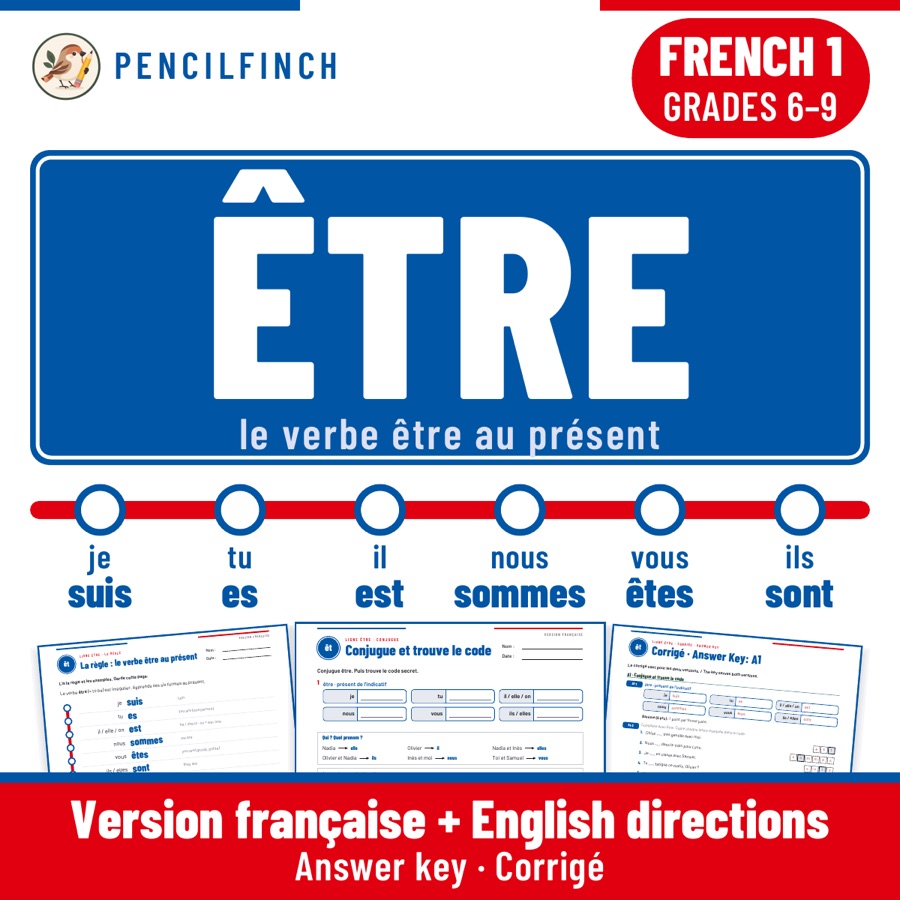
le verbe être au présent de l'indicatif - French - en français - Grades 6-9
18 pages, grades 6-9. USD 1.95
Get the full unit on TPT (USD 1.95)
Next topics
- After this topicFrench Negation Worksheets, Ne... Pas, French 1 (Free Sample + Pack)
- All topics in this lineFrench 1 Worksheets and Quizzes