How to Teach French Stressed Pronouns (French 1)
French 1 students need to see that a stressed pronoun takes over once a pronoun is pulled away from its own conjugated verb: right after a preposition, in the slot c’est leaves open, pushed to the front of a clause for punch, or carrying a whole reply by itself. Most slips come from one habit: reaching for the subject pronoun (il, elle, ils) instead of switching to the stressed set. This page names three common mix-ups and gives you a short board lesson to run after students have met the eight forms.
Printable for this topic: French Stressed Pronouns Worksheets for French 1 (Free Sample + Pack) (free sample page and the full unit).
The idea in plain words
A stressed pronoun, also called a pronom tonique or disjunctive pronoun, is the form a personal pronoun takes when it stands apart from a conjugated verb. French 1 uses eight of them, and four pairs look identical to the subject pronoun they come from:
| Subject | Stressed form |
|---|---|
| je | moi |
| tu | toi |
| il | lui |
| elle | elle |
| nous | nous |
| vous | vous |
| ils | eux |
| elles | elles |
Four forms change completely (je, tu, il, ils become moi, toi, lui, eux); four stay the same (elle, nous, vous, elles). Students who notice that pattern early stop trying to memorize eight new words and learn four instead.
The hard part is not memorizing the chart, it is catching the moment a pronoun steps outside the verb’s normal subject slot. A quick test helps: is the pronoun the subject, sitting right before its own conjugated verb? If yes, use je, tu, il and the others. If it follows a preposition or c’est, stands alone, or is set off by a comma, use the stressed form.
After c’est, eux and elles usually take the plural verb, ce sont, rather than the singular: ce sont eux for a male or mixed group, ce sont elles for an all-female group; c’est eux is common in speech. Nous and vous keep the singular: c’est nous.
Three misconceptions and what to say
*C’est il, le capitaine de l’équipe.
The student keeps the subject pronoun after c’est instead of switching to lui. It is tempting because il is the only third-person word drilled for weeks, so a sentence built around c’est still feels like it needs a subject. The same slip shows up after a preposition too, writing avec il instead of avec lui. Write « C’est ___, le capitaine de l’équipe » on the board with a gap and let students fill it only from the stressed column; once the gap stops looking like a subject slot, il stops looking possible.
*Nous travaillons pour lui cet été. (à propos de ma tante)
Students often treat lui as the all-purpose third-person form, male or female, especially once they have met lui as an indirect object (je lui parle means to him or to her). Here the person meant is ma tante, a woman, so the sentence needs pour elle. Remind students: lui is masculine singular, elle is feminine singular, eux covers an all-male or mixed group, elles an all-female group only. A group with even one boy still takes eux.
*Moi aussi ! (après une phrase négative)
Aussi is the first word students learn for agreeing with someone, so they reach for it no matter what the first speaker said. A negative first statement (ne … jamais, ne … pas) needs a reply with non plus, not aussi. Draw a plus sign over aussi and a minus sign over non plus, then read pairs of statements aloud, alternating polarity, and have students call out only the reply word until the pairing is automatic.
A 10-minute mini-lesson
- Write the eight subject pronouns in a column. Ask, "Which of these can go right after avec or chez?" Have students try each one aloud: avec je and avec il sound wrong; avec nous and avec elle sound fine.
- Build the stressed column next to it as a class. Circle the four forms that did not change (elle, nous, vous, elles).
- Point to a student and ask « Pour qui est ce cahier ? », then have the class answer « C’est pour ___ » with the right form, going around the room.
- Write one true statement about yourself, affirmative, then one negative. Have students write the reply that agrees, "Moi aussi" or "Moi non plus," for each, then compare with a neighbor.
- Name a family member or a group (mon oncle; ma tante et ma cousine; ma tante et mon cousin) and have students call out lui, elle, eux or elles before you confirm.
Quick check
- Mon cousin dort encore. Ne faites pas de bruit près de ________ !
- Léna, sa sœur et son frère partent en camping. Vous campez avec ________ ce week-end ?
- Léna : « Je ne sors jamais le lundi soir. » C’est pareil pour Nathan. Il répond : « ________ ! »
Answers: 1. lui, because près de governs a stressed pronoun and mon cousin is masculine singular. 2. eux, because the group includes a boy (son frère), so French treats it as eux even though a girl is named first. 3. Moi non plus, because Léna’s statement uses ne … jamais and Nathan agrees, so the reply needs non plus, not aussi.
Sources
- TV5MONDE, Apprendre le français, « Les pronoms toniques (moi, toi …) et la préposition « chez » » (read 2026-11-22): the eight-form paradigm and its four uses. https://apprendre.tv5monde.com/fr/aides/grammaire-les-pronoms-toniques-moi-toi-et-la-preposition-chez-0
- OQLF, Banque de dépannage linguistique, « Accord et emploi de c’est et ce sont » (read 2026-11-22): before eux/elles the plural is recommended; before nous/vous the singular is required. https://vitrinelinguistique.oqlf.gouv.qc.ca/21603/la-grammaire/le-verbe/accord-du-verbe-avec-le-sujet/cas-particuliers-daccord-du-verbe/accord-et-emploi-de-cest-et-ce-sont
The full unit
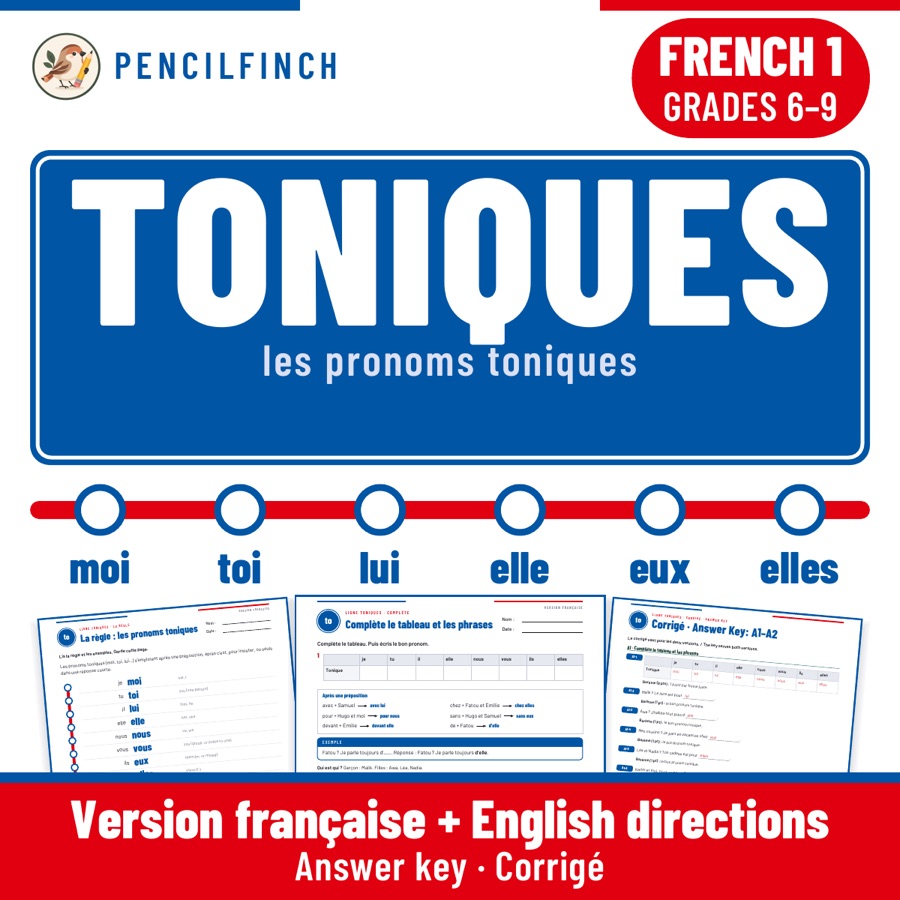
Les pronoms toniques - French 1 Worksheets en français - Grades 6-9
17 pages, grades 6-9, answer key included with rubric. USD 2.50
Get the full unit on TPT (USD 2.50)
Next topics
- Before this topicFrench Adjective Agreement Worksheets, French 1 (Free Sample + Pack)
- All topics in this lineFrench 1 Worksheets and Quizzes