How to Teach the Passé Composé with Avoir (French 2)
By the end of this topic, French 2 students should be able to say what somebody did, with two words where English often uses one. The helping verb is rarely the problem, since they have known avoir from French 1. They get stuck on the second word, the participle, and on where the negative goes. This page gives you the rule with its limits, three typical errors with a reply for each, and a short board lesson.
Printable for this topic: Passé Composé with Avoir Worksheets, French 2 (Free Sample + Pack) (free sample page and the full unit).
The idea in plain words
The passé composé with avoir is the present tense of avoir followed by the past participle of the main verb. Only avoir changes with the subject; the participle stays as it is: Le facteur a trouvé un chaton devant la porte. One French form covers three English ones, "he found," "he has found" and "he did find."
Regular verbs form the participle from the infinitive. Verbs in -er take -é (trouver, trouvé). Verbs in -ir like finir take -i (remplir, rempli), and so do dormir and servir. Verbs in -re like vendre take -u (répondre, répondu). The patterns stop there: many common verbs have a participle to learn by heart, such as eu, été, fait, pris, mis, dit, écrit, vu, lu, bu, pu, voulu, reçu, ouvert and couru.
Two more points belong in the first week. In the negative, ne and pas go around avoir and the participle comes after: Elle n’a pas rempli le formulaire. And the subject leaves the participle alone: Les musiciennes ont travaillé tout le week-end, with no added -es. A participle can agree with a direct object that comes ahead of the verb, but that is a later topic; leave it out for now. The verbs that take être are a later topic too.
Three misconceptions and what to say
*J’ai allé chez le dentiste lundi.
Once students own avoir + participle, they use it for every verb, and English gives no warning because "I went" and "I ate" look alike. A small group of verbs of movement or change, aller among them, take être: Je suis allé chez le dentiste lundi (allée if je is a girl or a woman). You do not need to teach that list during this unit, but say plainly that it exists, and correct j’ai allé every time you hear it so that it does not settle in.
*Je n’ai répondu pas.
In the present, students learned to put ne and pas around "the verb," and they treat ai répondu as one verb. Ask, "Which word is conjugated?" It is ai. Draw a box around ai alone, write n’ before the box and pas after it, then add the participle outside: Je n’ai pas répondu. The English "did not answer" has the same order, helper, not, main verb, so point to it.
*J’ai couri dans le parc.
A student who writes this has applied the -ir pattern correctly to a verb the pattern does not cover. Say so, and praise the reasoning. Then restate the limit: -i is for verbs like finir. Courir gives couru (J’ai couru dans le parc.) and ouvrir gives ouvert, and the same caution applies to -re, where prendre gives pris, not *prendu. Keep a short irregular list on the wall and add to it when a new verb comes up.
A 10-minute mini-lesson
- (2 minutes) Write "he found," "he has found," "he did find." Ask, "How many French sentences do I need?" Write il a trouvé under all three.
- (2 minutes) Write the six present forms of avoir in a column and trouvé beside each. Ask, "Which word changed when the subject changed? Which one never moved?"
- (2 minutes) Draw three columns headed -er, -ir like finir, -re like vendre. Call out trouver, remplir, répondre, gagner, entendre, grandir. Students write each participle on paper, then hold it up.
- (2 minutes) Write fait, pris, mis, dit, écrit, vu on the board, out of order. Ask, "Which infinitive does each come from? Could you have guessed it from the three columns?" (No: these are learned.)
- (2 minutes) Write Le facteur a trouvé un chaton. Ask, "Where is the conjugated verb?" Box a, then ask a student to place n’ and pas. Students make two more sentences negative on paper.
Quick check
- Complete with the passé composé: Hier soir, Clémence et sa sœur ________ (remplir) trois cartons de livres.
- Make the sentence negative with ne and pas: Vous avez entendu l’annonce.
- Complete with the passé composé: Pendant les vacances, Antoine ________ (écrire) deux cartes postales à son parrain.
Answers: 1. ont rempli: two people, so ont, and rempli takes no -es, since the subject never changes a participle used with avoir. 2. Vous n’avez pas entendu l’annonce. Here n’ and pas go around avez, and entendu follows. 3. a écrit: écrire has an irregular participle, écrit, not *écrivé or *écri.
Sources
- University of Texas at Austin, Tex’s French Grammar, "passé composé with avoir" (read 2026-11-22): present tense of the auxiliary + past participle; three English translations; -er gives -é, regular -ir gives -i, regular -re gives -u; list of irregular participles (eu, été, fait, ouvert, pris, mis, bu, vu, dit, lu, écrit, pu, voulu, reçu); ne ... pas around the auxiliary. https://www.laits.utexas.edu/tex/gr/tap2.html
- Office québécois de la langue française, Banque de dépannage linguistique, « Généralités sur le passé composé » (read 2026-11-22): « On forme le passé composé avec l’auxiliaire avoir ou être au présent de l’indicatif et le participe passé du verbe conjugué. » https://vitrinelinguistique.oqlf.gouv.qc.ca/24218/la-grammaire/le-verbe/temps-grammaticaux/passe/generalites-sur-le-passe-compose
- Office québécois de la langue française, Banque de dépannage linguistique, « Accord du participe passé employé avec l’auxiliaire avoir » (read 2026-11-22): the participle agrees with the direct object, and only when that object is placed before the verb. https://vitrinelinguistique.oqlf.gouv.qc.ca/21546/la-grammaire/le-verbe/accord-du-participe-passe/avec-lauxiliaire-avoir/accord-du-participe-passe-employe-avec-lauxiliaire-avoir
- Office québécois de la langue française, Banque de dépannage linguistique, « Emploi des auxiliaires avoir et être » (read 2026-11-22): avoir is the more frequent auxiliary; être serves certain intransitive verbs of movement or transformation, such as aller, arriver, partir, venir. https://vitrinelinguistique.oqlf.gouv.qc.ca/24224/la-grammaire/le-verbe/auxiliaires/emploi-des-auxiliaires-avoir-et-etre
- Le Robert, conjugation tables (read 2026-11-22) for avoir, trouver, remplir, répondre, entendre, écrire, courir, aller, dormir, servir, gagner, grandir, travailler, offrir: https://dictionnaire.lerobert.com/conjugaison/avoir, https://dictionnaire.lerobert.com/conjugaison/trouver, https://dictionnaire.lerobert.com/conjugaison/remplir, https://dictionnaire.lerobert.com/conjugaison/repondre, https://dictionnaire.lerobert.com/conjugaison/entendre, https://dictionnaire.lerobert.com/conjugaison/ecrire, https://dictionnaire.lerobert.com/conjugaison/courir, https://dictionnaire.lerobert.com/conjugaison/aller, https://dictionnaire.lerobert.com/conjugaison/dormir, https://dictionnaire.lerobert.com/conjugaison/servir, https://dictionnaire.lerobert.com/conjugaison/gagner, https://dictionnaire.lerobert.com/conjugaison/grandir, https://dictionnaire.lerobert.com/conjugaison/travailler, https://dictionnaire.lerobert.com/conjugaison/offrir
The full unit
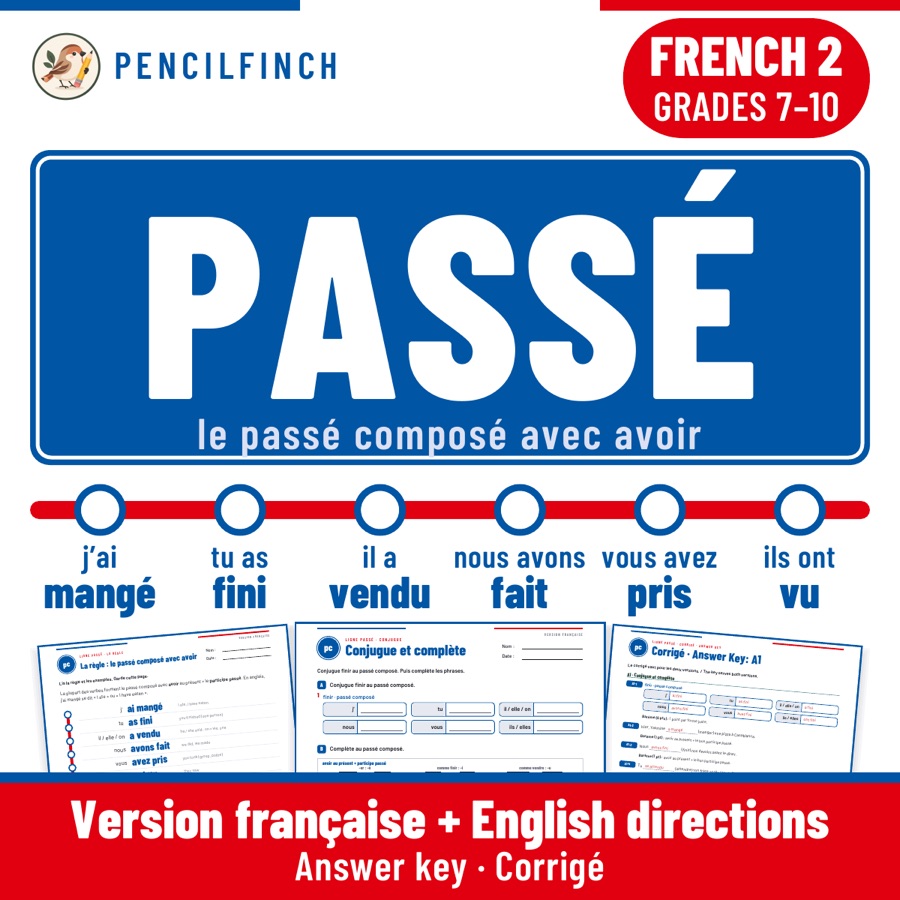
Le passé composé avec avoir - French 2 Worksheets en français - Grades 7-10
17 pages, grades 7-10, answer key included with rubric. USD 2.50
Get the full unit on TPT (USD 2.50)
Next topics
- After this topicFrench Imparfait Worksheets for French 2 (Free Sample + Pack)
- All topics in this lineFrench 2 Worksheets, Quizzes and Games