How to Teach French Negation with Ne... Pas (French 1)
Students should leave this topic able to do three things in writing: put ne and pas on either side of the conjugated verb, switch to n’ when the verb starts with a vowel sound, and change the article after pas when the rule calls for it. They get stuck because English says not with one word, and because the French they hear in songs and videos often has no ne at all. This page gives you the rule with its limits, three mix-ups to expect and a short board lesson.
Printable for this topic: French Negation Worksheets, Ne... Pas, French 1 (Free Sample + Pack) (free sample page and the full unit).
The idea in plain words
Ne... pas is a negation in two parts: ne stands just in front of the conjugated verb, and pas follows that verb directly (Le bus ne passe pas le dimanche.). When the verb begins with a vowel or with a mute h (h muet), ne becomes n’ (Je n’utilise pas ce stylo. Ils n’hésitent pas.). When a second verb follows in the infinitive, the two parts still go around the conjugated one (Tu ne dois pas courir ici.).
The article rule has three cases, and students need all three at once.
| Before the noun | After pas | Example |
|---|---|---|
| un, une and des, plus du, de la and de l’ | de (d’ when a vowel or a mute h comes next) | Elle ajoute de l’ail. Elle n’ajoute pas d’ail. |
| le, la, l’, les | no change | Je ne trouve pas les ciseaux. |
| any article, after être | no change | Ce n’est pas un accident. |
The change to de concerns a direct object, the thing the verb acts on. A sentence that corrects one thing with another keeps the full article as well (Je ne veux pas du thé, mais du café.); that case can wait until the basic rule is secure.
Three misconceptions and what to say
*Je comprends pas la question. (in a written answer)
This is what students hear: in relaxed spoken French, ne is often dropped, and learners who watch French videos notice it quickly. In writing, both parts are expected. Tell the class that their ear is right about speech, then set the classroom rule for paper: a written negative has two pieces, and each student underlines both before handing work in. Je ne comprends pas la question.
*Je ne pas trouve mon cahier.
English puts not in front of the main verb (I do not find), and ne pas next to each other looks like one word for not. In French the verb sits between the two parts: Je ne trouve pas mon cahier. On the board, draw square brackets around the verb, then write ne just outside the left one and pas just outside the right one, and ask: "What is inside the brackets?" Only the conjugated verb.
*Le prof ne donne pas des devoirs ce soir.
English keeps its little word (the teacher is not giving any homework), and the student has correctly learned des devoirs, so nothing signals a change. After pas, des becomes de: Le prof ne donne pas de devoirs ce soir. Give one question to ask every time: "Is the verb être?" If it is, leave the article alone. If it is not, and un, une or des, or du, de la or de l’, comes right after pas, write de.
A 10-minute mini-lesson
- (1 minute) Write « Je cours. » on the board. Ask: "Which word is the conjugated verb? Where do the two parts of the negative go?" Add ne and pas: « Je ne cours pas. »
- (2 minutes) Write four verb forms: il arrive, nous habitons, vous cherchez, elles hésitent. For each one ask: "Ne or n’? What is the first sound of the verb?" Students answer on paper, then you write the negatives (il n’arrive pas, nous n’habitons pas, vous ne cherchez pas, elles n’hésitent pas).
- (3 minutes) Write three sentences: « J’ai une trottinette. » « Il prend du sucre. » « C’est une trottinette. » Students make each one negative on paper. Ask: "In which sentences did the article change? Which verb is in the sentence that kept its article?" Then write the three negatives: Je n’ai pas de trottinette. Il ne prend pas de sucre. Ce n’est pas une trottinette.
- (2 minutes) Write « Je sais pas. » and say it the way a French teenager would. Ask: "What is missing on paper?" Have a student come up and add it.
- (2 minutes) Each student writes two true negative sentences about themselves, one with avoir and one with être. A neighbor checks for two parts and for the article.
Quick check
Turn each statement into a negative one and write it out in full.
- Clément achète des timbres.
- Ces fleurs sont des roses.
- Thomas utilise l’ascenseur.
Answers: 1. Clément n’achète pas de timbres, because achète starts with a vowel (n’) and des becomes de after pas. 2. Ces fleurs ne sont pas des roses, because after être the article des does not change. 3. Thomas n’utilise pas l’ascenseur, because utilise starts with a vowel (n’) and l’ is a definite article, which stays as it is.
Sources
- University of Texas at Austin, Tex’s French Grammar, "basic negation: ne ... pas" (read 2026-11-22): ne ... pas goes around the conjugated verb; ne becomes n’ before a vowel or a mute h; with aller + infinitive it goes around aller. https://www.laits.utexas.edu/tex/gr/neg2.html
- Office québécois de la langue française, Banque de dépannage linguistique, « De dans une phrase négative » (read 2026-11-22): un, une, des, du, de la are reduced to de or d’ before the direct object with ne... pas; they keep their form when something is set against what is denied and "lorsque le nom est employé comme attribut après le verbe être." https://vitrinelinguistique.oqlf.gouv.qc.ca/23514/la-grammaire/les-determinants/determinants-indefinis/de-dans-une-phrase-negative
- Académie française, Dire, ne pas dire, « On a pas de chance pour On n’a pas de chance » (read 2026-11-22): ne disappears in speech « de plus en plus souvent » (je veux pas, tu sais pas) and is « le plus souvent rétablie » in writing (je ne veux pas, tu ne sais pas). https://www.dictionnaire-academie.fr/article/DNP0641
The full unit
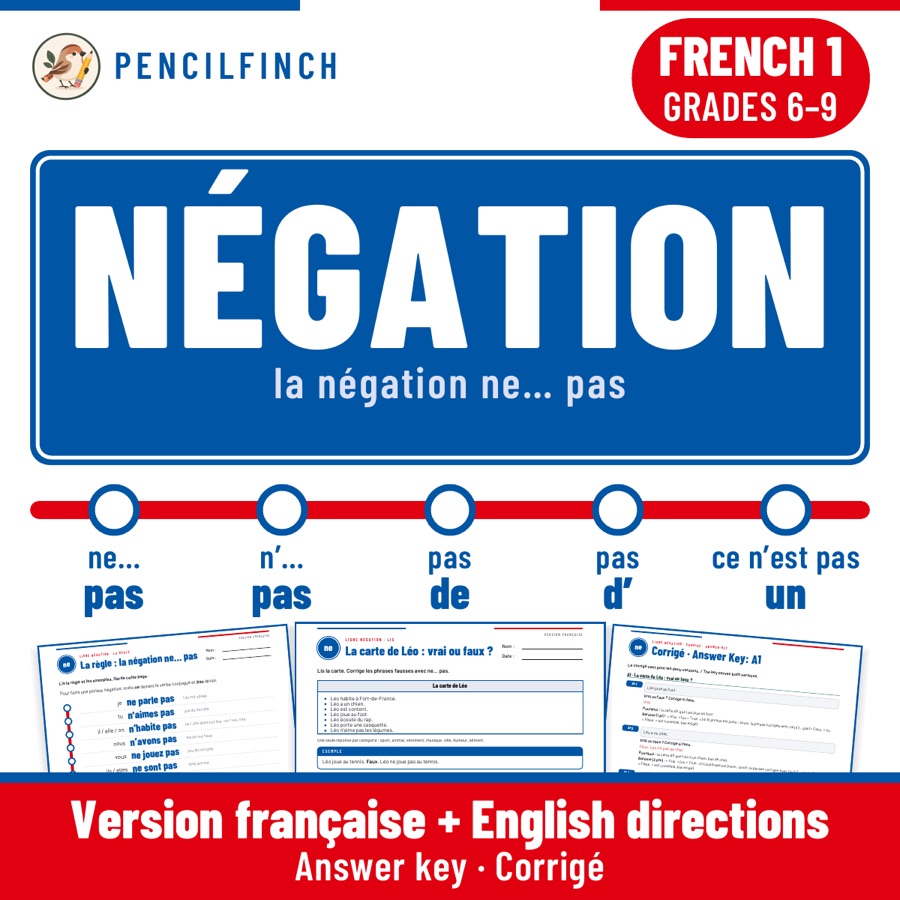
La négation (ne... pas) - French 1 Worksheets en français - Grades 6-9
19 pages, grades 6-9, answer key included with rubric. USD 2.50
Get the full unit on TPT (USD 2.50)
Next topics
- Before this topicFrench Verb Être Worksheets, Present Tense (Free Sample + Pack)
- After this topicFrench Adjective Agreement Worksheets, French 1 (Free Sample + Pack)
- All topics in this lineFrench 1 Worksheets and Quizzes