How to Teach the French Imparfait (French 2)
French 2 students should leave this topic able to build any imparfait form from a present-tense form they already know, and able to say what the tense does in a sentence. The forms come quickly; the trouble starts with the shortcuts students invent to build it and to decide when to use it. This page gives the rule with its limits, a reply to three of those shortcuts, and a short board lesson.
Printable for this topic: French Imparfait Worksheets for French 2 (Free Sample + Pack) (free sample page and the full unit).
The idea in plain words
The imparfait is a past tense that shows an action or a state as under way, with no beginning or end in view. It has three jobs: a habit (Tous les jeudis, ma marraine vendait des fleurs sur la place.), a description (Dans mon ancien quartier, tout le monde connaissait le boulanger.) and the background to an event (Je cherchais mon chargeur quand le livreur a sonné.).
To build it, start from the nous form of the present, remove -ons, and attach the endings: -ais for je and tu, -ait, -ions, -iez and -aient. Nous voyons gives je voyais; nous connaissons gives elle connaissait. Être is the only verb whose nous form does not give the stem: it uses ét- (j’étais, nous étions). Weather verbs such as pleuvoir have no nous form; teach il pleuvait as a set form. Two spelling points follow from sound: whenever the ending starts with a, a -ger verb keeps its e and a -cer verb changes c to ç, so je rangeais and il plaçait, but nous rangions and vous placiez.
Time words help, but they do not choose the tense. A single action or state with a stated length is usually told as a whole, in the passé composé: Mon oncle a vécu à Tunis pendant deux ans. Even souvent can sit next to a passé composé when the speaker sums up a period that is over: L’été dernier, nous avons souvent mangé dehors. The imparfait is just as correct there (nous mangions souvent dehors) if the speaker is describing a habit of that summer; the choice follows how the speaker presents it, not the time word.
Three misconceptions and what to say
"Imparfait means was + -ing, so if English has no -ing, I use the passé composé."
The first half is a fair shortcut: "it was raining" is il pleuvait. The second half fails, because English often uses a plain past for a habit or a state. "Everybody knew the baker" and "she sold flowers every Thursday" have no -ing, yet both take the imparfait. Add two English signals, "used to" and the "would" of a past habit, then the real test: is the sentence telling what happened next, or what things were like?
"The imparfait is for long actions and the passé composé is for short ones."
Tempting, because backgrounds often last a while. Write two sentences: Le voyage a duré trois jours. Il était midi. Three days is long but takes the passé composé, because the trip is presented as one finished block; noon is an instant but takes the imparfait, because it sets the scene. Draw a closed box for the first, an open-ended line for the second.
"I drop the ending of the infinitive and add -ais, like I do in the present."
That works for most -er verbs and for verbs like vendre, which is why students trust it. It fails for -ger and -cer verbs, for verbs like finir and for many irregular verbs, producing forms such as *Mes parents connaîtaient tous les voisins. Have them say the nous form aloud before they write anything: nous connaissons, so mes parents connaissaient.
A 10-minute mini-lesson
- (2 minutes) Write nous voyons, nous connaissons, nous rangeons. Ask, "What is left when I erase -ons?" Underline voy-, connaiss-, range-.
- (2 minutes) Add the six endings to voy-. Ask, "Which four forms sound the same?" (je, tu, il or elle, ils or elles.) Ask how a listener tells them apart: by the subject.
- (1 minute) Ask for the nous form of être. Students say sommes. Ask, "Can I erase -ons?" Write ét- and j’étais.
- (2 minutes) Point to range-. Ask, "Which endings start with a? What happens to the e before -ions and -iez?" Students write the six forms of ranger on paper.
- (3 minutes) Draw a timeline. Say three sentences in English: "We lived near the stadium." "One day the roof fell in." "Every weekend we heard the crowd." For each, ask, "What things were like or used to happen, or what happened next?" Students draw a wavy line or an X on paper.
Quick check
Items 1 and 2 need the verb in parentheses in the imparfait. For 3, choose the form that fits.
- Tous les jours à la cantine, mes frères ________ (échanger) leurs cartes.
- À l’époque, vous ________ (remplacer) souvent le gardien de but ?
- L’an dernier, Karim (travaillait / a travaillé) dans une librairie pendant trois mois.
Answers: 1. échangeaient: the stem is échange- from nous échangeons, and the e stays before -aient. 2. remplaciez: the ending begins with i, so the c needs no cedilla. 3. a travaillé: pendant trois mois gives the job a fixed length and nothing makes it a habit or a background, so it is told as one finished whole, even though three months is a long time.
Sources
- University of Texas at Austin, Tex’s French Grammar, "imparfait: formation" (read 2026-11-22): the stem is the present nous form minus -ons, regular for all verbs except être; -ais, -ais, -ait and -aient are pronounced alike; voyager and commencer add e or ç before endings in a. https://www.laits.utexas.edu/tex/gr/tap5.html
- University of Texas at Austin, Tex’s French Grammar, "imparfait: states of being, habitual actions" (read 2026-11-22): past habits are often translated "used to" or "would", and sometimes by the English simple past. https://www.laits.utexas.edu/tex/gr/tap6.html
- University of Texas at Austin, Tex’s French Grammar, "narration: passé composé vs. imparfait" (read 2026-11-22): the passé composé is generally used for a precise length of time with a definite beginning and end; the whole context, not a given adverb, decides the tense. https://www.laits.utexas.edu/tex/gr/tap8.html
- Office québécois de la langue française, Banque de dépannage linguistique, « Valeur temporelle de l’imparfait » (read 2026-11-22): action en cours, descriptions, circonstances, récurrence. https://vitrinelinguistique.oqlf.gouv.qc.ca/24197/la-grammaire/le-verbe/temps-grammaticaux/passe/valeur-temporelle-de-limparfait
- Office québécois de la langue française, Banque de dépannage linguistique, « Généralités sur le passé composé » (read 2026-11-22): the passé composé can report a fact repeated in the past (« Nous avons souvent organisé des soupers à ce restaurant. »). https://vitrinelinguistique.oqlf.gouv.qc.ca/24218/la-grammaire/le-verbe/temps-grammaticaux/passe/generalites-sur-le-passe-compose
- Le Robert, Dico en ligne, « imparfait » (read 2026-11-22): "Temps du verbe ayant essentiellement pour fonction d’énoncer une action en voie d’accomplissement dans le passé et conçue comme non achevée." https://dictionnaire.lerobert.com/definition/imparfait
- Le Robert, conjugation tables (read 2026-11-22) for ranger, placer, remplacer, échanger, voir, connaitre, être, vivre, pleuvoir, durer, chercher, sonner: https://dictionnaire.lerobert.com/conjugaison/ranger, https://dictionnaire.lerobert.com/conjugaison/placer, https://dictionnaire.lerobert.com/conjugaison/remplacer, https://dictionnaire.lerobert.com/conjugaison/echanger, https://dictionnaire.lerobert.com/conjugaison/voir, https://dictionnaire.lerobert.com/conjugaison/connaitre, https://dictionnaire.lerobert.com/conjugaison/etre, https://dictionnaire.lerobert.com/conjugaison/vivre, https://dictionnaire.lerobert.com/conjugaison/pleuvoir, https://dictionnaire.lerobert.com/conjugaison/durer, https://dictionnaire.lerobert.com/conjugaison/chercher, https://dictionnaire.lerobert.com/conjugaison/sonner
The full unit
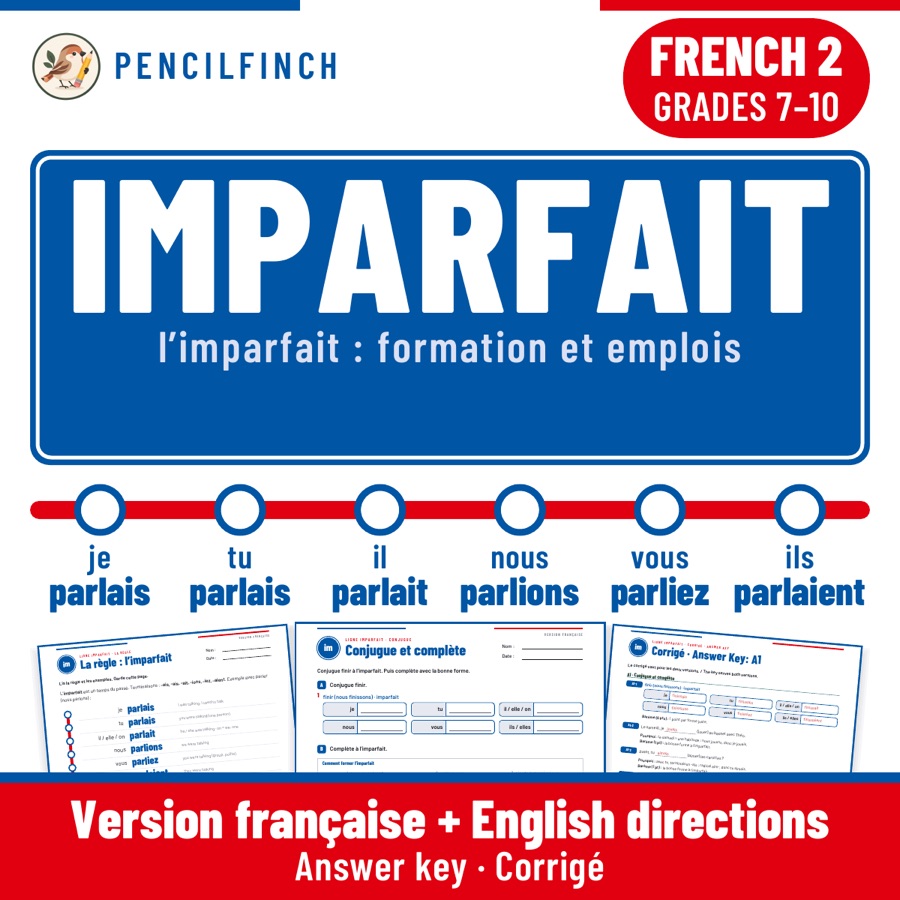
L'imparfait - French 2 Worksheets en français - Grades 7-10
17 pages, grades 7-10, answer key included with rubric. USD 2.50
Get the full unit on TPT (USD 2.50)
Next topics
- Before this topicPassé Composé with Avoir Worksheets, French 2 (Free Sample + Pack)
- After this topicDepuis, Il y a and Pendant Worksheets, French 2 (Free Sample + Pack)
- All topics in this lineFrench 2 Worksheets, Quizzes and Games