How to Teach French Adjective Agreement (French 1)
French 1 students need to learn that an adjective’s spelling shifts to track its noun on two counts: how many there are, and whether the noun counts as masculine or feminine. Most of the slips come from trusting the ear instead of the eye: a missing plural -s is silent, and so is a feminine -e after a vowel (poli, polie), so proofreading by reading aloud will not catch it. This page names the three mix-ups that keep showing up and gives you a short board lesson built entirely from what students can see, not hear.
Printable for this topic: French Adjective Agreement Worksheets, French 1 (Free Sample + Pack) (free sample page and the full unit).
The idea in plain words
A French adjective takes the gender and number of its noun: most add -e for the feminine and -s for the plural, but one already ending in -e adds nothing for the feminine, and one ending in -s or -x adds nothing for the plural (gris, heureux). A few common ones change more (gentil, gentille).
| Ending added | Example | Audible change? |
|---|---|---|
| + -s (plural) | poli → polis | none |
| + -e (feminine) | poli → polie | none |
| + -es (feminine plural) | poli → polies | none |
All four forms of an adjective like poli sound identical out loud, which is exactly why students who check their work by reading it to themselves rarely notice a missing letter. Nouns of mixed gender together, people or things, take the masculine plural: un pull et une veste noirs.
Three misconceptions and what to say
*Les profs sont très aimable avec les élèves.
The spoken sentence sounds complete without the final -s, and there is no audible cue to catch the missing letter by reading aloud. Les profs is plural, so the adjective needs the plural -s even though aimable already ends in -e: aimables. Teach a visual check instead of an audio one: circle the plural signal in front of the noun (les, mes, ces, deux, plusieurs) and have students draw a line from that signal straight to the final -s on the adjective, unless the word already ends with -s or -x, regardless of what they hear.
*Cette voiture est rapidee.
Students have just drilled "add -e for the feminine" as a rule that applies everywhere, so they apply it even to an adjective that already ends in -e. Rapide stays rapide for a feminine noun; the -e is already there, so nothing is added. Teach students to look at the last letter of the adjective first: if it is a plain -e (not -é), the feminine form does not change, and only a plural -s might still apply; fatigué still becomes fatiguée.
*Marwan et sa sœur sont polies avec les voisins.
The adjective sits right after sa sœur, so students agree with the nearest noun instead of scanning the whole subject. Because Marwan is a boy, the pair takes the masculine plural, polis, even though the feminine noun comes last. Have students list several boy-and-girl pairs in a column and write only the plural ending they need next to each one, before they write any adjective at all, so that decision happens separately from the spelling.
A 10-minute mini-lesson
- Write "le, la, les, mes, ces, deux" on the board. Ask which ones signal more than one noun (les, mes, ces, deux).
- Write a sentence with a plural subject and a blank for an adjective that already ends in -e, such as jeune. Have a student circle the plural signal, then decide: does jeune need an extra -e (no, it already has one), does it need an -s (yes).
- Call out six adjectives, three that already end in -e (triste, jeune, rapide) and three that do not (poli, joli, fatigué), and a fresh noun each round. Have students write the correct spelling on paper without saying the word aloud first.
- Write two subjects on the board, one all girls and one a boy paired with a girl. Ask students to write only the ending each pair needs, with no adjective yet.
- Have students write one full sentence with a boy-and-girl subject and the plural form it needs, then trade papers with a neighbor and check only the final letters, not the whole sentence.
Quick check
- Ces chaises sont ________ (confortable).
- Ma grand-tante est ________ (facile) à vivre.
- Mon cousin et ma cousine sont ________ (déçu) par le résultat.
Answers: 1. confortables, because chaises is plural and the final -s is silent, so only the plural signal (ces) tells you to add it. 2. facile, because the adjective already ends in -e, so the feminine form does not change. 3. déçus, because the subject has a boy and a girl together, so the masculine plural wins, even though ma cousine is the noun closest to the adjective.
Sources
- OQLF, Banque de dépannage linguistique, « Formation de l’adjectif au féminin » (read 2026-11-22): "Les adjectifs se terminant par un -e ont la même forme au masculin et au féminin." https://vitrinelinguistique.oqlf.gouv.qc.ca/25840/banque-de-depannage-linguistique/la-grammaire/ladjectif/formation-de-ladjectif-au-feminin
- OQLF, « L’accord dans le groupe nominal » (read 2026-11-22): "L’adjectif … en relation avec plusieurs noms de genres différents reçoit le genre masculin et s’accorde au pluriel." https://www.oqlf.gouv.qc.ca/francisation/ordres_prof/capsules-grammaticales/accord-groupe-nominal.aspx
- Alloprof, « Le pluriel des adjectifs » (read 2026-11-22): "Lorsque l’adjectif singulier se termine par -s ou -x, il ne change pas au pluriel." https://www.alloprof.qc.ca/fr/eleves/bv/francais/le-pluriel-des-adjectifs-f1502
The full unit
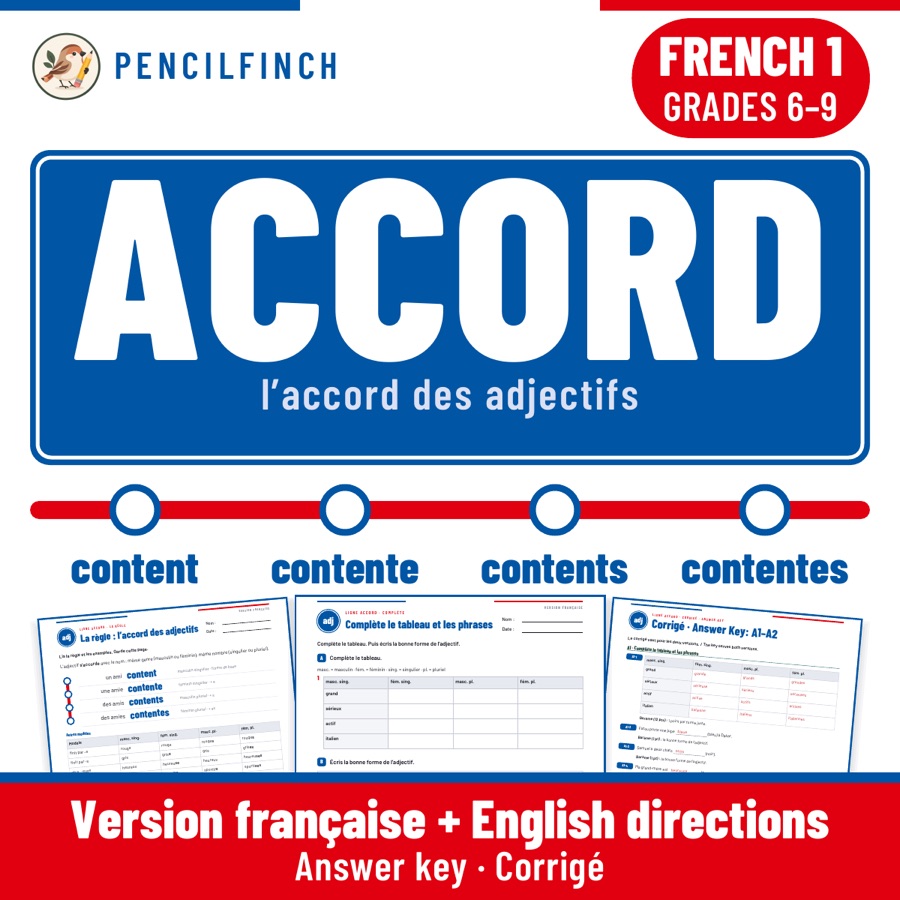
L'accord des adjectifs - French 1 Worksheets en français - Grades 6-9
17 pages, grades 6-9, answer key included with rubric. USD 2.50
Get the full unit on TPT (USD 2.50)
Next topics
- Before this topicFrench Negation Worksheets, Ne... Pas, French 1 (Free Sample + Pack)
- After this topicFrench Stressed Pronouns Worksheets for French 1 (Free Sample + Pack)
- All topics in this lineFrench 1 Worksheets and Quizzes